What Freezes First on a Property and How to Stop It
Wellheads, hydrants, pump houses and stock tanks all fail in predictable places. Find yours in October, not at 4am in February.
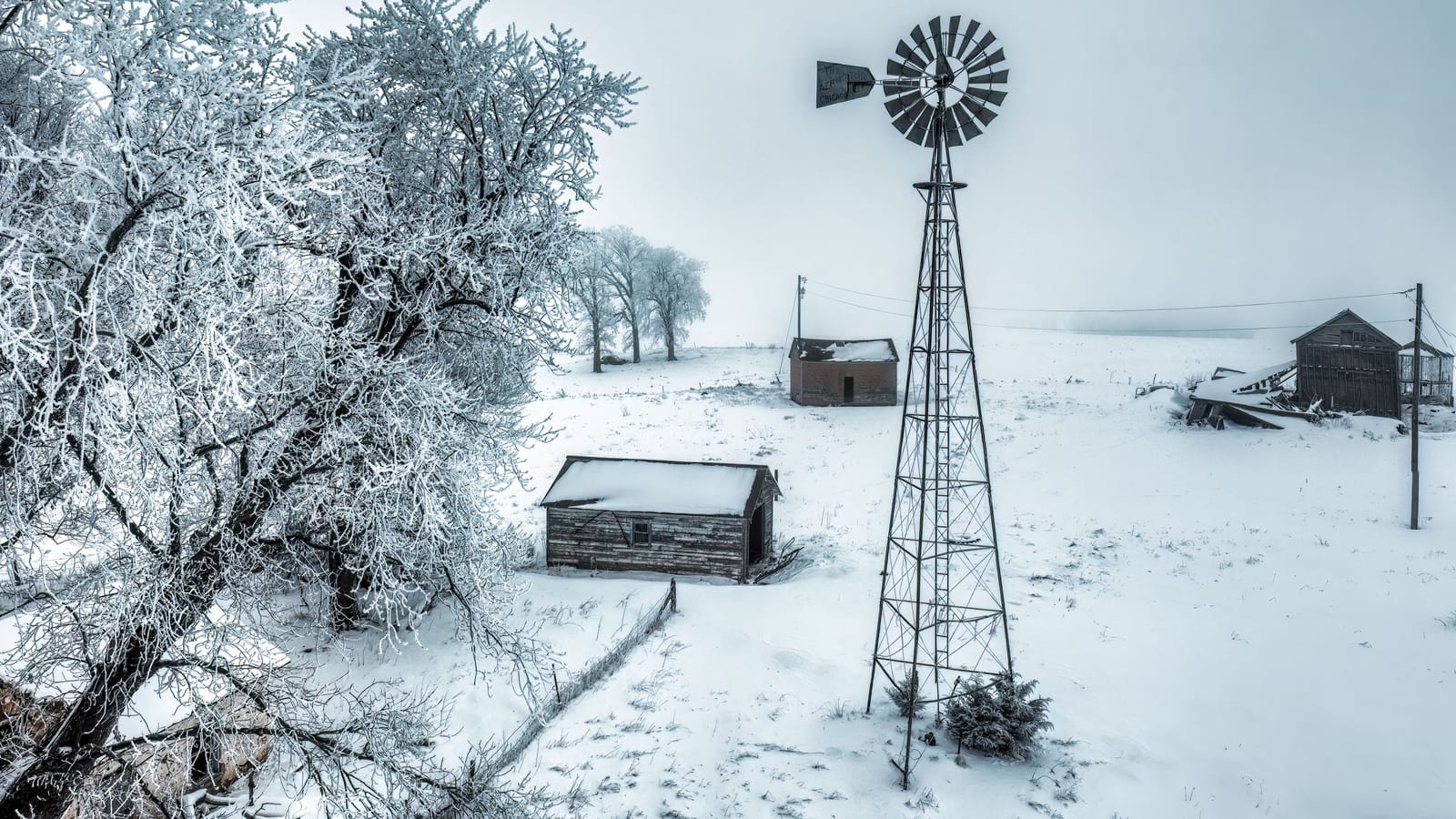
Walk your water system before the first hard freeze and touch every point where a pipe leaves conditioned space. That's the whole job. Every burst line you'll ever have starts somewhere you could have put your hand on in October.
Most people skip this because the water worked fine last year. Then a cold snap arrives with a north wind, the pump house door doesn't seal like it used to, and you're hauling five-gallon buckets from a neighbor's frost-free hydrant for four days.
Start at the well and work toward the house
At the wellhead, the thing that matters is whether the pitless adapter is set below your local frost line. If the well was drilled by a licensed contractor to code, it almost certainly is. If somebody's uncle did it, find out. Your county building department or state extension office will tell you the frost depth where you live, and it varies enormously between a river bottom in Tennessee and a ridge in North Dakota.
Above ground, the well cap should be sealed and vermin-proof. Snow is insulation, not a threat. What hurts is wind scouring bare ground down to frozen soil, which drives frost deeper than average. If your wellhead sits in an exposed spot, a few bales of straw stacked around it — not on top of the cap — buys you real margin.
Then the run from well to pressure tank. This is where a lot of older properties have a shallow line that was "good enough" through a string of mild winters. If you don't know how deep that line is, now's the time to ask whoever installed it or pull a record from the well log.
The pump house is the usual suspect
Pressure tanks, pumps and pressure switches live in small outbuildings, and small outbuildings leak heat fast. The failure isn't usually dramatic. A door sags, a knothole opens up, a rodent chews through the insulation batt, and one night the temperature inside drops below freezing for six hours.
Three things keep a pump house alive:
- A sealed envelope. Weatherstrip the door. Foam the penetrations where wires and pipes come through. Check the floor where the line comes up from the ground.
- Insulation on the walls and ceiling, not just around the pipe. Wrapping a pipe only slows the loss. It doesn't add heat.
- A heat source with a thermostat. A small, sealed enclosure needs very little. A thermostatically controlled electric heater rated for damp locations, set just above freezing, will carry most pump houses through.
Put a cheap wireless thermometer in there with the display in your kitchen. You'll know the building is cooling off before the pipe knows.
Never use an open-flame heater, a propane torpedo, or anything with a pilot light in a closed shed you're not watching. And don't run a heater on an extension cord you'd hesitate to shake hands with.
Hydrants fail because somebody left a hose on
A frost-free yard hydrant works by draining the standpipe through a small weep hole at the bottom, below the frost line, every time you shut it off. It only works if three conditions hold.
The handle has to close fully. A partially closed hydrant doesn't seat the plunger and doesn't drain.
The drain hole has to be clear. Hydrants are supposed to sit in a bed of gravel. If yours was set in clay, or the gravel silted in over ten years, the water has nowhere to go and the standpipe stays full.
And nothing can be attached to the outlet. Leave a hose connected and you've made the hydrant a closed system. It can't drain, it freezes solid, and you'll be replacing the head in March. Same rule for a frost-free sillcock on the house — the hose comes off in the fall, every fall, no exceptions.
Drain and coil your hoses in a shed or under cover. A hose frozen into a curve on the ground will crack when you try to move it.
Heat tape is a tool, not a fix
Self-regulating heat cable is the right kind. It varies output based on pipe temperature, so it won't cook itself where it overlaps at a valve. The cheaper constant-wattage tape is where house fires come from.
Follow the rules that come in the box, because they exist for a reason. Don't spiral it over itself. Don't run it under insulation unless the product specifically allows it. Plug it into a GFCI. And replace it when it's brittle or the jacket is cracked — heat tape has a service life, and old tape on a crawl space pipe is a genuine hazard.
Heat tape is for the pipe you can't insulate properly or the run that crosses an unavoidable cold spot. It isn't a substitute for getting the line below frost or getting the building sealed.
Stock tanks and the power bill
Livestock need water every day, and a frozen tank at dawn means chopping ice with an axe while the cows watch you.
Electric tank heaters work. Read the nameplate wattage before you plug one in, and count how many you're running on one circuit — these are among the biggest continuous draws on a farm, and overloaded circuits in outbuildings are a reliable way to start a fire. Use a heavy, outdoor-rated cord, keep the connection off the ground, and protect the circuit with GFCI.
Check your heaters for stray voltage. An animal that gets a tingle at the water surface will stop drinking, and you won't know why until you've got a health problem. If cattle suddenly quit a tank they've used all year, suspect the heater first.
Energy-free insulated waterers work well with enough animals to keep the water turning over. With three horses and a big unit, the water sits and freezes anyway. Match the waterer to the herd, not to the catalog.
Float valves and supply lines to automatic waterers freeze more often than the tanks do. Insulate the riser and know where the shutoff is.
Have a plan for the night the power goes out
No power, no pump. That's the whole equation on a well.
Know the voltage and horsepower of your pump, and ask an electrician what generator it takes to start it — submersible pumps draw hard on startup, and a generator that runs it fine won't necessarily spin it up. A properly installed transfer switch is the right way to do this. Backfeeding through a dryer outlet can kill a lineman and it's illegal in most places.
Independent of the generator, keep water on hand. Fill jugs before a forecast storm. Figure roughly a gallon per person per day for drinking and cooking, more for washing, and be honest about what your animals go through daily. Food-grade drums in an outbuilding will freeze, so keep the drinking supply somewhere heated, and the flushing supply anywhere at all.
When something does freeze
Turn the water off first. If the pipe has split, you'll find out the moment the ice lets go, and you'd rather find out with a valve already closed.
Open the nearest faucet downstream so melting water has somewhere to go. Warm the pipe from the open end backward, with a hair dryer, a heat gun on low, or a space heater placed a safe distance away. Slow and boring is the point.
Never use a torch. Not on copper, not on anything. You'll boil water trapped between two ice plugs and turn the pipe into a pressure vessel, and you'll set the joists on fire.
If you can't reach the frozen section, or it's in a wall, call a plumber. Underground between well and house, call a well contractor. That's a thaw machine and an excavator, not a Saturday project.
Come spring, walk the whole system again with the pressure on and look for weeping at the fittings. Pipes that froze but didn't burst have often been stretched, and they fail in April when nobody's watching.
The property will tell you where it's weak. It just won't do it at a convenient hour.
Wes Dunbar
Country & Skills
Grew up on an acreage and never quite left. Covers trucks, trades, land, and how to do the thing yourself.

Watch
Worth an hour of your evening
More from Country Bro.
From channels we rate. Plays on YouTube.
Read next