A spring, a hill and some black pipe will water your garden
Gravity does the pumping if you've got the drop. Check the water rights, size the pipe, and you can build it in a weekend.
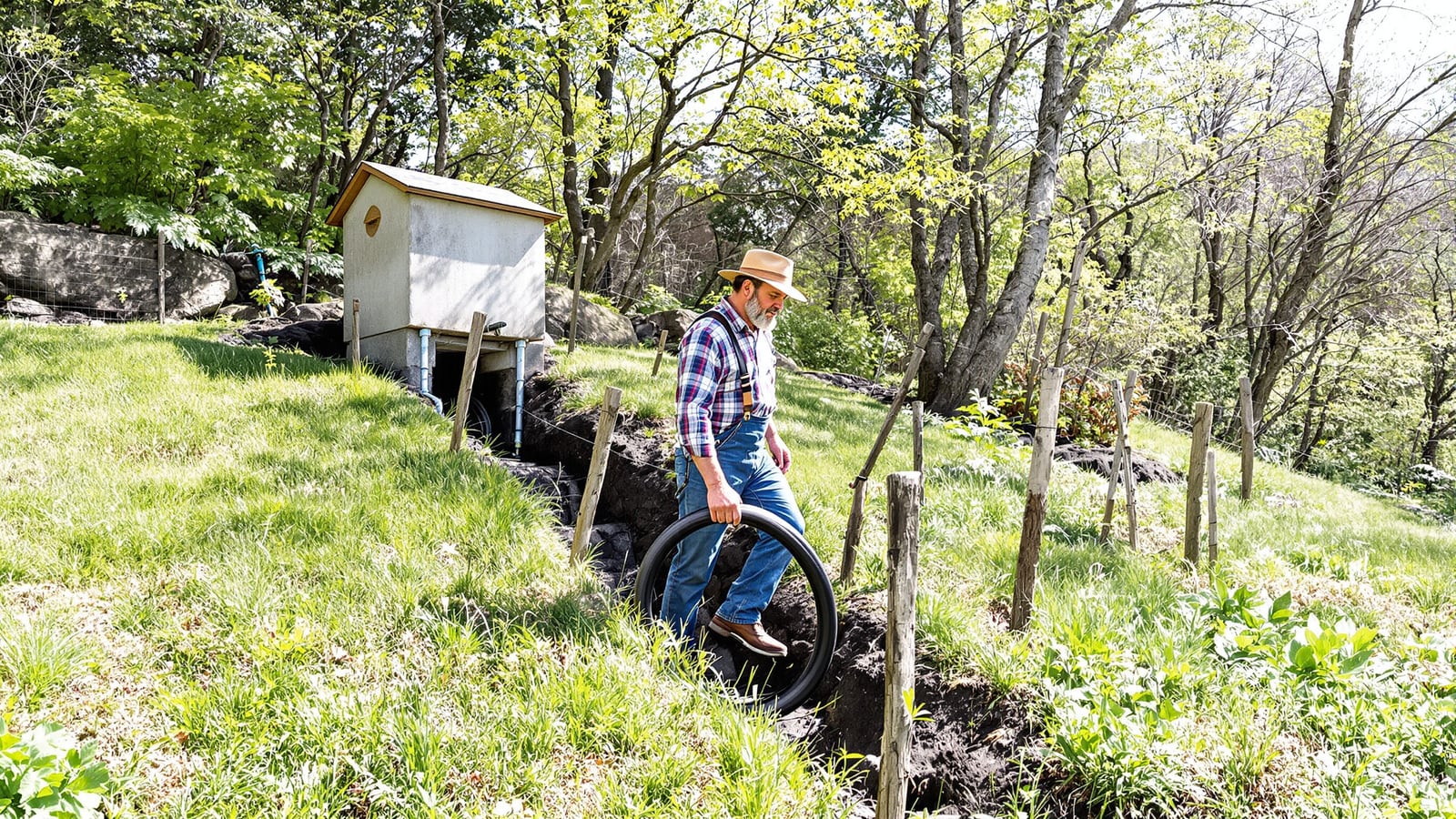
Quick answer: Every 2.31 feet of drop gives you about 1 psi. Twenty-five feet between your water and your garden is enough to run drip line with no pump and no electric bill. Call your state water agency first, because the law on who owns that water is not the same everywhere.
Call before you cut
Do this before you buy a foot of pipe.
Water law is a patchwork. Some states treat water as something you can use if your land touches it. Others, mostly in the West, run on permits and priority dates, and a creek you've watched run through your back forty all your life may still belong, on paper, to someone downstream. A spring that starts and ends on your land is often treated differently from a creek that crosses it. Often isn't always.
Ask your state's water resources office, or your county extension agent, three questions. Do I need a permit or registration to divert from this creek? Does a spring that rises on my land count differently? Is there a limit on how much, or on what I can use it for? This is general information and not legal advice. If the answers sound complicated, an hour with a local attorney costs less than a stop-work order or an angry neighbor. If you're still shopping for land, put water rights on your list of questions before you sign.
And whatever the law lets you take, don't take all of it. The creek was here first.
Measure what you've got
Grab a five-gallon bucket and a watch. Hold the bucket under the flow, or under a pipe you've set into the spring pool, and time how long it takes to fill.
Fifteen seconds means 20 gallons a minute. Five minutes means one gallon a minute. Most springs are closer to the second number than the first, and that's fine.
One gallon a minute is 1,440 gallons a day. A garden gets about an inch of water a week in a normal season, and an inch over 1,000 square feet is roughly 620 gallons. So a trickle you'd barely notice can run a good-sized garden with water to spare, as long as you store it.
Test in late summer if you can. A spring that gushes in April and dribbles in August is a different animal, and August is when the garden needs it.
Check the drop
You need to know how many vertical feet separate your intake from your garden. Distance doesn't matter here. Height does.
Cheap ways to find it: a smartphone with a decent elevation app is close enough to plan with. A line level and a long string works if you're patient. A contractor's laser level and a buddy with a tall stick works better.
Then do the math. Divide the drop by 2.31 and you have your static pressure. Twenty-three feet gives about 10 psi. Fifty feet gives about 22. Most drip line and drip tape wants somewhere around 10 to 25 psi at the emitters, and the packaging will tell you the exact range for what you buy. Too little drop and the line barely weeps. Too much and you blow fittings off the pipe, which a regulator fixes for about fifteen dollars.
If you've got less than ten feet, don't give up. Use a bigger storage tank on a stand, or run soaker hose or a simple open-ditch furrow system. It won't be elegant. It will work.
Build it in four pieces
1. The intake. Don't just stick a hose in the water. Dig out the spring so it pools, set a bucket or a plastic barrel with the bottom cut off into the pool, and take your pipe from near the top of it. Wrap the pipe inlet in fine mesh or a stocking over a screen. Leaves and silt are what kill these systems, not mechanical failure. On a creek, put the intake on the inside of a bend in a calm spot, off the bottom, and never in a way that dams the channel.
2. The mainline. Use black polyethylene pipe, 3/4 inch for runs under a couple hundred feet and 1 inch beyond that. It's cheap, it bends around obstacles, and it survives a rock or a cow better than PVC. Lay it with some slack so it can expand and shrink. Bury it six to twelve inches if you can, mostly to keep the sun off it and the mower away from it. Set the pipe so there's never a high spot between intake and garden. A rise in the middle traps air, and an airlocked line is the number one reason a gravity system "doesn't work."
3. The tank. This is the part most people skip and then regret. Run the mainline into a storage tank, a 275-gallon tote or a stock tank with a lid, and draw from the tank instead of straight from the spring. The spring fills it overnight. You open the valve for an hour in the morning and get a real flow instead of a trickle. A tote also gives you a place to let silt settle. Put the tank at the high point, with a float valve or an overflow pipe so extra water goes back to the creek, not onto the ground around it.
4. The filter and the lines. Put a screen or disc filter, about 150 mesh, between the tank and the drip lines. Follow it with a pressure regulator if your drop is large. Then run 1/2 inch mainline across the garden and drip tape down each row, and flush the ends of the lines every few weeks. Without a filter, drip emitters clog. Don't skip it.
What goes wrong
Air in the line, covered. Silt, covered. Here are the rest.
Critters chew exposed poly. Bury what you can and wrap what you can't.
The first hard freeze will crack anything full of water. Drain the tank and open the low points in the fall. We've covered what freezes first on a property, and it's always the fittings.
Creek water carries whatever is upstream. If cattle graze above you, or there's a septic system on the hill, the water isn't clean. Drip to the soil instead of overhead spraying, wash anything you eat, and don't drink from it or fill a livestock trough without a lab test. Your county health office can point you to one. Well water has its own costs and rules, and it's worth knowing the difference.
Do it right the first time
Build it, then walk the whole line once a month in season. Clear the screen, check the joints, look for wet spots that shouldn't be wet.
If the creek runs through a neighbor's land after yours, tell him what you're doing before he finds a lower flow and wonders. That's one of the unwritten rules, and it's cheaper than a lawyer.
Then leave the spring cleaner than you found it. Pull out the old branches, rake the leaves off the pool, and put the stones back where the water wants them. A good intake should look like it was always there.
Wes Dunbar
Country & Skills
Grew up on an acreage and never quite left. Covers trucks, trades, land, and how to do the thing yourself.

Watch
Worth an hour of your evening
More from Country Bro.
From channels we rate. Plays on YouTube.
Read next