Buying jeans you can actually work in
Weight, rise, and a handful of seams decide whether a pair of jeans lasts a season or five years. Most of it you can check before you buy.
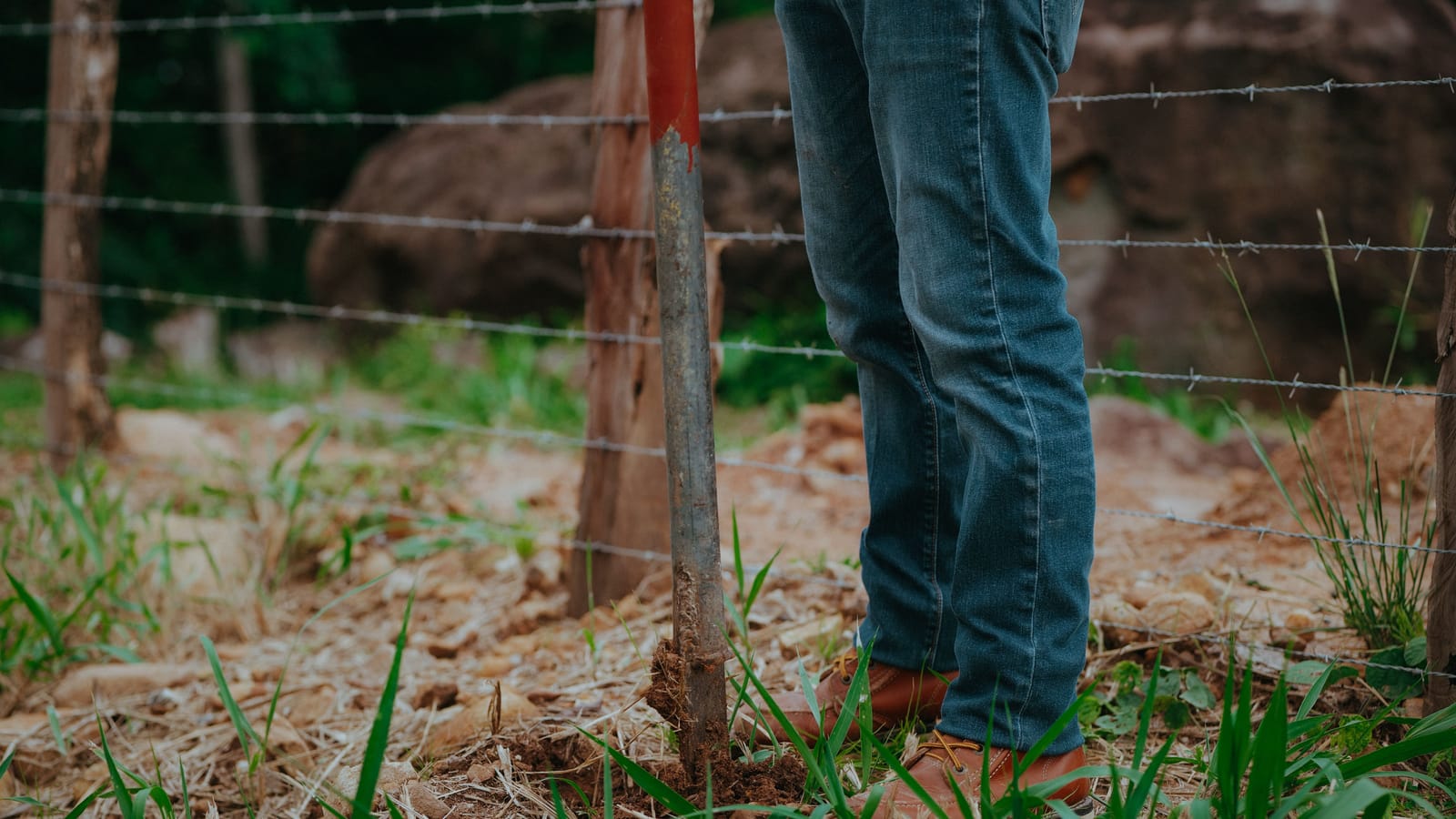
Before you look at the label, do three things in the fitting room. Squat all the way down. Kneel on one knee. Sit on the bench and cross an ankle over the opposite knee.
If the waistband gaps at the back, the rise is too low. If the crotch pulls tight enough that you feel it, the seat is cut too shallow and that seam will blow within a year. If the knee binds when you kneel, there isn't enough room through the leg and the fabric will wear through right there.
Three movements, thirty seconds, and you've learned more than the tag will tell you.
Weight is the number nobody explains
Denim gets measured in ounces per square yard. That number tells you how the fabric will behave and roughly how long it'll last.
- Around 10 to 11 oz — light. Comfortable in July, drapes nicely, wears out fast under abrasion. Fine for town, poor for fence work.
- 12 to 14 oz — the working middle. Heavy enough to take a beating, broken in within a few weeks. Most jeans sold as workwear live here.
- 14 to 16 oz — properly stout. Stiff for the first month, then molds to you and stays. Hot in summer, excellent everywhere else.
- 16 oz and up — specialist territory. Wonderful if you like it, genuinely uncomfortable if you don't. Don't start here.
If a brand doesn't publish the weight, that's information too. Companies that put real fabric in their jeans tend to say so.
Weight isn't the whole story. A tightly woven 12 oz can outlast a loose 14 oz. But as a first filter, it works, and it'll steer you away from the thin stuff that photographs well and lasts one summer.
Rise, seat, and thigh — in that order
Most men buy jeans by waist and inseam, which are the two least interesting measurements on the garment.
Rise is the distance from the crotch seam to the top of the waistband. A low rise puts the waistband below your natural waist, which means a belt has nothing to grip and the back gaps every time you bend. For work, you want a mid or high rise — the waistband sitting at or just under your navel. It stays put. Your shirt stays tucked. You stop hitching your pants up twenty times a day.
Seat and thigh room come next. A working man's jeans need enough fabric across the seat that squatting doesn't put the crotch seam under tension. That's the single most common failure point in denim, and it's almost always a fit problem rather than a fabric problem.
Taper below the knee if you want — a slim leg over a boot looks sharp and keeps the hem out of the way. Just don't let a slim knee come along with it.
The seams that decide everything
Turn the jeans inside out in the store. Nobody will mind.
Look for flat-felled seams down the outseam and inseam. The edges are folded under and stitched twice, so there's no raw edge to fray. A single-stitched, overlocked seam is faster to make and the first thing to give.
Count the bar tacks. Those are the dense little blocks of stitching at the top of the pocket openings, the base of the fly, and the belt loops. They exist because those are the spots that take sudden load. More of them, and heavier thread, means somebody was thinking about the person wearing them.
Check the belt loops. Five is standard. Seven is better, and a loop at the center back that's stitched into the waistband rather than tacked on top of it won't tear off when you hang a heavy belt on it.
A gusseted crotch — a diamond of extra fabric where the four seams meet — is the difference between jeans that survive squatting and jeans that don't. It costs the maker a little more. Not every good pair has one, but a pair that does is telling you something.
Rivets or bar tacks at the pocket corners. Rivets are stronger. They'll also scratch a truck tailgate, a saddle, and the seat of anything you care about. Some makers now hide the rivet behind the fabric. Decide which problem you'd rather have.
Stretch, and when it's worth it
A small amount of elastane — one to two percent — makes a pair of jeans noticeably easier to move in. If you spend your day climbing in and out of a cab, on and off equipment, up and down ladders, that's real comfort.
The trade-off is honest and you should know it. Stretch denim goes baggy at the knee faster, and once the elastic fibers break down, they don't come back. A hundred percent cotton pair will mold to you and stay there. A stretch pair will feel great for a year and then feel tired.
Anything above about two percent stretch, and you're wearing something closer to leggings than denim. It'll be comfortable. It won't last.
Sizing, shrinkage, and the length question
Measure your actual waist with a tape, over the shirt you'd normally wear. Then measure the waistband of a pair of jeans that fits you, flat, and double it. Those two numbers won't match the number on the tag, and that's normal — sizing has drifted for decades.
Shrinkage matters if the denim is unsanforized, sometimes labeled shrink-to-fit or loomstate. Those will tighten up significantly the first time they get wet, mostly in the length. Sanforized denim is pre-shrunk and will move very little. If the tag doesn't say, assume sanforized and expect an inch or less of change in the inseam.
For length over a boot, you want the hem to reach the top of the heel with a slight break. Too long and the hem drags, frays, and eventually catches. Too short and it rides up past the boot shaft when you sit.
Make them last
Wash them cold, inside out, and not often. Denim doesn't need weekly laundering unless it's genuinely dirty, and every wash cycle costs you fabric.
Stay out of the dryer. Heat is what shrinks the waistband, cooks the elastane, and puts those white stress lines through the thigh. Hang them over a rail and let them dry. They'll be stiff for an hour and then fine.
Repair early. The moment you see the weave going thin at the knee or the seat — before it's a hole — put a patch behind it and run a few passes of stitching across it. A tailor charges very little for this and it can add years. Once it's an actual hole with frayed edges, the repair is harder and uglier.
And buy two pairs, not one. Rotating them so each has a day off roughly doubles the life of both. Cotton fibers recover when they rest. That's not folklore, it's just how the fabric behaves.
A good pair of jeans ends up recording what you did in them. The fade at the wallet, the wear at the hammer loop, the pale patch where you kneel. You can't buy that, and no factory can fake it convincingly. You just have to put in the years.
Tobias Reed
Style & Grooming
Spent a decade in menswear retail watching men buy the wrong size. Believes fit is ninety per cent of it and says so weekly.

Watch
Watch how it's done
Picked for this article.
From channels we rate. Plays on YouTube.
Essential Craftsman
The Best Work Pants: Levi's vs Carhart Dungaree vs Prison Blues VS Key
Project Farm
$16 vs $99 Jeans? Let's Settle This! Wrangler, Levi’s, Carhartt, Dickies, Nautica, LEE, Lucky
Read next