
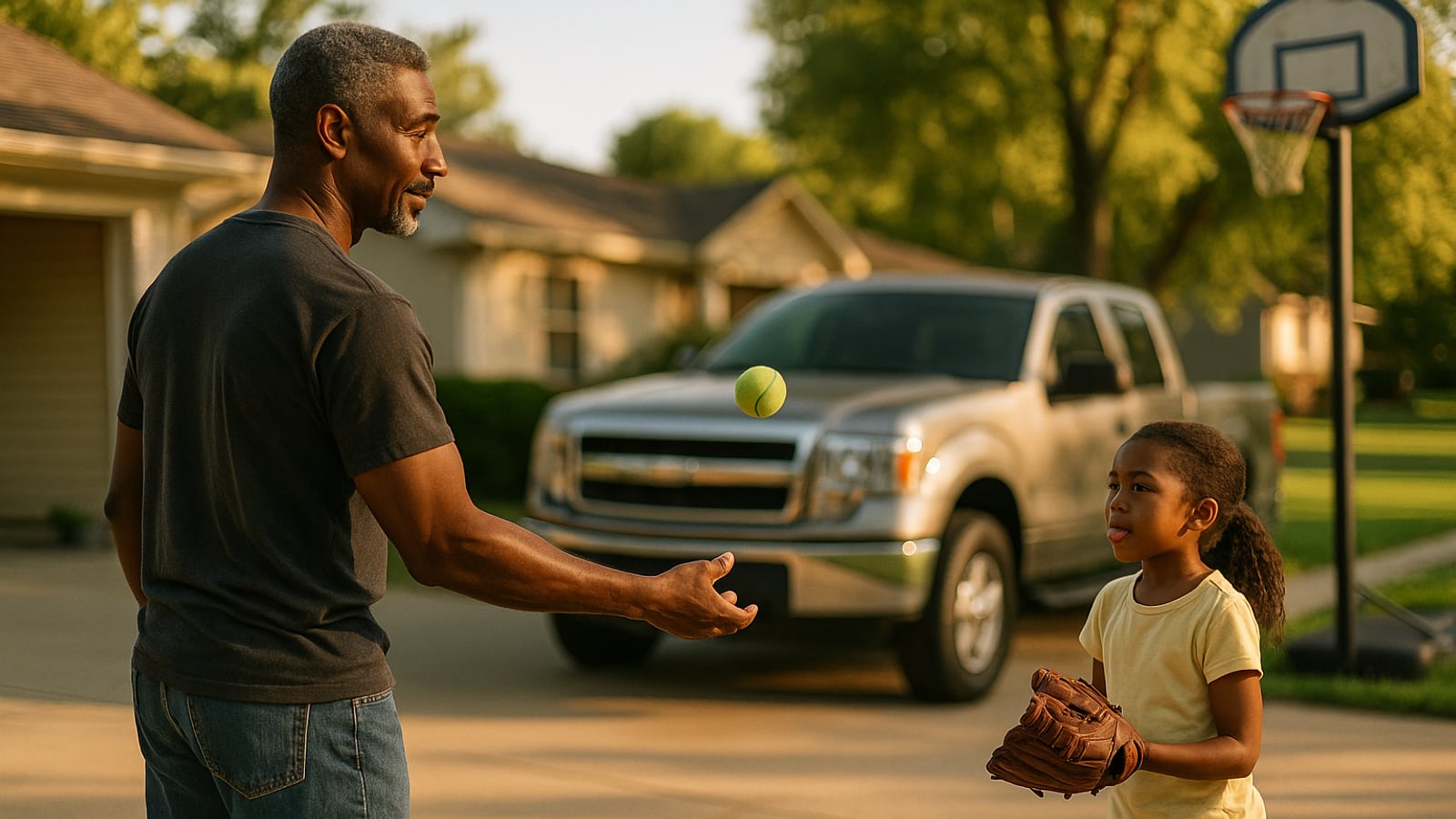
Quick answer: Start at ten feet with a tennis ball. Throw to their chest, make them chase their own misses, count the catches in a row, and quit while they still want one more.
It's 6:40 on a Tuesday in August. The driveway still holds the day's heat. Your seven-year-old is standing there with a glove so stiff it won't close, and you're twelve feet away wondering why this felt easier in your head.
It will be the best twenty minutes of your week if you let it. Most dads don't. They turn it into practice.
Start closer than you think
The first mistake is distance. You stand where catch feels normal to you, which is about three times farther than a small kid can handle. So they miss, the ball rolls under the truck, and the evening turns into fetching.
Stand about ten feet apart. That's less than a car length. For a kid under six, go closer and throw underhand.
Use a tennis ball at first, or anything soft. A real baseball to the cheekbone ends catch for a month, and the flinch it leaves behind can last longer than the bruise. A kid who isn't afraid of the ball watches it all the way in. A kid who is afraid turns her head, and nobody catches anything with their head turned.
About the glove: buy one that fits the hand they have now, not the one they'll have in three years. Everybody's dad bought the glove "to grow into." Everybody's dad was wrong. A glove that's too big flops open and spits the ball out. And don't put it in the oven to break it in. You break a glove in by playing catch with it, which is sort of the whole point.
The throw is your job
This is the lesson, and you never have to say it out loud.
If they can't catch it, that's on the thrower. Aim for the chest, give it an easy arc, and keep it in the space between their shoulders and their belt. When you airmail one over their head, say "my bad" and mean it.
Your kid is watching how a grown man handles his own mistake. Does he blame the catcher? Does he make excuses? Or does he own it and throw a better one?
Then flip it. When they throw one into the neighbor's hydrangeas, you don't sigh. You go get it. Later, when they're a little older, the rule becomes simple: you throw to the person, not near them. You're responsible for making it easy on the guy across from you.
That's how you treat a teammate, a coworker and eventually a wife. You learn it in a driveway long before anybody explains it.
They chase their own misses
Now the backbone part.
When the ball gets past them, they go get it. Not you. Not with a lecture, and not with a frown. Just a cheerful "Go get it" and you wait.
A seven-year-old will test this. He'll stand there. He'll look at the ball, then at you, then at the ball. Wait him out. If you jog over and fetch it every time, you've taught him that his mistakes are somebody else's errand.
One exception, and it's a good one. If the ball goes over the fence into Mr. Alvarez's yard, you both walk over, knock and ask. Doesn't matter whose throw it was. You don't hop the fence and you don't leave a ball in a man's flower bed. If you trampled something getting it, you fix it before you leave.
Count the streak, not the drops
Kids love numbers. Use that.
Count how many you catch in a row, together. Not his drops, not your drops. Ours. "That's eleven. Let's get to fifteen."
This changes everything about the game. A drop isn't a failure anymore. It's just the reset. And suddenly you're both on the same side, which is exactly where a father and his kid should be.
It also quietly fixes your throwing. You'll stop firing it in to show off, because every bad throw kills the streak you both want.
Your daughter might be the one who wants to keep the record on the garage wall in chalk. Let her. Some families have a height chart. You can have a streak chart. Twenty-three in April. Forty-one by July. That's a kid who got better because she kept showing up, and she can see it.
Say less than you want to
Every dad has a list of corrections. Step toward your target. Point your glove shoulder. Two hands. Eye on the ball. Follow through.
Pick one. Say it once. Then shut up for ten throws.
If you can't help yourself, you're coaching, and your kid already has a coach, or will. What they don't have is somebody who plays catch with them for no reason. If you're coaching their team too, keep the two jobs separate. There's a whole piece on coaching your kid's team without becoming that parent, and most of it comes down to knowing when you're Coach and when you're Dad.
Especially if your kid plays travel ball. That kid gets evaluated all weekend. Your driveway should be the one place a throw is just a throw.
Let them talk sideways
Something odd happens around throw forty.
Kids start talking. Not because you asked, because you didn't. Their hands are busy, you're not staring at them across a kitchen table, and the rhythm of the ball going back and forth makes silence comfortable. So things come out. A kid at school. A teacher who's unfair. Something they're scared of.
Don't stop the game when it happens. Don't put the ball down and get serious. Keep throwing. Answer between catches. The second you turn it into A Conversation, the window shuts.
Plenty of dads say they want to be the guy their teenager comes to. This is where that gets built, at nine years old, one throw at a time. It works the same for daughters. The conversation about her worth is a hundred conversations, and a surprising number of them happen with a ball in the air.
When it isn't catch
Some kids don't like catch. That's fine.
If you've given it a fair shot, a soft ball, short distance and no coaching, and your son still wanders off after three throws, don't force it. You were never really after the throwing. You wanted the shared rhythm, the side-by-side time and the low-stakes place to mess up.
Shoot free throws. Kick a soccer ball against the garage. Pass a football. Hit tennis balls with cheap rackets in an empty church parking lot on a Saturday. The rules carry over. Make it easy on the other person. Go get your own misses. Count together.
And on the nights you're wrecked from work, catch is still one of the best things you can do. It takes zero setup and no screens, and you can do it half-asleep. If you need more ideas for those evenings, keep what to do with your kids when you've got nothing left handy.
Quit first
This is the one nobody does.
End it while they're still having fun. Don't wait until they're bored, whiny or hungry. Stop at thirty-one in a row and say, "Good one. Tomorrow we beat it."
A kid who walks inside wanting more will be standing by the door with his glove tomorrow at 6:40. A kid who got dragged through forty extra minutes won't.
That's the long game. You aren't building a shortstop. You're building a kid who knows his dad will be in the driveway, knows how to own a bad throw, and knows the ball over the fence is his to go get.
He'll figure out later that it was never really about baseball. Let him figure it out on his own.
Sam Ortiz
Dads & Family
Father of three. Writes about presence, discipline and the long game, without pretending any of it's tidy.

Watch
Worth an hour of your evening
More from Dads.
From channels we rate. Plays on YouTube.
Read next