Spot the Fish, Then Make Yourself Disappear
Seeing a fish in shallow water is the easy half. Getting a cast to it without turning it into a wake is where the day is won.
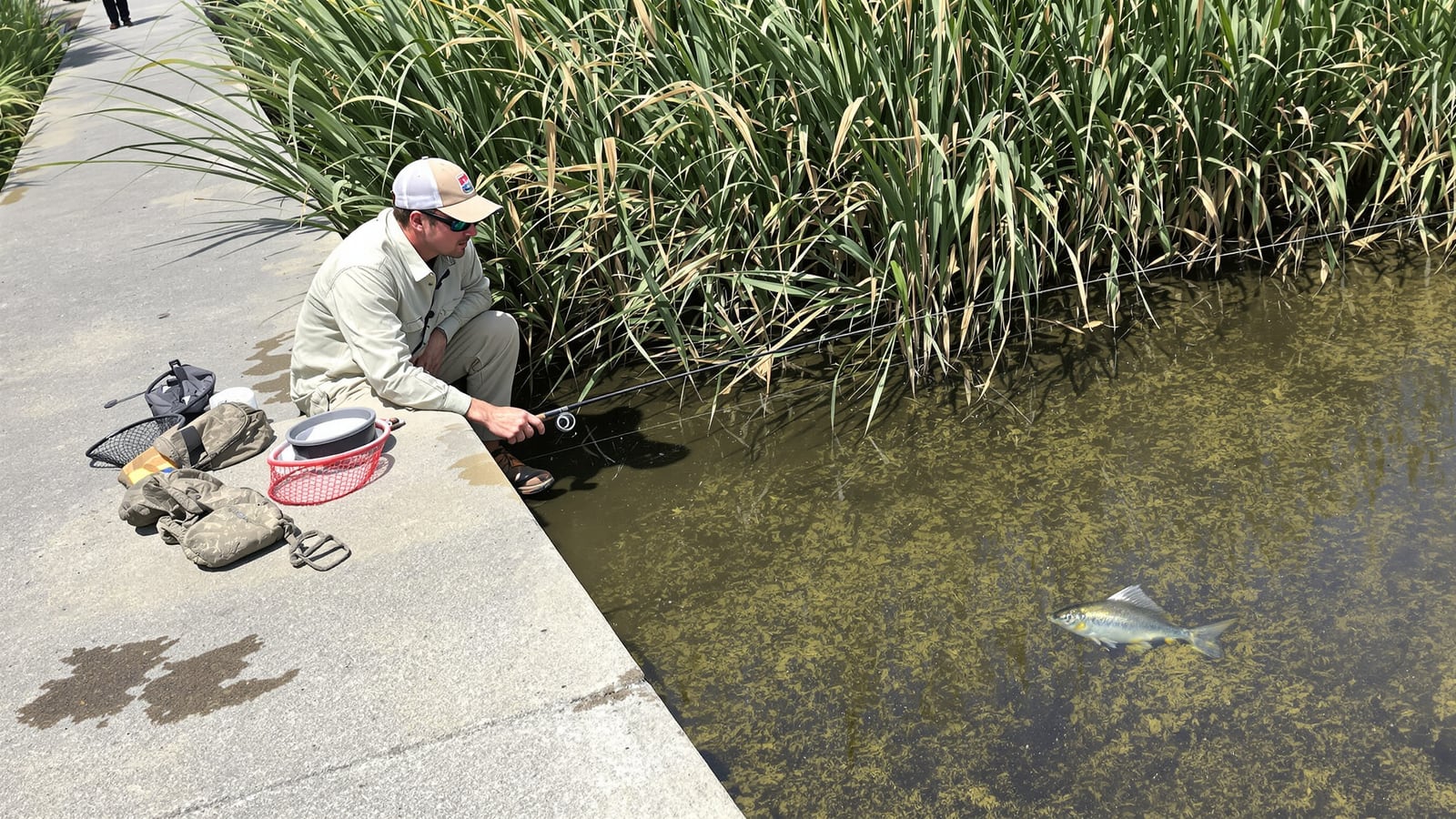
Quick answer: Wear polarized glasses, keep the sun at your back, and look for the parts of the fish that aren't the fish: a shadow, a tail, a puff of mud. Then move slower than feels reasonable, cast low, and land the lure ahead of the fish, never on its head.
You'll spot a redfish at sixty feet and spook it at forty. That's the whole problem with sight fishing. The seeing gets easier within a few trips. The not-being-seen takes longer, and it's where most of the fish go home unbothered.
Learn to see the fish without looking for fish
Beginners hunt for a whole fish shape. Water doesn't give you that very often. It gives you pieces.
- A shadow. On a sunny sand or grass flat, the shadow is often easier to see than the fish.
- A tail or fin. Redfish, carp and bonefish all tip up to feed, and a tail breaking the surface looks like a small flag.
- A push. A V-shaped wake on calm water, or a patch that looks nervous when the water around it is flat.
- Mud. A drifting cloud means something fed or bolted there a moment ago.
- Movement against the bottom. A patch of bottom that slides is a fish. A patch that stays put is a rock.
Polarized lenses do most of the work, because they cut the glare that turns the surface into a mirror. They're the one piece of gear worth real money here. Lens color matters too. Copper or amber helps in low light and over dark bottoms. Gray or green handles bright, high sun. If you only buy one pair, copper is the safer bet for most freshwater and flats.
Add a brimmed hat with a dark underside. The bright underside of a white brim bounces light into your eyes. A dark one doesn't.
Put the sun behind you
Sun over your shoulder lights up the water in front of you. Sun in your face turns that same water into a sheet of glare. If you can only approach a fish one way, you've picked the wrong flat or the wrong hour.
Best light runs from mid-morning to mid-afternoon, when the sun is high enough to see into the water. At sunrise and dusk you're mostly guessing, so wait for the light to come to you.
Be a bad shape on purpose
A fish in skinny water has one job, and it isn't eating. It's not getting eaten. Herons, ospreys and otters taught it that anything tall, quick or sudden means trouble. So you stop being any of those.
Dress in dull colors. Skip the white shirt, and skip the bright-orange kayak jacket if you have a choice. Wade like you're carrying a full coffee. Take a step, stop, look. Take another. Each step pushes a little wave ahead of you, and fish feel that long before they see you.
Don't clank. A dropped pliers or a boot against a hull carries a long way in shallow water.
And lower yourself. Fish in a few inches of water have a wide view of whatever stands above the surface. A crouch or a seat on a kayak or poling platform shrinks that profile. For a kayak angle, Kayak Fishing Without Going Swimming covers sitting versus standing and why the first one wins early on.
Stop and watch before you cast
This is the step people skip. You see a fish at fifty feet and your arm wants to move.
Don't. Give it a full minute and answer three questions:
- Which way is it facing? Most fish feed into the current or the wind. Approach from behind and you're in its blind spot.
- Is it moving or parked? A cruiser needs a lead. A fish holding on a spot gets a presentation that goes to it.
- Is it feeding or just passing? Tailing, nosing the bottom and slow turns mean feeding. A straight steady line means it's leaving, so let it go and find another.
You can often watch a fish for ten seconds and know what its next three feet look like.
Make the cast small
A big, hard cast is the second most common way to ruin a good fish, right behind a loud walk.
- Cast sidearm and keep the rod low. A rod flashing overhead catches the sun and a fish's eye.
- Land the lure past the fish and bring it into its path. If the fish is moving left to right, drop it a few feet ahead and to the far side. Let the fish arrive at the lure, don't drive the lure at the fish. A splash on its nose clears the flat.
- Go lighter at the end. A long fluorocarbon leader, twelve feet or more for fly anglers, keeps the line from landing close to the fish. For spinning, a small soft bait or a light jig that lands quietly beats a heavy spoon that slaps down.
- Cast short on the first try if you can't judge distance. Too short can be fixed. Too long lands on top of the fish.
Spend a few minutes at home casting at a paper plate on the lawn. It's boring and it works. Fly anglers just starting out should read Start Fly Fishing With One Rod and Two Casts. Two good casts beat ten fancy ones, and that's doubly true when the fish is watching.
What goes wrong
You'll cast at a fish you saw, and it won't be there. Refraction bends what you see, and fish look farther along the bottom than they are. With practice you learn to cast a touch short of where your eyes say.
You'll also spook the next fish while fighting the last one. A hooked fish thrashing in the shallows tells everything nearby to leave. Lead it away from the flat before you fight it hard. If you're keeping fish, that's fine and perfectly respectable. If you're releasing them, How to Release a Fish So It Actually Lives covers it.
One more thing: fish on spawning beds are easy to see, and they're also easy to hurt. Many states and provinces close or restrict certain seasons, species and waters, and the rules change from one jurisdiction to the next. Check your local regulations and buy the right license before you go. Anglers keep fishing worth fishing by following them.
What you'd buy and what you'd skip
Buy: a pair of polarized sunglasses with a copper or amber lens, and a hat with a dark underbrim. A fluorocarbon leader in the weight your outfit can handle.
Skip: the expensive new rod. A cheap rod you can cast quietly beats a nice one you can't.
Leave the flat the way you found it. Pick up the line and the lure packaging, and if you moved a rock to get a better look, put it back. The fish and the next angler will never know you were there.
Wes Dunbar
Country & Skills
Grew up on an acreage and never quite left. Covers trucks, trades, land, and how to do the thing yourself.

Watch
Worth an hour of your evening
More from Fishing.
From channels we rate. Plays on YouTube.
Read next