How to Catch Small Stream Trout Without Spooking Them
Wild trout in a creek you can jump across will see you before you see them. Fix your approach first, then worry about the fly.
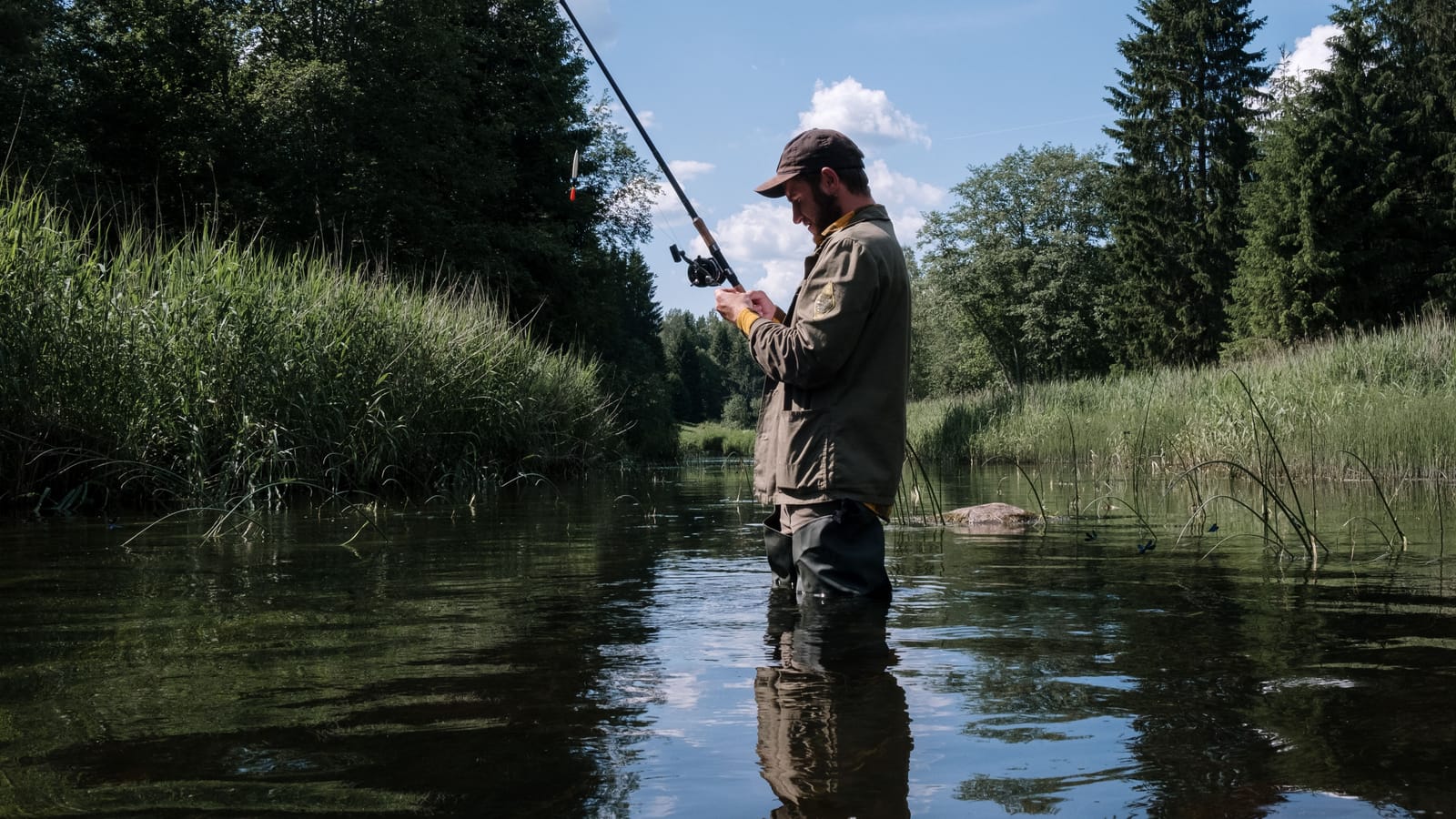
Most small stream trout are lost before the first cast. A guy parks at the bridge, walks down the bank in a bright shirt, wades in at the head of the pool and starts casting downstream into water where every fish already bolted under the ledge. He fishes for an hour, catches one six-inch dink, and decides the creek is dead.
The creek isn't dead. He blew it in the first eleven seconds.
Small water is the most honest fishing there is. Eight feet across, knee-deep, a brook trout the color of a stained-glass window sitting in the seam behind a rock. Nothing about it's technical in the way big-river fishing is technical. There's no mending across three currents, no matching a blizzard hatch. It's about where you put your feet and where the fish is looking.
Trout face into the current, so you come from behind
This is the whole game in one sentence. A feeding trout points upstream because that's where dinner comes from. Its blind spot is directly behind it. So you fish upstream, always, and you move up the creek one pool at a time.
That means every cast is quartered up and across, the fly drifts back toward you, and you strip or lift line to keep slack out. It feels awkward if you learned on lakes. Do it anyway.
The fish also has a hard ceiling on what it can see above the surface. Light bends at the water's edge, so a trout's window on the outside world is a cone about 97 degrees wide directly over its head. Everything outside the cone is mirror. The shallower the fish is sitting, the narrower that window gets. A trout in ten inches of water can see a much smaller patch of sky than one holding in four feet.
That's the good news. Get low and stay back, and you're physically outside the fish's window. The bad news is that the window is only half of it, because water carries pressure waves and stream bottoms carry vibration, and a heavy-footed wader announces himself for forty yards.
Read the pool in four parts
Every plunge pool on every creek in North America has the same anatomy. Learn it once and you'll read water in Pennsylvania, Montana and northern Ontario with the same eyes.
The head. Where the white water piles in. Oxygen, tumbling food, cover from the foam. Often holds the most aggressive fish, not always the biggest.
The seams. The fast water and the slow water rub shoulders and form a line you can see, usually marked with bubbles. A trout sits in the slow side and eats out of the fast side. Minimum effort, maximum calories. If you only fished foam lines for the rest of your life you'd do fine.
The belly. The deep middle. Big fish hold here in bright sun, and they're the hardest to fool because they've got time to inspect the fly.
The tailout. The shallow, glassy skid where the pool drains into the next riffle. This is where the biggest trout in the pool often feeds at dusk, and it's the first water you'll wreck if you come charging up the middle. Fish the tailout first, from below, before you take another step.
Now add the stuff that isn't water: an undercut bank, a log jam, a rock the size of a truck tire, the shade under a hemlock. Trout want current, cover and food within a body length of each other. Where all three overlap, there's a fish. Not usually. There's a fish.
Pocket water is a series of tiny pools
On steep creeks you'll hit stretches with no real pool at all, just boulders scattered through fast water. Everybody walks through it to get to the next pool. Don't.
Each boulder makes a soft spot in front of it and a soft spot behind it, and both hold trout. The cushion in front surprises people, but the water piles up and slows before it splits around the rock. Drop a fly there and it gets eaten.
These drifts last about a second and a half. Forget beautiful casting. Get within fifteen feet, hold the rod tip high, keep the line off the water and let the fly ride through. That's high-sticking, and on pocket water it outfishes a pretty forty-foot cast every day.
The stealth rules that actually matter
Wear drab. Olive, tan, gray, faded blue. Not white, not orange, not a hunting-camo pattern so dark it reads as a silhouette against a bright sky.
Never skyline yourself. Standing on a bank with open sky behind you turns you into a moving billboard. Kneel. Crouch behind a boulder. Use the brush you'd otherwise complain about.
Watch your shadow, not the sun. Sun at your back feels comfortable and puts your shadow across the pool. Cast with the sun in your face when you can stand it.
Wade less. Every step in the water pushes a wake, and the wake goes upstream to the exact fish you want. Fish from the bank until the bank runs out.
And slow down. Most people move through a small creek at walking speed. Move at about a third of that, with one foot testing before the other commits. The angler who fishes 300 yards carefully beats the one who fishes a mile in a hurry.
Keep the tackle short and light
A 6'6" to 7'6" rod in 2- to 4-weight is the sweet spot for water under twenty feet wide. Longer rods tangle in rhododendron. A 7.5-foot leader tapered to 5X handles most of it, and you'll want 6X on glassy tailouts in low summer flow.
Four dry flies cover more creeks than they have any right to: Parachute Adams in 14 and 16, Elk Hair Caddis 16, a Stimulator in 12 for high water, a foam beetle in 14 for August. Add a beadhead Pheasant Tail 16 to drop off the bend of the dry and you've got a two-fly rig for the entire season.
Prefer spinning gear? No apology needed on small water. A 4'6" to 5'6" ultralight, 4-pound mono, and a size 0 or 1 inline spinner. Same rules apply: cast upstream, retrieve just fast enough to turn the blade, and keep your body out of the fish's window. Where regulations allow bait, a single split shot and a worm drifted under a cutbank has embarrassed a lot of fly rods.
Learn the bow-and-arrow cast before you need it. Pinch the fly, load the rod, let go. It's the only way to get under a laurel tunnel, and small creeks are mostly laurel tunnels.
Keep some, release some, know the rules
Licenses, seasons, size limits, creel limits and gear restrictions vary by state and by province, and on a lot of creeks they vary by the mile. Special-regulation stretches, delayed-harvest sections and wild-trout water can all sit on the same stream. Read the current regulations for the specific water before you go, and check whether felt soles are legal where you're fishing, because several jurisdictions ban them over invasive species.
A wild brook trout out of a headwater creek is a slow-growing, hard-won fish. Most of those populations do better when you wet your hands, keep the fish in the net, twist the barbless hook and let it swim. But a stocked stream with a legal limit is food, and there's nothing sentimental about a few trout in a cast-iron pan with cornmeal and bacon grease. Take what you'll eat. Leave what you won't.
The measure of a small-stream angler isn't the fish he lands. It's the pool he walks up on so quietly that he watches a trout rise twice before he ever makes a cast.
Wes Dunbar
Country & Skills
Grew up on an acreage and never quite left. Covers trucks, trades, land, and how to do the thing yourself.

Watch
Watch how it's done
Picked for this article.
From channels we rate. Plays on YouTube.
Ventures Fly Co.
How to Sneak Up on Fish in a River — Small Stream Tips for Beginners | Episode 19
Orvis Guide to Fly Fishing
Fly Fishing Small Streams
Read next