
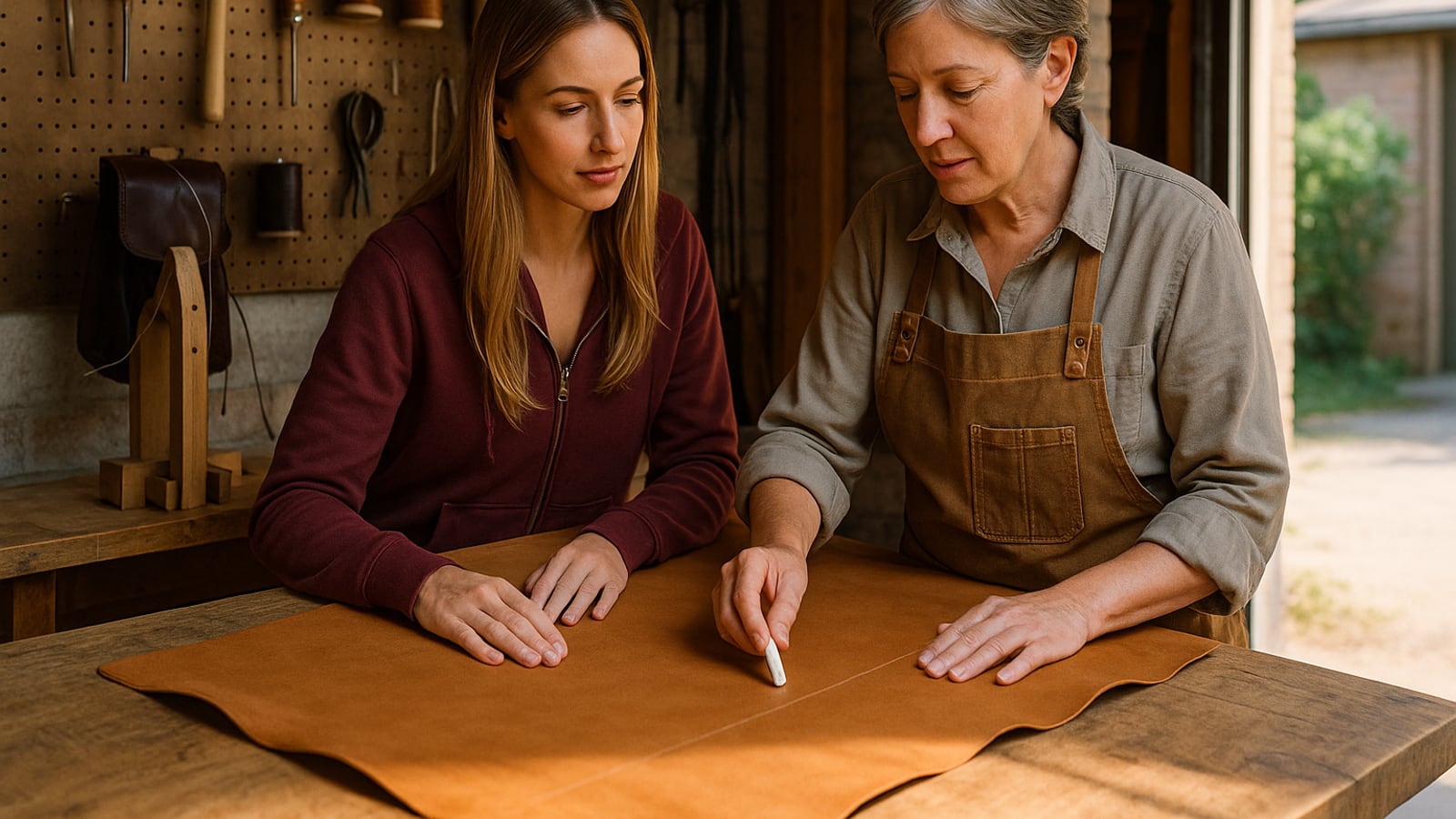
The most luxurious thing you'll ever own probably won't come in a branded box with a ribbon. It'll come from a woman in a converted garage who asked you how you carry your keys, which hand you write with, and whether you'll be picking up a toddler while wearing it.
That question about the toddler is the whole difference.
Quick answer: Pick one piece you'll use for twenty years and commission it from a named maker. Ask about materials, repairs and timeline before you pay a cent. Then write down who made it, because in forty years somebody will want to know.
The label is selling you a feeling. The maker is selling you hours.
A big fashion house has runway shows, flagship rents on Fifth Avenue and a celebrity campaign to pay for. A good chunk of what you hand over at the register goes there. None of it goes into the stitching.
An independent jeweler, dressmaker or leatherworker has a bench, tools and the one thing a department store can't sell you: a person who'll still pick up the phone when a clasp breaks in 2041.
Be fair about it, though. Some old European workshops still make beautiful things by hand, and plenty of solo makers on Instagram are selling mediocre work with nice lighting. The name on the door doesn't decide quality. What decides it is whether you can see how the thing was built and whether the person who built it will fix it. Everything below is about checking those two things.
Jewelry: build it for the hand that wears it every day
Most heirloom rings don't fail because the stone falls out on its own. They fail because the metal around it wore thin over thirty years of dishes, steering wheels and gardening.
So start with the metal. 18k gold is 75 percent gold. It's richer in color and softer, which means it scratches and wears faster. 14k is about 58 percent gold, harder and better suited to a ring you'll never take off. Neither is the "cheap" option. They're different jobs. Platinum is heavier and pricier, and it wears by moving the metal around rather than losing it, which is why many jewelers use platinum prongs to hold a diamond even when the band is gold.
Ask whether the piece will be cast (poured into a mold) or hand-fabricated (built from wire and sheet at the bench). Good casting is perfectly respectable. Hand-fabricated metal tends to be denser, and it's what you're paying a bench jeweler for.
Then the scene that plays out in jewelry shops every week: a woman brings in her grandmother's engagement ring. The shank on the underside is worn thin as paper, and two of the six prongs are nearly flat. The jeweler can re-tip the prongs and rebuild the shank, or move that old stone into a new, sturdier setting. If you're weighing a reset before an engagement, it's worth reading the things to watch before you marry him, because the ring really is the smaller decision.
Either way, ask for a maker's mark and a karat stamp inside the band. It's a signature. Your granddaughter will look for it.
Clothes: you want a dressmaker, not "couture"
"Haute couture" is a protected term in France, governed by the country's official fashion federation, and only a short list of Paris houses may use it. In America, "couture" on a sign means whatever the sign painter wanted it to mean.
What you're actually after is a skilled dressmaker who does bespoke work: drafting a pattern from your own measurements rather than altering a size 8.
A real one will do two things a boutique won't:
- Make a muslin first. That's a test garment in cheap cotton, pinned and marked on your body before anybody touches the good fabric. If she skips it for a fitted piece, walk.
- Leave generous seam allowances. This is the heirloom detail nobody mentions. Extra fabric tucked inside the seams means the dress or coat can be let out after a baby, taken in later and altered for a daughter one day. Fast fashion trims seams to the thread to save pennies. That garment has one body and one decade in it.
The honest downside: bespoke takes months and several fittings, and you can't return it. If your body is about to change a lot, wait, or choose a piece like a wool coat that forgives a few inches. A coat is a smarter first commission than a gown anyway. You'll wear it two hundred times.
Leather: four checks, thirty seconds
You can judge a handmade bag in the time it takes to hold it.
The grain. Full-grain leather keeps the original surface of the hide, pores and all. It's the toughest and it ages best. "Genuine leather" sounds reassuring and usually means a lower grade. Ask the maker what the hide is and where it's from. A good one will light up.
The tanning. Vegetable-tanned leather darkens and develops a patina with years of handling. Chrome-tanned leather is softer out of the gate and changes less. Neither is wrong. Just know which story you're buying.
The stitching. A hand-sewn saddle stitch uses two needles working one thread from both sides. If a stitch breaks, the seam holds. A machine lockstitch can start to unravel from a single break. Look at the back of the stitch line. Hand stitching sits at a slight, even slant.
The edges and hardware. Burnished edges, sanded and rubbed smooth, last. Thick painted edges crack and peel within a few years. Ask whether the buckles and rings are solid brass or plated. Plated hardware flakes. Solid brass just gets a little darker and more handsome.
Before you pay the deposit
Most makers ask for a deposit up front, often a sizable share, because they're buying your gold or hide before they start. That's fair. Ask these first:
- What exactly is the material, and can I see it?
- How many fittings or check-ins, and when?
- What's the timeline, and what happens if it slips?
- What if I don't like the finished piece?
- Do you repair your own work, and what does that cost?
- Can I see something you made five or ten years ago?
That last one tells you everything. Anyone can make a thing look good on day one.
Get the answers in writing, even a plain email. And set the budget before you walk in, not while you're holding the sample. The same habit that makes the raise conversation go better with a spreadsheet works here: know your number, and let the maker work inside it.
What we'd buy, what we'd skip
Buy: a 14k or platinum band with a maker's mark. A tailored wool coat with real seam allowances. A full-grain, hand-stitched bag or belt with solid brass hardware from a maker who offers repairs.
Skip: "limited edition" designer bags that are mostly logo. Anything sold as "genuine leather" with no further detail. Plated hardware on a piece priced like an heirloom. And any maker who gets vague when you ask about repairs.
Skip the whole idea, too, if the money belongs somewhere else this year. A down payment beats a handbag. The maker will still be there.
Pass it on better than you got it
An heirloom isn't an heirloom because it's expensive. It's an heirloom because someone kept it going.
So look after it. Have prongs checked every year or two. Condition the leather. Get the coat cleaned properly and hung on a wide wooden hanger, never wire. When something wears, send it back to the person who made it, or to someone just as good.
Then write the card. Maker's name, the year, the metal or hide, what it cost, why you had it made. Tuck it in the box or sew it into the lining.
Your daughter won't remember the price. She'll remember that you wore it to her graduation, and she'll want to know whose hands made it.
Nina Castellan
BRO for Her
Runs the women-facing desk. Same standard, same tools, written for a different reader — not a softer one.

Watch
Worth an hour of your evening
More from BRO for Her.
From channels we rate. Plays on YouTube.
Read next