
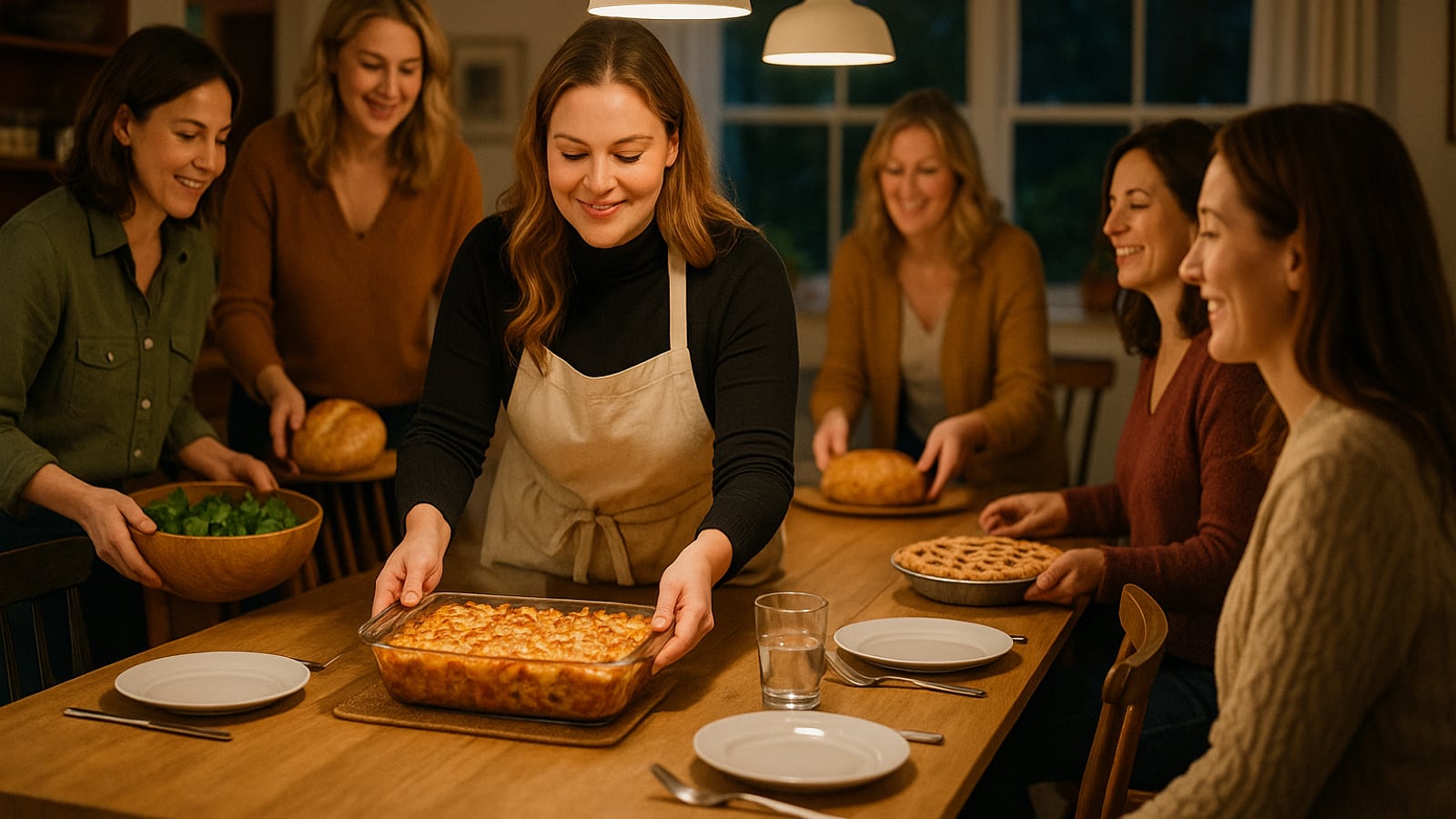
Quick answer: Pick a fixed night, like the second Tuesday, and never poll for dates. Invite eight women to get five. You make one main dish, everyone else brings one assigned thing, and store-bought counts.
Most monthly women's nights don't die from bad food or awkward conversation. They die in a group text around month three, when somebody writes "can we push to the 19th?" and eleven replies later nobody has met since October.
So make the one decision that matters before you invite anybody.
Pick the day once, then stop asking
"Second Tuesday of every month, 7:30 to 9:30, my house." That's the whole schedule. It doesn't move for birthdays, busy weeks or the one friend who can't make it this time.
This sounds rigid. It's supposed to. A floating date turns every month into a negotiation, and negotiations are where busy women quietly drop out. A fixed date becomes a habit. People write it on the fridge calendar. Husbands learn it's Mom's night and plan bath time around it. After a few months nobody has to decide anything, and that's exactly why it survives.
The trade-off is real. Somebody will miss months, and if your closest friend is a nurse on rotating shifts, a fixed Tuesday might lock her out for good. If your core group has a scheduling problem like that, pick the pattern that works for most of them and tell the rest, honestly, "We'll miss you when you can't come, and the door's open when you can." That beats a group built around nobody.
Start at 7:30 if any of you have little ones. By then the kids are down or close to it, and Dad's got the last story handled. Ending at 9:30 matters just as much. Women with 6 a.m. alarms will come every month to something with a clear end. They'll skip a night that might run till midnight.
Invite eight, expect five
Somebody always has a sick kid. Somebody's mother-in-law is in town. If you invite five and three show, the night feels thin and you'll wonder if it's worth it. Invite eight and you'll usually land around five, which is the right size. Everyone talks at one table and nobody hides.
Mix it up on purpose. The best groups include a young mom, a woman whose kids are grown, a newlywed, somebody single, somebody who just moved to town. The woman with three teenagers has answers the woman with a toddler doesn't know she needs yet. Groups made entirely of your college roommates are lovely, but they tend to run on old stories instead of new ones.
Invite people one at a time, not in a mass text. A personal text says you actually want her there. Something like:
"I'm starting a women's night at my house, second Tuesday of every month, 7:30 to 9:30. Just dinner and good conversation. First one's March 11. I'd love for you to come. You'd bring a salad or dessert, nothing fancy."
Notice what it does. It gives the date, the end time and her job. It doesn't ask "when works for everyone?" That question is where the whole project goes to die.
Then start a group text with everyone who says yes, and use it for exactly two things: the reminder and who's bringing what.
The food rule that keeps it from becoming a competition
You make one main dish. Everyone else brings one assigned thing: salad, bread, a side, dessert, drinks. You assign it in the group text the week before so you don't end up with four bags of tortilla chips and no fork in sight.
Keep the main dish forgiving. Something that holds in a pot or a low oven for an hour while people trickle in late:
- A big pot of chili with the toppings in bowls
- Baked ziti in a 9x13
- Sheet-pan chicken thighs with potatoes
- A soup bar in winter, with bread from the store
- Tacos, where the only real work is browning the meat
Say it out loud in the first invite: store-bought is welcome. A bakery pie is a perfectly good dessert. The moment one person arrives with a hand-lettered cheese board, the next three start feeling like they have to match it, and a relaxed evening turns into a Pinterest audition. The woman who's barely keeping her head above water should be able to grab a bag of salad on the way over and feel good about it.
Hosting will cost you something every month. That's fine. It's the price of being the person who made this happen, and it runs well under what you'd spend on a restaurant night out.
What actually happens once they're in the door
Put a basket by the door for phones, or ask everyone to keep them face-down unless a babysitter calls. It sounds prim until you notice how much better people listen without one buzzing next to their plate. If you want the longer case for that, getting your evenings back from a phone built to keep them makes it well.
You don't need a program. Food and a table do most of the work. But a little shape helps the first few months, while people are still strangers:
- One question on the table. "What's something you're good at that nobody asks you about?" works better than "How's everyone doing?"
- Every few months, a skill night. One woman teaches the rest to sharpen a kitchen knife, can peaches, start a sourdough starter or read a pay stub properly.
- Somebody's news gets real attention. A woman going back to work after ten years home with her kids needs this room. Help her polish a résumé, and pass along getting hired again after years out of the workforce.
One house rule is worth setting early, kindly and without apology: no trashing husbands. Ask for advice about your marriage all you want. Talk honestly about what's hard. But a table that turns into a weekly roast of the men at home poisons everyone's marriage a little at a time, including the marriages of women who didn't say a word. Sometimes a woman is really struggling, and that's different. Give her your full attention, and maybe a quiet coffee later that week. Just don't let the group make a sport of it.
Gossip gets the same treatment. If the conversation drifts toward a woman who isn't there, steer it back. It only takes you doing it twice before people understand the room.
Month four is the real test
Early nights feel great. Everybody's curious. Then comes a rainy February Tuesday when only two women text back, and you'll be tempted to cancel.
Don't. Hold it with two. Make half the chili. Those two will remember you held it, and they're the ones who make it a real group. The women who drift away usually aren't rejecting you. Their lives got loud. Don't guilt them in the group text. Send one warm personal note, something like "Missed you Tuesday, hope the kids are feeling better," and leave it there.
To keep it growing, invite one new woman every few months. Just one, so the group can absorb her. The neighbor whose name you finally learned. The mom from soccer pickup who always looks like she could use a night off.
After six months or so, offer to rotate hosting to anyone who wants a turn. Some will jump at it. Some never will. Both are fine. The group needs one anchor who never lets the date slip, and that's probably still you.
Leave it better
When it's somebody else's turn to host, stay to wash the dishes. Take your casserole dish home clean, not soaking in her sink. If you borrowed her serving bowl last month, bring it back with cookies in it. Wipe down the counter before you leave.
And when you're the host, notice who does that. She's the one you call when your own week falls apart.
The first night, maybe three women will sit at your table and it'll feel smaller than you pictured. Set the date for next month anyway, before anyone leaves.
Nina Castellan
BRO for Her
Runs the women-facing desk. Same standard, same tools, written for a different reader — not a softer one.

Watch
Worth an hour of your evening
More from BRO for Her.
From channels we rate. Plays on YouTube.
Read next