
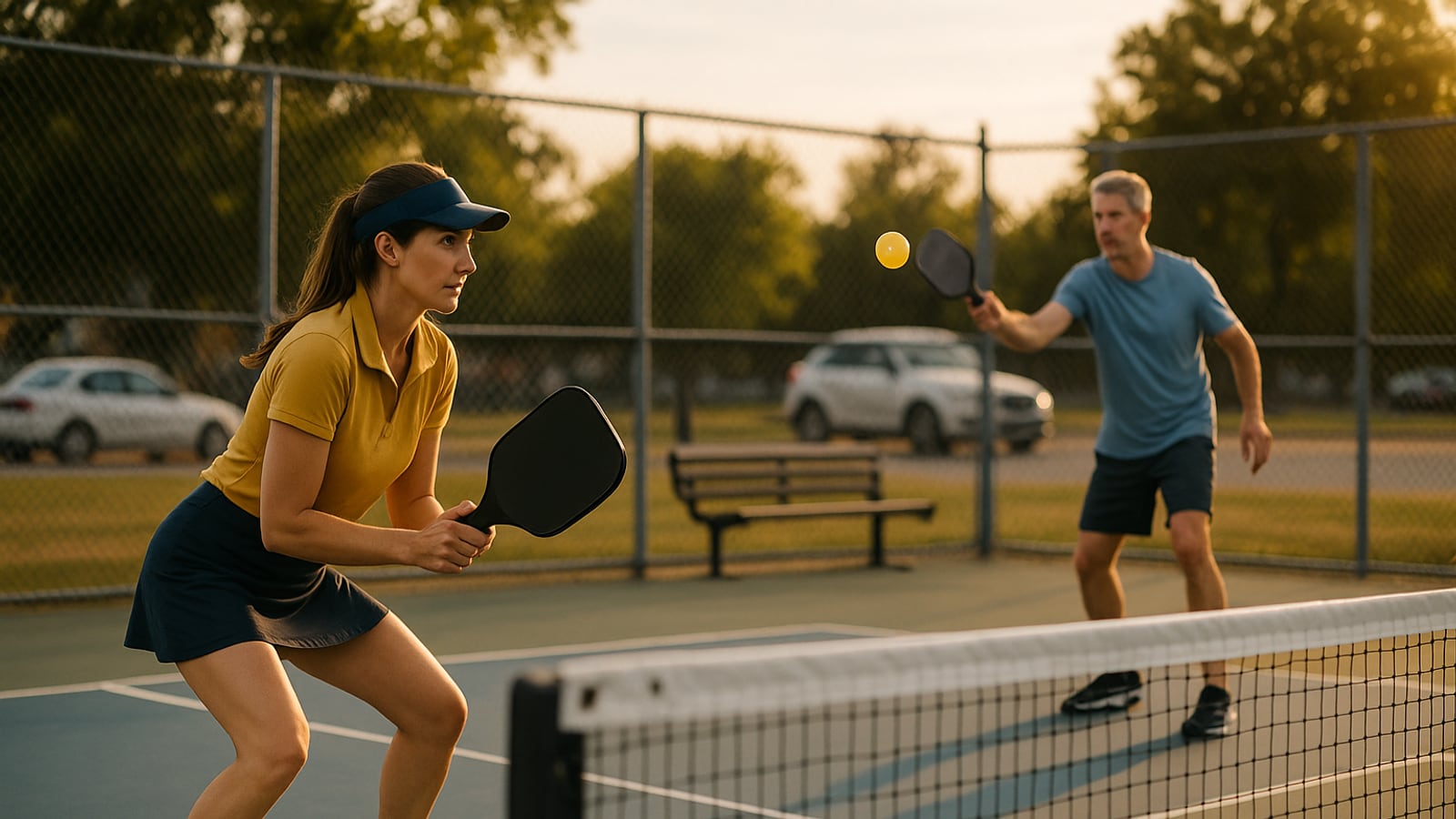
Quick answer: Get to the kitchen line early in every point and don't retreat when someone hits hard at you. Block the ball, don't swing at it. Find a group with skill-bracketed open play so your first month isn't spent getting run over.
The first time a man at open play drives a ball at your feet as hard as he can, you'll take two steps back. Almost everybody does. It feels like the safe move.
It's the move that loses the point. Then it loses the next one, and after a few weeks it becomes the reason you quietly stop showing up on Thursday nights.
The kitchen, in plain terms
The non-volley zone, which everyone calls the kitchen, is the 7-foot strip on each side of the net. You can't volley, meaning hit the ball out of the air, while you're standing in it or touching its line. If your momentum carries you into it after a volley, that's a fault too.
You can step in to play a ball that has bounced. Beginners forget that one constantly.
The two-bounce rule shapes everything else. The serve has to bounce, and the return has to bounce. After that, either team can volley. So the serving team starts the point pinned at the back, and the receiving team gets a head start to the net. Whoever gets to the kitchen line first and holds it usually wins the point. The tall guy with the big forehand doesn't get a vote in that.
Why backing up feels safe and isn't
When you're at the kitchen line, a hard shot gets to you fast. That's uncomfortable. When you back up, you get more time, and more time feels like control.
But look at the geometry. From the baseline, the ball has to travel 22 feet to reach the net and clear it at 34 inches in the middle. From the kitchen line, you're 7 feet away and nearly level with the tape. Up close you can hit down on the ball. From the back you have to lift it, and a lifted ball is exactly what the hard hitter across the net is waiting for.
Every step you retreat gives him a better angle and a softer target.
The people who bang the ball are counting on you to flinch. The cure is boring. Stand your ground and let the paddle do the work.
How to stand when it's coming hard
Get this right and the fear drops by half.
- Toes just behind the line, knees bent, weight forward. Not on your heels. Heels mean you've already decided to back up.
- Paddle up, out in front of your chest. Not hanging at your hip. Most hard shots at the net come at your body, and you don't have time to raise the paddle once the ball is in the air.
- Block, don't swing. Hold the paddle firm and let the ball bounce off it. A short, compact push back into the kitchen beats a big swing every time. Hold the paddle loosely enough and the ball dies softly in front of the net, which is the shot that drives bangers crazy.
- Let the high ones go. At the line, a ball that's still rising as it passes your shoulder is often headed out. Tracking it with your eyes and not your paddle wins you free points. Call it honestly, of course.
Practice this on purpose. Ask a friend to stand at the baseline and feed you firm balls while you just block for ten minutes. It's dull. It'll also do more for your game than an hour of games.
Getting there in the first place
If you're receiving, return the serve deep and walk forward right away. Don't admire it. You have a free trip to the line, so take it.
If you're serving, you're stuck back until the third shot. That third shot is the one players spend years on: a soft drop that arcs over the net and lands in the kitchen, low enough that the other team can't attack it. You won't hit it well for a while. Hit it anyway, then move up a few steps. If it's bad, stop, get set, and reset with another soft ball. Don't sprint forward while they're swinging.
Once all four players are at the net, the game turns into dinking, soft shots that bounce in the kitchen. Patience wins those exchanges. The first person to get impatient and pop the ball up usually loses the point. A lot of women are genuinely good at this part, because it rewards control over muscle.
Finding a group that'll make you better
USA Pickleball runs a court finder called Places2Play. Start there, then call your local rec center or parks department. The schedule posted online is often out of date, and the person at the front desk knows which night the friendly crowd shows up.
What to look for:
- Open play split by skill level. Many places run 2.5-and-under or "beginner" sessions. Go to those first. There's no shame in it, and you'll get far more rallies.
- A beginner clinic or a women's clinic. An hour with a coach in your first month saves you from bad habits that take a year to undo. Women's clinics also take the pressure off while you're still learning to hold the line.
- An organizer who actually runs rotation. At good open play, paddles go in a stack or a rack and the next four up take the court. If one group has held a court for an hour, keep looking.
Be honest about your level. Rating yourself a 3.5 to get into the better game gets you nothing but a miserable evening. Once a week, though, play up with people a little better than you. That's where you'll learn the most.
And if you've spent years pouring every evening into everybody else, a standing weekly game is one of the better ways to take a couple of hours back. It pairs well with getting your evenings back from a phone built to keep them.
Mixed doubles, and the partner who takes everything
In mixed doubles, the other team will often hit to the woman on purpose. Don't take it personally, and don't be offended by it either. It's reps. Every ball they send you is a chance to prove the plan is wrong, and holding the line proves it fast.
The harder problem can be your own partner. Some men poach every ball down the middle and some that aren't. A little of that's good teamwork. Too much and you're a spectator standing on a court you paid to play on.
Say something, and say it before the next point, not after the fifth one. Keep it plain and friendly: "Middle balls on my forehand are mine." Most partners will happily agree. If he keeps crossing anyway, stand your ground and go for your ball. Being a gracious partner doesn't mean giving away your half of the court. It's the same muscle you'd use walking back into an interview after years out of the workforce. You belong in the game, so act like it.
What to bring
Shoes first. Wear court shoes or tennis shoes, not running shoes. Running shoes are built to go forward, and pickleball is all side to side. Rolled ankles happen in running shoes.
Paddle second. Borrow one for your first few sessions. When you buy, get a midweight paddle from a known maker like Selkirk, JOOLA or Franklin, and check it's on the USA Pickleball approved list if you'll ever play a sanctioned event. You don't need the top model. Your hands matter far more than the paddle.
Balls. Outdoor balls and indoor balls are different. The Franklin X-40 is the common outdoor ball. Bring one or two of your own.
Sun protection, if you play outside. Wear any broad-spectrum SPF 30 or higher every time, reapply every two hours and after you sweat, and add a visor. If you're choosing, I'd go mineral: zinc oxide or titanium dioxide. Those are the only two filters the FDA proposed as generally recognized as safe and effective in 2019, and they're gentler on sensitive skin. Some leave a white cast, which the tinted versions fix. EltaMD UV Physical SPF 41 (tinted), Blue Lizard Sensitive Mineral SPF 30 and Neutrogena Sheer Zinc SPF 50 all fit the bill.
The unwritten rules
Call your own lines honestly, especially the close ones against you. Put your paddle in the stack and wait your turn. Say "nice shot" and mean it.
Once in a while, bring a sleeve of new balls and leave them for the group. When the session ends, stay the extra five minutes to roll up the portable nets and haul them to the storage closet. The regulars notice who does that. Those are the people who get invited to the good Saturday morning game.
Nobody will remember whether you won in your first month. They'll remember who stayed at the line when the ball came hard, and who stayed after to help put the nets away.
Be both.
Nina Castellan
BRO for Her
Runs the women-facing desk. Same standard, same tools, written for a different reader — not a softer one.

Watch
Watch how it's done
Picked for this article.
From channels we rate. Plays on YouTube.
Tyson McGuffin Pickleball
Stop Playing Scared at the Kitchen | Here’s How to OWN the Net Like a Pro
ThatPickleballGuy - Kyle Koszuta
7 Kitchen Strategies to Avoid Getting Crushed in Pickleball
Read next