Getting a Message Out When There's No Signal
Your phone's GPS still works with zero bars. Its maps don't. That gap is where people get into trouble, and here's what actually fixes it.
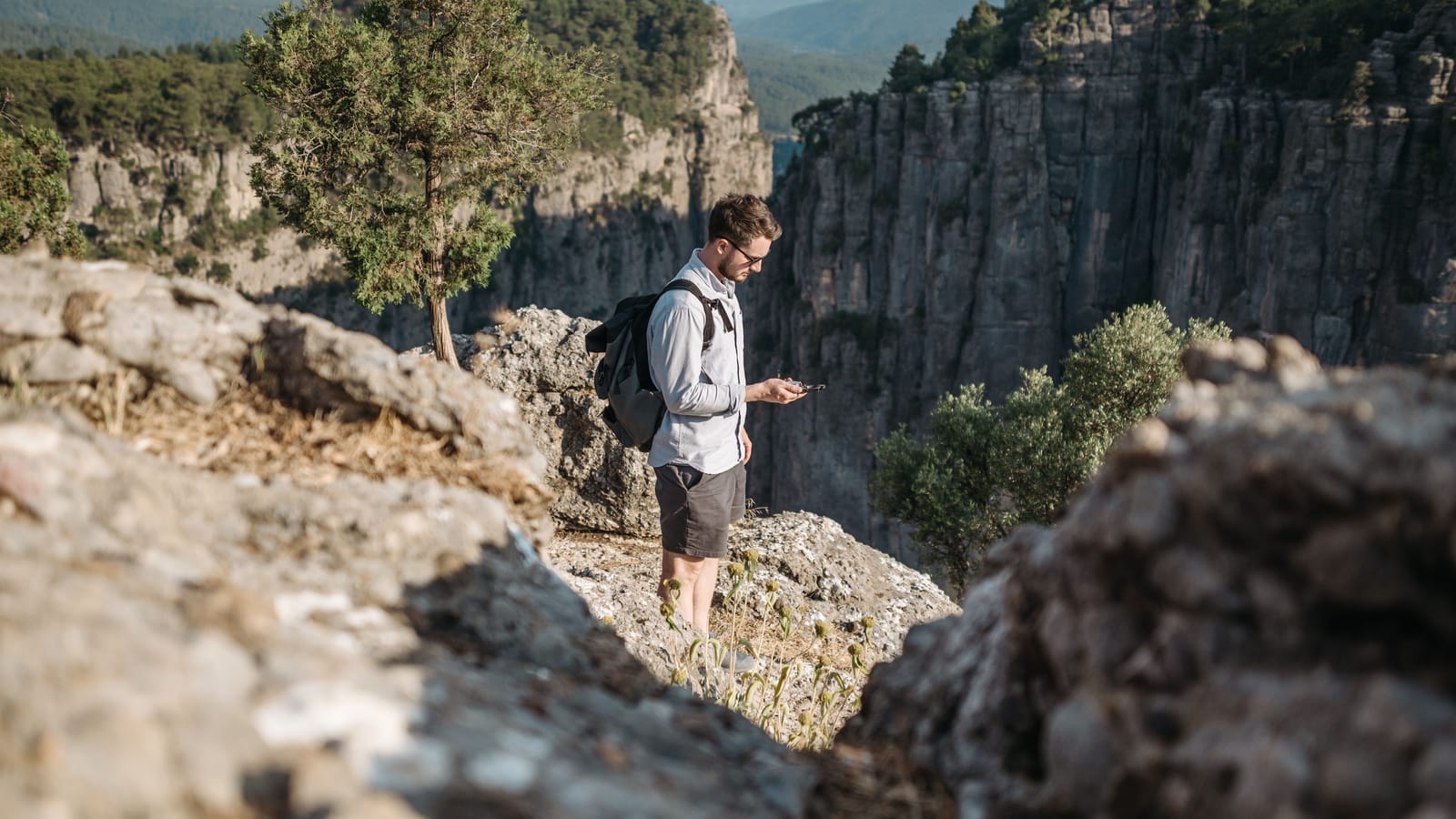
Your phone knows exactly where it's with zero bars. The GPS receiver doesn't need a cell tower. What it can't do is download the map underneath that blue dot, and it can't tell anyone at home where the dot is. That's the whole problem in one sentence, and the fix costs either nothing or about four hundred dollars, depending on how far out you're going.
Start with the free part. Before you leave pavement, open whichever map app you use and download the area offline. Gaia GPS, onX, CalTopo and Avenza all do it. So does Google Maps, though its offline coverage is thin once you're off maintained roads. Then put the phone in airplane mode. A phone hunting for a tower it will never find is the fastest way to a dead battery, and airplane mode doesn't turn off GPS.
That alone covers a lot of weekend trips. If you're doing a day hike on a signed trail in a state park, you don't need a satellite device. Buy the power bank instead.
Three different tools that people keep confusing
Satellite messengers send and receive short text messages over a satellite network and have an SOS button that reaches a 24/7 coordination center. Garmin's inReach Mini 2 and Messenger, Zoleo, and the SPOT X all sit here. They need a subscription. Garmin's cheapest tiers run around fifteen dollars a month on an annual plan, more if you want month-to-month or unlimited messages. Zoleo undercuts that a little.
Personal locator beacons do one thing. You deploy the antenna, you hold the button, and a 406 MHz distress signal goes to the international Cospas-Sarsat system along with your registered identity and a GPS fix. No subscription, no monthly fee, a battery rated for years of storage. The ACR ResQLink is the common one. You can't text your wife with it. You can't cancel easily. It's a one-way scream for help, and it's very good at being that.
Phone satellite SOS now exists on iPhone 14 and later and on recent Pixels. It works. Apple's version walks you through pointing the phone at the right patch of sky and asks a short questionnaire before relaying to emergency services. On newer iOS versions you can send regular messages by satellite too. It's a genuine safety net and it's already in your pocket.
But a phone is glass, it dies in the cold, and it's the thing most likely to be in the river or under the truck seat. A dedicated device is a second system, not a better one.
The network matters more than the device
Garmin inReach and Zoleo both ride Iridium, which has satellites in polar orbits covering the entire planet. SPOT uses Globalstar, which has real coverage gaps at high latitudes and in parts of the southern hemisphere. If you're hunting Alaska or trekking in Patagonia, check the coverage map for the constellation, not the marketing page for the device.
Everything satellite needs sky. Under heavy conifer canopy, in a slot canyon, or in the bottom of a steep drainage, a message that would clear in two minutes on a ridge can sit in the queue for twenty. That's not a fault. It's physics. The device will keep retrying, but you should assume nothing sent from a dense creek bottom has arrived until you get the delivery confirmation.
So step out from under the trees. Set the thing on a rock with a clear view, walk ten feet away, and let it work while you filter water.
What people get wrong in setup
Almost every failure I've seen is a setup failure, not a hardware failure.
The subscription lapsed. Garmin plans can be suspended in the off-season, and people forget to reactivate before the September trip. Check the account the week before you leave, not the morning of.
The preset messages were never written. You get a small number of canned messages that send for free or cheap on most plans. Write them so they're actually useful: "Made camp, all fine, no reply needed" and "Running late, not an emergency, do not call anyone." That second one prevents more searches than anything else on the device.
The emergency contacts were never entered, or they're a work number that rings to voicemail. When an SOS goes out, the coordination center calls those people to build context. They want to know how many in your party, what vehicle, when you were due back. A contact who can answer that's worth more than a better antenna.
The PLB was never registered. In the US, registration with NOAA is free and takes ten minutes. An unregistered beacon still works, but rescuers arrive knowing nothing about you.
And test it. Send one message from your driveway. Every inReach has a free test mode. Do it once a season.
Pick one, briefly
If you want a messenger and you're not going to carry a handheld GPS, the Garmin inReach Mini 2 is the default for a reason. It's small enough to clip to a shoulder strap and forget, it has a basic screen so it functions with a dead phone, and battery life runs days to weeks depending on tracking interval. The Messenger is cheaper and has better battery but leans harder on the phone app.
Zoleo is the value pick. It's a puck with no real screen, so you're phone-dependent, but it's noticeably cheaper up front and monthly, and it hands off to cell or wifi automatically when you have it, which means one message thread instead of two.
If you never intend to text anyone and you just want insurance, a ResQLink PLB costs roughly what a year and a half of messenger service costs and then sits in the pack for five to seven years doing nothing. For a solo fisherman or a guy who drives forest roads alone, that math is hard to argue with.
For dedicated navigation, the Garmin eTrex line still runs on two AA batteries, which is a real advantage on a ten-day trip where you can carry lithium AAs instead of a power bank. The GPSMAP 67i combines the handheld and the inReach in one unit, at real cost and real bulk.
The part about pressing the button
SOS is for loss of life or limb. Not for being tired, lost with water and daylight, or wanting a ride to the trailhead. Every unnecessary activation puts volunteers on bad roads at night, and in some jurisdictions it puts you in front of a bill.
That's exactly why two-way messaging beats a beacon for most people. You can text "broke my ankle, can walk out slowly, expect us at the truck at 2200" and nobody launches anything. A beacon can't say that.
Leave a plan with a human
Write down your vehicle, plate, where it's parked, your route, your turnaround time, and the hour after which someone should call the county sheriff. Text it to your wife or your brother before you lose signal. Share your MapShare or tracking link.
My father-in-law used to leave a note on the kitchen table with the trailhead name and a time, and that was the whole system. It worked because someone was home to read it.
The device is the backup to that. Not the replacement for it.
Dean Shaw
Gear & Garage
Reads the warranty, the parts list and the long-term owner reviews before anything else. Trucks, tools, watches, and the cheap version that costs more.

Watch
Watch how it's done
Picked for this article.
From channels we rate. Plays on YouTube.
REI
PLBs vs. Satellite Messengers—Which is Right for You? || REI
AllOffroad 4x4
PLB vs Satellite Messenger vs iPhone SOS – Which One Could Save Your Life?
Read next