Canning Season Without the Guesswork
Acid level, altitude and a tested recipe decide whether your pantry is food or a hazard. Everything else is preference.
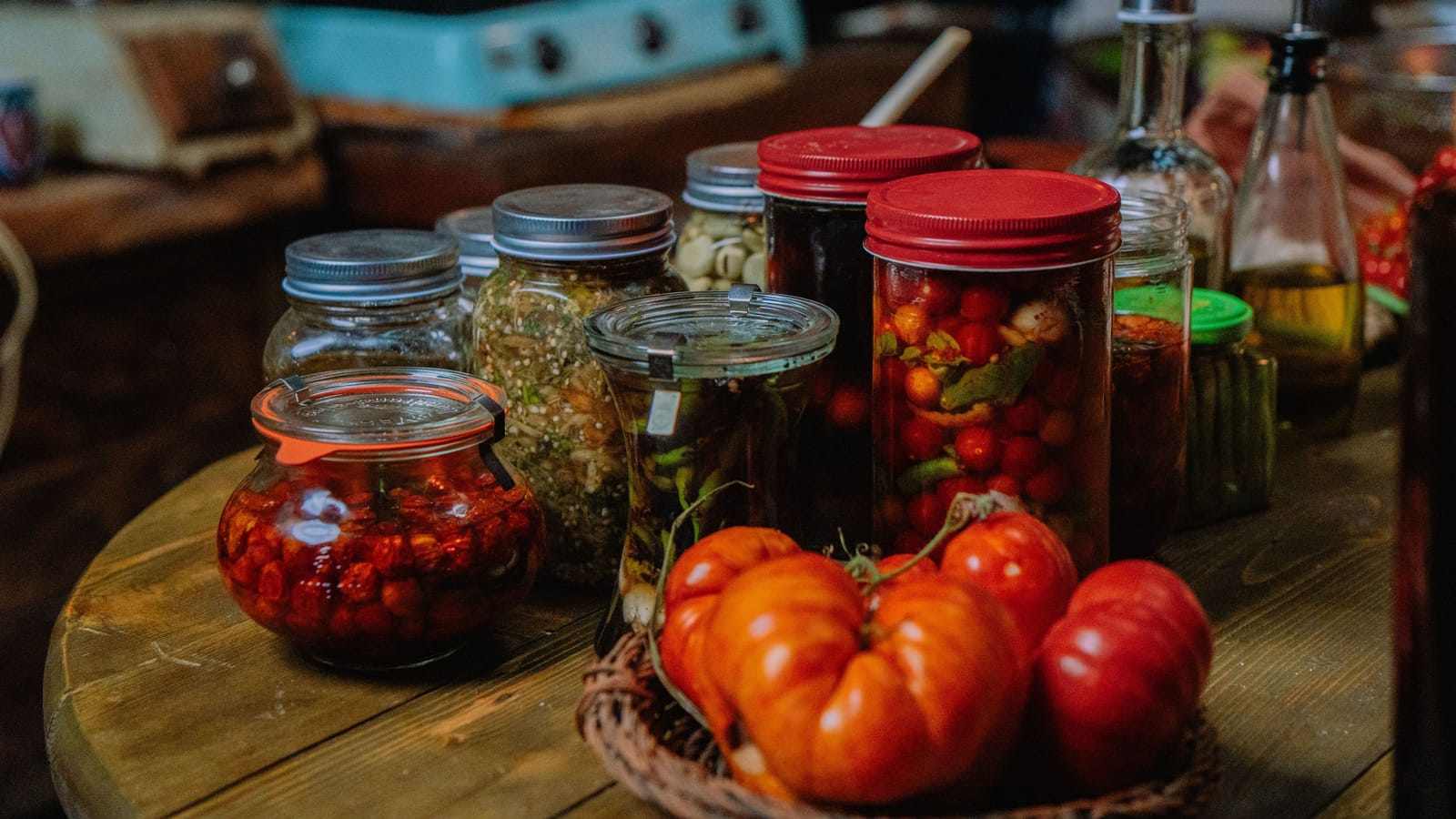
Forty pounds of Roma tomatoes will show up on your kitchen floor in one afternoon, and they won't wait. That's the actual problem with preserving a harvest. Not the technique. The timing. In zone 5 the tomato flood hits somewhere in the back half of August and runs until the first frost kills the vines in late September. In zone 8 or 9 you get an early wave in June, a sulk through the worst of the heat, and a second push in October. Either way, it arrives all at once, on a 90-degree day, when you have other plans.
So decide your method before the fruit is sitting there going soft.
The only rule that actually matters
Food splits into two camps, and the line is acidity. pH 4.6 is the border.
High-acid foods (most fruits, properly acidified tomatoes, pickles in vinegar brine, jams and jellies) can be processed in a boiling water bath. The acid does the heavy lifting. Botulism spores can't grow in that environment.
Low-acid foods (green beans, corn, carrots, potatoes, squash, beets, meat, stock, plain vegetable soup) must go in a pressure canner. Not a pressure cooker. Not an electric multi-cooker with a "canning" button. A tested pressure canner that holds 10 to 15 pounds of pressure and gets the interior of the jar to 240°F or better, because that's the temperature that kills Clostridium botulinum spores. Boiling water tops out at 212°F. It doesn't matter how long you leave it there.
There's no workaround. No amount of vinegar in the green beans, no heirloom family method, no "my grandmother did it for fifty years." Grandma was also lucky, and a lot of other people's grandmothers weren't.
Tomatoes are the trap
Everyone assumes tomatoes are acidic. Modern varieties sit right on the line, and a fully ripe or overripe one can drift past it. Every tested tomato recipe now tells you to add acid, and you should do it even if you're pressure canning.
Bottled lemon juice, not fresh. Fresh lemons vary; the bottled stuff is standardized. Two tablespoons per quart, one per pint. Or citric acid, half a teaspoon per quart. Add it to the empty jar before the tomatoes go in. If the flavor bothers you, a little sugar balances it without touching the pH.
Altitude changes the numbers, and your zone doesn't
This is the part people skip. Water boils cooler as you climb, so above 1,000 feet every processing time and pressure has to go up.
For boiling water bath, you add time. For a weighted-gauge pressure canner, you go from 10 pounds to 15 pounds above 1,000 feet, and that's the whole adjustment. For a dial-gauge canner, the increase is stepped by elevation.
Look up your actual elevation. Denver is a mile up. Plenty of the Texas Hill Country is over 1,500 feet. If you're in Salt Lake City and you're running a Blue Ridge recipe at sea-level times, you're under-processing every jar.
Dial gauges also drift. Most county extension offices will test yours, usually free or close to it, and they'll tell you to bring it in once a year. Weighted gauges don't need testing because a chunk of metal can't lie about how heavy it is.
What it costs to start
- A 21 to 23-quart pressure canner, the aluminum kind with a weighted jiggler: expect somewhere around $120 to $160. It will outlive you if you keep the gasket soft and the vent pipe clear.
- A cast aluminum canner with a metal-to-metal seal and no gasket: $350 and up. Buy it if you're canning meat every year. Skip it otherwise.
- Water bath setup: a deep stockpot you already own plus a rack, or a dedicated canner for $30 to $50. The rack matters. Jars sitting flat on the bottom of the pot can crack.
- Jars: about $16 to $20 a case of twelve, so a bit over a dollar each. They're reusable forever unless you chip a rim.
- Lids: roughly 30 cents each, single use, no exceptions. The sealing compound takes one impression and that's it. Bands are reusable.
- Jar lifter, magnetic lid wand, wide funnel, headspace tool: $15 to $20 as a set, and the lifter alone is worth it. Trying to fish a hot quart jar out with tongs is how you get a burn and a broken jar in the same second.
Call it $200 to get going with a pressure canner and four dozen jars. That's one Saturday.
The workflow that keeps a canning day from falling apart
Start early. A full pressure canner run takes longer than you think: 10 minutes venting steam, time to come up to pressure, the processing time itself, then 30 to 45 minutes for the pressure to fall on its own.
Prep everything before a single jar goes in the canner. Wash jars, heat your brine or sauce, get the lids ready, clear counter space for cooling. Once you're loading, you shouldn't be looking for the funnel.
Headspace is measured, not guessed. A quarter inch for jams and jellies. Half an inch for most fruits, tomatoes and pickles. A full inch for low-acid vegetables and meat, because they expand. Too little and food pushes out under the lid and ruins the seal. Too much and you've left air that won't vent.
Wipe every rim with a clean damp cloth. One tomato seed is enough to fail a seal.
Bands go on fingertip tight. Not cranked. Air has to escape during processing.
What goes wrong, in order of how often
Siphoning. You open the canner, the jars are half empty, liquid all over the rack. That's a pressure change that happened too fast. Let a pressure canner depressurize naturally, wait 10 minutes after the lock drops, then remove the lid away from your face and let the jars sit in the canner another five. Water bath: kill the heat, take the lid off, wait five minutes, then lift.
Reused lids. They seal, they look fine, they fail in November.
Messing with the recipe. You can swap spices and you can cut the salt in most things, pickles fermented in brine excepted. You can't add flour, pasta, rice, dairy or a pile of extra onions to a tested salsa. Those change density and pH and the processing time is no longer valid. Thicken it in the pot on the day you eat it.
Cooling on a cold granite counter. Put a towel down. Thermal shock cracks jars.
Leaving bands on in storage. Take them off after 24 hours. A band can hold a failed lid in place and hide the problem from you.
Test every seal by pressing the center. No flex, no click, it's good. Anything that didn't seal goes in the fridge and gets eaten this week. Label the sealed ones with contents and the month, and store them somewhere dark and between 50 and 70°F.
When a jar looks wrong
Bulging lid, liquid that spurts when you open it, mold, an off smell, cloudy brine on something that should be clear. Don't taste it. Tasting isn't a test.
USDA guidance for a suspect low-acid jar is to boil the container and contents for 30 minutes before disposal, then double-bag it. Wash anything it touched with a bleach solution. And as routine practice, boiling home-canned low-acid foods for 10 minutes before serving gives you a second layer of protection that costs you nothing but a saucepan.
The honest trade-off
Freezing beats canning on green beans and sweet corn. Better texture, a third of the work, no gauge to test. A chest freezer runs maybe a few dollars a month.
Canning wins on shelf life, on power outages, and on the fact that a shelf doesn't need electricity. It also wins on tomatoes, which freeze into something sad.
So do both. Freeze the beans, can the sauce, dehydrate the herbs, and put your kids on label duty with a Sharpie.
Come February, when the garden is mud and the grocery store tomatoes taste like wet cardboard, you'll open a quart of August. That's the payoff, and it's a real one.
Nina Castellan
BRO for Her
Runs the women-facing desk. Same standard, same tools, written for a different reader — not a softer one.

Watch
Worth an hour of your evening
More from Garden & Yard.
From channels we rate. Plays on YouTube.
Read next