Stop Nodding Along and Go Get Your Hearing Tested
The test takes twenty minutes in a soundproof booth, and it tells you things about your brain and your marriage that you can't guess at.
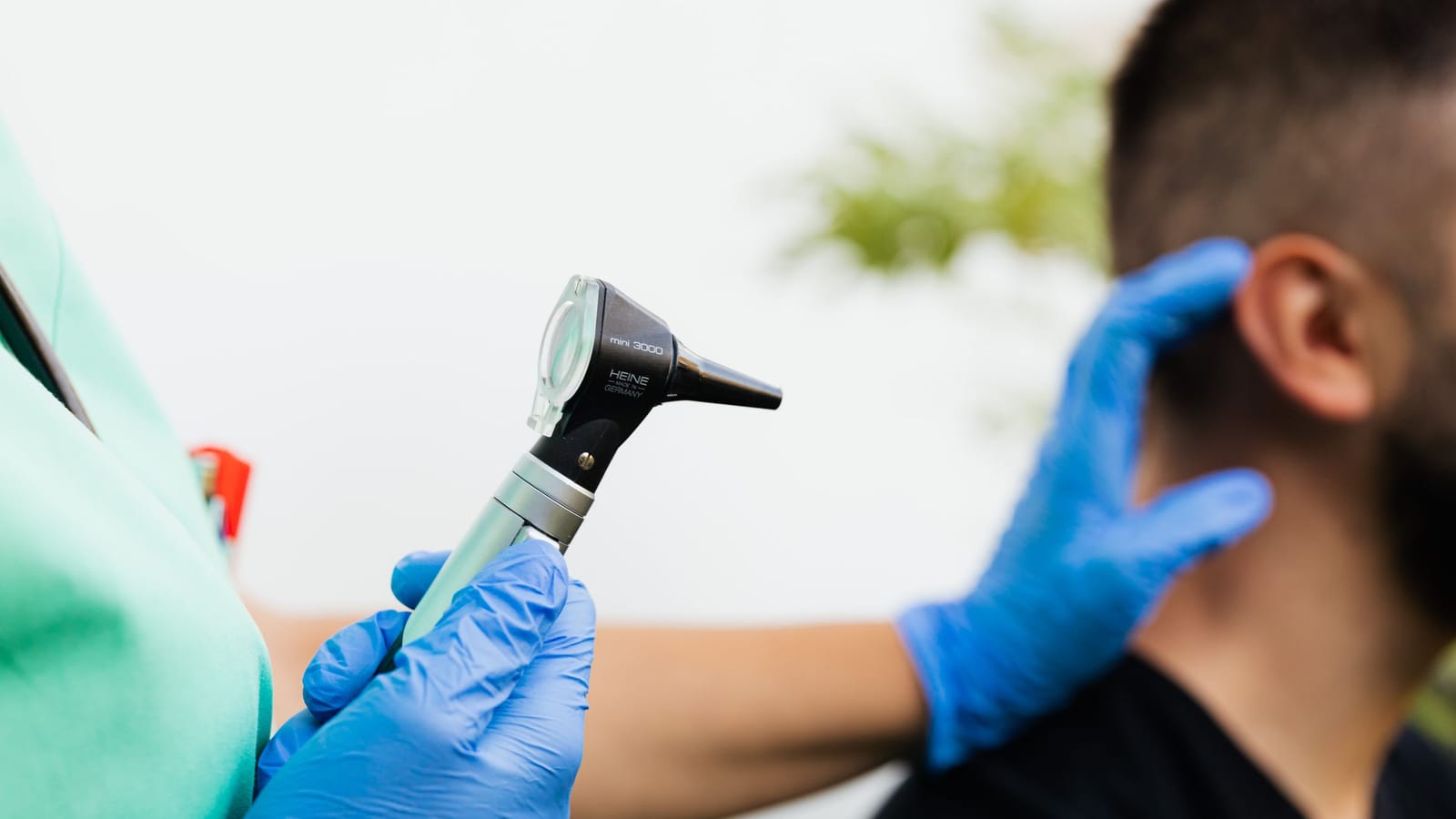
Two people at your table are laughing and you missed the setup. You laugh anyway. That's the moment most people file away and forget, and it's the single most reliable early sign that the high frequencies are going.
Get the test. A full audiogram with an audiologist takes about twenty to thirty minutes, happens in a booth quieter than your bedroom at 3 a.m., and doesn't hurt. Many insurance plans cover a diagnostic hearing evaluation when there's a reason for it, and Medicare covers it with a physician order. Call and ask what your plan does before you book, because coverage for the test and coverage for the devices are two completely different conversations.
Why the dinner table goes first
Noise damage doesn't take your hearing evenly. It eats the high frequencies first, usually around 3,000 to 6,000 Hz, and that's exactly where consonants live. Vowels are low and loud. Consonants are high and quiet. So you hear that someone spoke, you just can't tell whether they said "fifty" or "sixty," "cat" or "hat."
Add a room with hard surfaces, a football game on a TV in the corner, and three conversations running at once, and your brain runs out of raw material to reconstruct the sentence. You're not distracted. You're missing data.
This is why the classic complaint is "I can hear fine, people just mumble." Half of that sentence is true. You can hear fine in a quiet kitchen with one person facing you. Put yourself at a wedding reception and the math collapses.
The part nobody tells you about
Untreated hearing loss doesn't stay in your ears. Researchers studying dementia risk have consistently flagged hearing loss as one of the modifiable factors worth paying attention to in midlife, and a large randomized trial published in 2023 found that hearing intervention slowed cognitive decline over three years in older adults who were already at elevated risk. The mechanism is still argued over. The pattern isn't.
Think about what's plausible. If every conversation costs you extra effort, that's effort you're not spending on remembering the story. If restaurants become exhausting, you stop going. If small group at church turns into a room where you catch every third sentence, you stop raising your hand. Isolation is a known problem for older adults, and losing your hearing is a quiet, polite way of walking into it.
There's a marriage version of this too. The spouse of a person with untreated hearing loss repeats themselves ten times a day, gets short about it, and feels ignored. The person with the loss feels nagged. Neither of them has named the actual problem. An audiogram names it in an afternoon.
What the test actually involves
You'll sit in a booth with headphones or foam inserts. A tone plays, you press a button. The tones start obvious and get quieter until you're pressing on faint whispers of sound, and yes, you will second-guess yourself. Press when you think you hear it. That's the instruction.
Then they'll do a bone conduction test with a small vibrating device behind your ear, which bypasses the outer and middle ear entirely. The difference between those two results tells the audiologist whether the problem is conductive, meaning something is blocking sound on the way in, or sensorineural, meaning the inner ear or nerve.
That distinction matters enormously. Conductive loss is often fixable. Wax impaction, fluid, a middle ear issue. Sensorineural loss from noise and age is usually permanent.
Finally they'll test word recognition, reading you a list of single-syllable words at a comfortable volume and scoring how many you repeat correctly. This is the number I'd look at hardest. Two people can have identical tone results and wildly different word scores, and word score is what predicts how much a hearing aid will help you.
Reading the chart
The audiogram is a graph. Pitch runs left to right, 250 Hz on the left up to 8,000 Hz on the right. Loudness runs top to bottom, and it's upside down from what you'd expect: quieter at the top, louder at the bottom. Lower on the page is worse.
Red circles are your right ear. Blue X's are your left. In adults, thresholds down to about 25 decibels are generally called normal, 26 to 40 is mild, 41 to 55 is moderate, and it keeps going from there.
The shape you're looking for is a line that runs flat across the left side and then dives on the right. If there's a distinct dip around 4,000 Hz that recovers slightly at 8,000, that's the classic noise notch. Chainsaws, gunfire, band practice, twenty years of a shop compressor cycling twelve feet from your head.
Three things that mean call today, not next month
Sudden hearing loss in one ear. If hearing drops in one ear over hours or a few days, that's sudden sensorineural hearing loss, and it's treated as urgent. The window for steroid treatment is measured in days. Don't wait to see if it clears up. Call your doctor or an ENT immediately.
One-sided anything. Hearing loss, ringing, or fullness that's clearly worse in one ear deserves a real workup. Age and noise damage usually hit both ears roughly the same.
Tinnitus that arrives with dizziness or facial weakness. Get seen.
None of the above is a diagnosis from me. It's a list of reasons to pick up the phone.
What you do with a bad result
The FDA opened up over-the-counter hearing aids for adults with perceived mild to moderate loss in 2022, and the market changed fast. Devices that used to run four to six thousand dollars a pair through a clinic now have OTC competitors in the few-hundred-dollar range. Apple's AirPods Pro 2 even carry an FDA-authorized hearing aid feature and a built-in hearing test, which is a genuinely useful on-ramp for a guy who'd rather chew glass than walk into an audiology office.
The trade-off is real, though. OTC means no professional fitting, no real-ear measurement, no one adjusting the gain curve to your specific audiogram. If your loss is moderate to severe, asymmetric, or your word recognition score is poor, a cheap earbud isn't the answer and you'll conclude that "hearing aids don't work." They work. That one wasn't set up for your ears.
The other honest concession: hearing aids live in a drawer more often than anyone in the industry likes to admit. The first two weeks are strange. Your own voice sounds boomy, the refrigerator is suddenly a jet engine, and paper is deafening. That's your brain recalibrating after years of a muffled world, and it takes about a month of daily wear to settle. People who wear them four hours a day for two weeks and quit never get to the good part.
Protect what's left
You can't undo the notch. You can absolutely stop widening it.
- At the range, double up. Foam plugs under muffs. Highest-rated foam plugs run around NRR 33, and rolling them down thin and holding them in place for thirty seconds while they expand is the difference between real protection and decoration.
- Electronic muffs are worth the money if you shoot with other people, because you can hear range commands and conversation while the compression clamps down on the shot.
- Mowers, leaf blowers, miter saws, angle grinders. Keep a pair of plugs in the truck and a pair on a nail in the garage. The barrier is never cost, it's not having them within arm's reach.
- Concerts and gyms with the volume cranked. Musician's earplugs cut volume fairly evenly across frequencies instead of just killing the treble. You still hear the music. You just hear it at a level that lets you hear it again in ten years.
Your grandkids are going to talk quietly and fast, the way small kids do, and they're going to say the thing once. Book the appointment while catching it's still a choice.
General information only. Talk to your physician or a licensed audiologist about your own hearing.
Cal Brennan
Fitness
Strength coach. Trains fathers, tradesmen and desk workers, which means programs that survive a bad week.

Watch
Watch how it's done
Picked for this article.
From channels we rate. Plays on YouTube.
UC Speech and Hearing
Adult hearing test - Audiology at the University of Canterbury
Audiology TV
What Happens During a Hearing Test?
Read next