

When the Stairs Start Winning, See a Doctor
Getting winded on things that used to be easy isn't a fitness problem until a doctor says it is. What to watch for, what to say, and what gets tested.
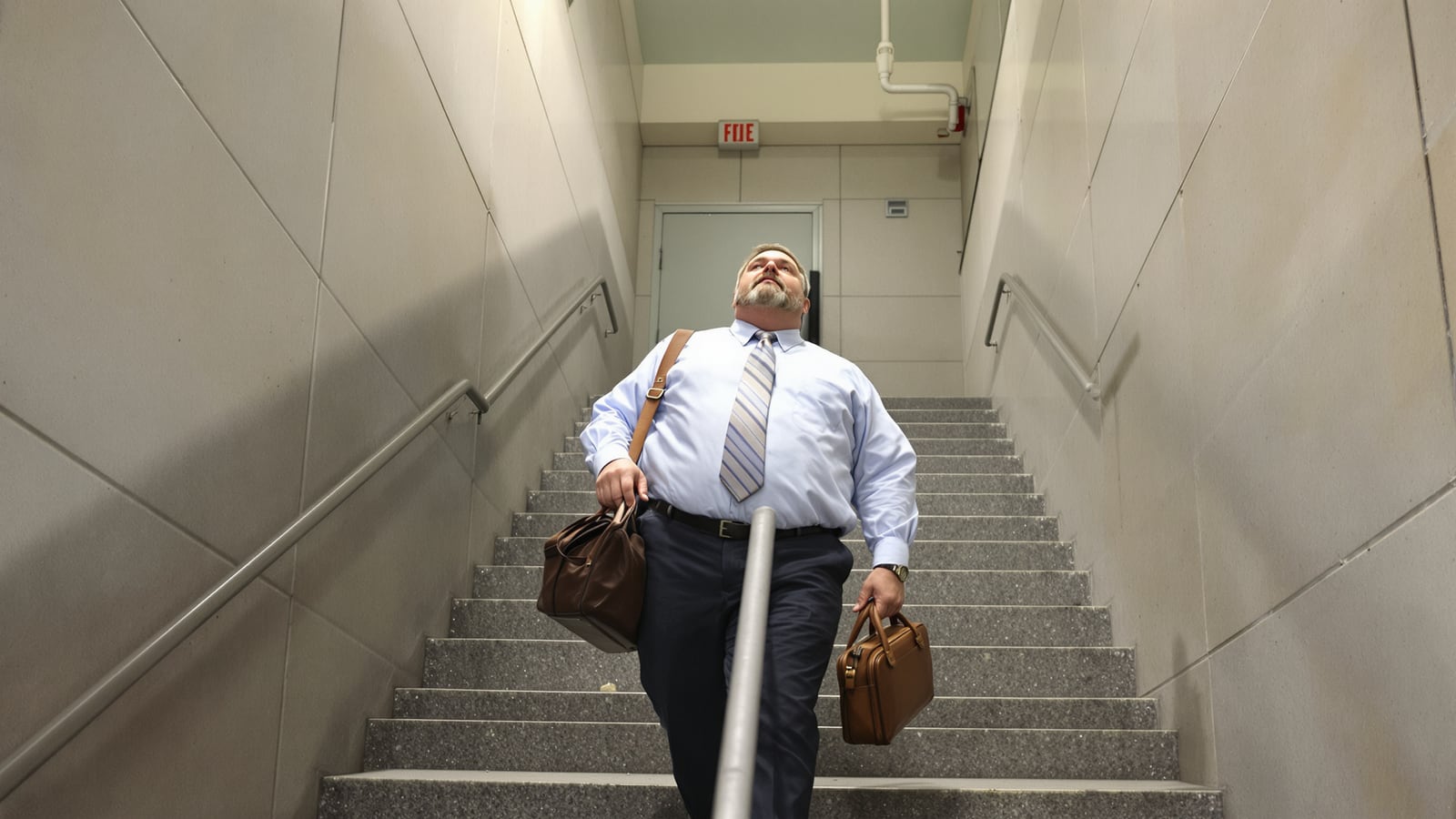
Quick answer: Breathlessness that's new, getting worse, or showing up during ordinary things like stairs, a short hill, or carrying groceries deserves an appointment within days or weeks, not a "wait and see" year. Breathlessness that comes on suddenly, or arrives with chest pressure, fainting, or a blue tint to the lips, needs medical help right away.
The slow drift is the dangerous kind
Nobody ignores a sudden choking spell. What gets ignored is the slow one.
You start taking the stairs a little slower. You park closer. You stop mid-staircase to "check your phone." You tell yourself you're forty-eight, you sit at a desk, and you haven't touched a barbell since the Obama administration. Maybe that's even true.
But the body adapts quietly. You shrink your life to fit the symptom and never notice you did it. Six months later you're avoiding the second-floor meeting room and calling it a preference.
So stop measuring against the gym. Measure against last year. What used to be easy that now isn't? Write down two or three of them: the flight of stairs at work, the walk from the far end of the parking lot, mowing the back half of the yard without a break. That list is your baseline, and it's what your doctor will want.
Heart or lungs: why it's one conversation
Breathing is a team sport. The lungs bring oxygen in, the heart moves it around, and the blood carries it. A problem in any of the three can show up as the same feeling: you can't get enough air for what you're doing.
On the heart side, the usual suspects include narrowed arteries, a weakened heart muscle that isn't pumping as well as it should, a leaky or stiff valve, and a rhythm problem. On the lung side, think asthma, COPD, scarring of the lung tissue, or an infection that never fully cleared. And then there's the less dramatic stuff: low iron or other anemia, an overactive or underactive thyroid, extra body weight, and plain old deconditioning.
You can't sort these out by feel. That's the whole point. The same symptom can be a three-month walking program or a heart valve, and only testing tells you which. Guessing is the one option that's always wrong.
Signs it's not just "out of shape"
Some details change how quickly you should be seen. Tell your doctor if you have any of these:
- Breathlessness that's worse than it was a month or two ago
- Swelling in your ankles or lower legs, or shoes that suddenly fit tight
- Needing extra pillows to sleep, or waking up gasping
- A cough that won't quit, especially with wheezing
- A racing, skipping, or pounding heartbeat
- Lightheadedness or near-fainting on exertion
- Weight gain of several pounds over a few days with no change in eating
- Pressure or tightness in the chest when you exert yourself and eases when you stop
And a note for the women reading. Heart trouble in women often shows up as breathlessness and unusual tiredness more than the movie-version chest clutch. If you're in your forties or fifties and "just can't keep up the way I used to," that's worth saying out loud at your next visit. What Actually Changes for Women in Their Forties and Fifties covers the bigger picture.
When it's not an appointment, it's an emergency
Some breathlessness doesn't wait for a calendar slot. Get medical help right away, and don't drive yourself, if the shortness of breath:
- Comes on suddenly and hard
- Arrives with chest pain, pressure, or pain spreading to the arm, jaw, or back
- Comes with fainting, confusion, or a bluish color in the lips or fingertips
- Follows a long trip or surgery and comes with swelling or pain in one leg, especially the calf
- Comes with coughing up blood
Don't wait to see if it passes. Don't "sleep on it." If you're alone, get someone to you and get to an emergency room. For more on how a cardiac event actually presents, read What a Heart Attack Actually Feels Like.
What to bring to the appointment
Doctors have about fifteen minutes. Spend them well.
Walk in with specifics. "I get winded" gives a doctor very little. "Two flights of stairs at work used to be nothing, and now I stop at the landing, and it's been getting worse since spring" gives a doctor a place to start.
Bring:
- Your baseline list: what's harder than last year, and roughly when it started
- Every medication and supplement you take, with doses
- Your smoking or vaping history, honestly, including when you quit
- Whether it's worse lying flat, in cold air, or after eating
- Whether anyone in your family had heart or lung disease young
- Anything your spouse has noticed. Spouses catch this stuff first, and usually they've been saying it for months
If you smoke, say so plainly. Nobody in that room is there to lecture you, and the information changes what gets looked at. When you're ready to deal with it, What Actually Works When You Quit Tobacco is a practical place to start.
What the workup usually looks like
Every case is different, and your doctor decides what fits yours. But you can expect some version of the following.
First, the basics: a conversation, a physical exam, listening to your heart and lungs, checking blood pressure and the oxygen level in your blood. Then, depending on what they hear, some combination of an ECG (a quick, painless tracing of your heart's rhythm), a chest X-ray, and blood work. Blood work may check for anemia, thyroid problems, or markers of heart strain. A breathing test called spirometry measures how much air you move and how fast. If a heart cause looks possible, an echocardiogram, which is an ultrasound of the heart, is a common next step.
None of this is exotic. Most of it happens in a single office or a nearby lab.
Two ways people get this wrong
They self-diagnose with a gadget. A fingertip pulse oximeter or a smartwatch reading can be thrown off by cold hands, nail polish, or a loose fit. A normal number doesn't mean you're fine, and an odd number doesn't mean you're in trouble. Tell your doctor what the device said, but don't let it make the decision.
They treat it as a character flaw. Some guys hear "winded on the stairs" and hear "soft." Some wives hear it and say nothing so he won't be embarrassed. Both are wrong. A man who gets checked at forty-eight and finds a fixable problem hasn't failed at anything. A man who skips it to look tough and leaves his family holding the bill is the one who's gone soft.
Serving your family means being around for them. That's the job, and a doctor's visit is part of it.
The honest odds
Plenty of these visits end with "you're deconditioned, here's a walking plan." That's a good outcome. It means you got an answer and a place to start, and you can build back up the old-fashioned way: a little further each week, until the stairs go back to being stairs.
But you only get that answer by asking. Book the appointment this week. If your blood pressure or cholesterol numbers are overdue too, ask for those at the same visit and save yourself a trip. And if you're not sure what your plan will cost you, The Four Numbers That Decide What Your Health Plan Costs will help you walk in prepared.
Then take the stairs on the way out. Slowly, if you have to. Just make a note of how they felt.
Cal Brennan
Fitness
Strength coach. Trains fathers, tradesmen and desk workers, which means programs that survive a bad week.

Watch
Worth an hour of your evening
More from Health.
From channels we rate. Plays on YouTube.
Read next