

A Broke Missouri Trader Opened the Road to Santa Fe
In 1821 William Becknell was in debt and heading west for mules. He found an open door, and merchants did the rest long before any railroad.
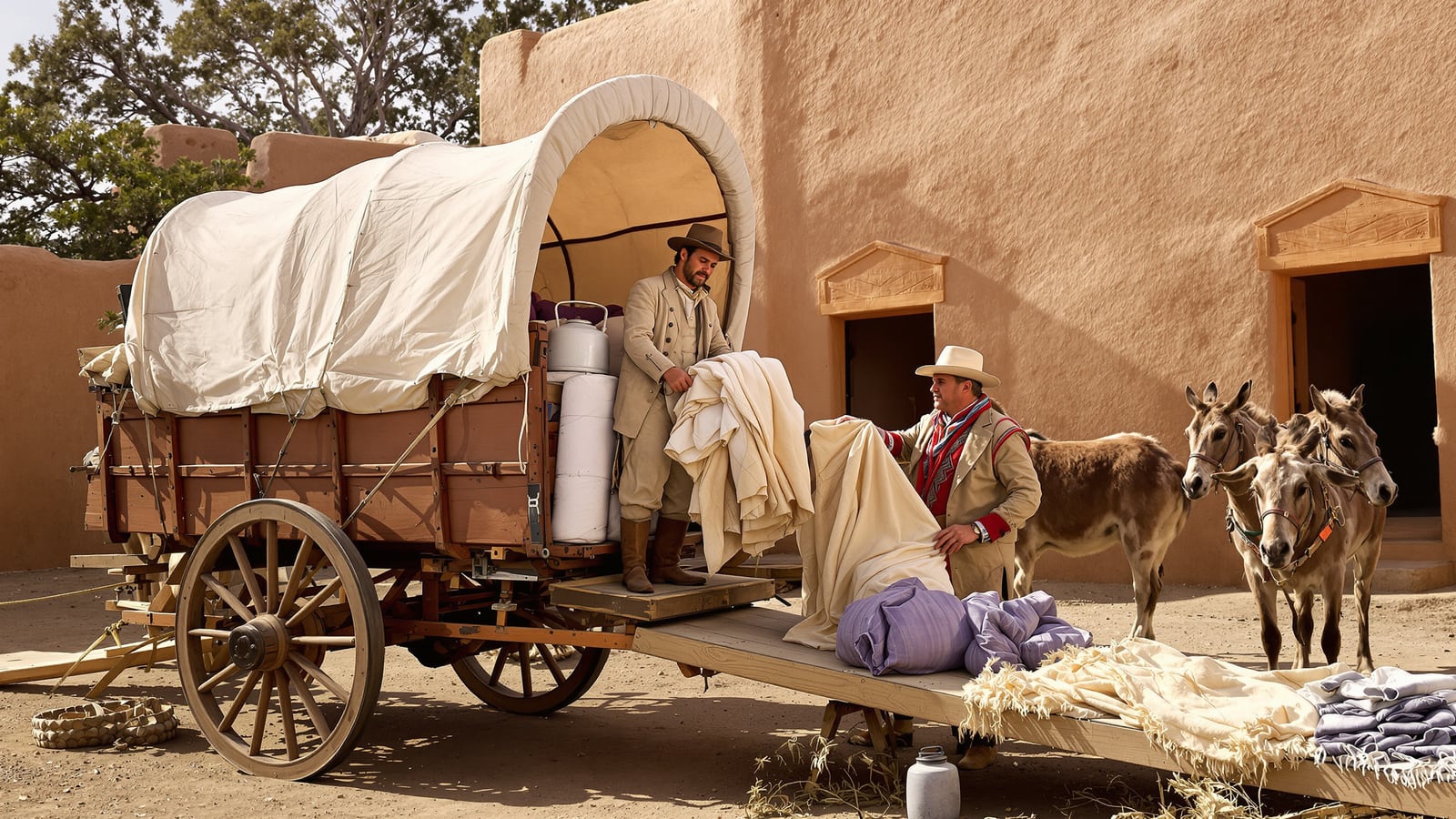
William Becknell was in debt in the summer of 1821, and a man who owes money will try things a comfortable man won't. He lived in Franklin, Missouri, on the edge of the settled country. He put a notice in the local paper looking for men to ride west with him and trade for horses and mules. He had no map to Santa Fe. He wasn't even sure he'd be allowed in.
He had good reason to doubt it. Under Spanish rule, Americans who showed up in New Mexico with goods to sell got arrested. Some of the earlier ones sat in prison for years.
The door nobody had told him about
Becknell's little party left in September and worked its way across the plains toward the mountains. Somewhere in the high country they met a patrol of Mexican soldiers. The news they carried changed everything. Mexico had won its independence from Spain, and the new authorities wanted trade.
Becknell reached Santa Fe in mid-November. The people there had gone years with almost no access to manufactured goods from the east, and his cloth and hardware sold at a handsome profit. He rode home to Missouri a solvent man. He had found out that a road was open, and he'd found it out before anybody else had.
The lesson Becknell took was simple. Don't wait for permission that has already been granted.
Wagons across the dry stretch
His first trip used pack animals. In 1822 he went back with three wagons and about twenty men, and that trip made him the man later remembered as the father of the Santa Fe Trail.
He also tried a shortcut. The Cimarron Cutoff sliced days off the journey by cutting straight across a dry stretch of country between the Arkansas River and the Cimarron. The cost was water. By the accounts that survive, the party got so thirsty that men were reduced to drinking the blood of animals before they found a stream.
They made it, and others followed. The longer Mountain Branch swung north through Raton Pass, with better water and worse grades. Traders picked their poison. The whole trail ran roughly 900 miles, and a loaded caravan took about two months to cover it.
A republic on wheels
Nobody in Washington was running these caravans. The traders ran themselves.
Josiah Gregg, the trader who wrote the classic account, Commerce of the Prairies (1844), described how it worked. Wagons gathered at Council Grove, in what's now Kansas, the last good stand of timber before the open plains. The men there drew up rules and elected a captain. They divided the train into companies and set up the guard duty. Every man took his turn on watch, whether he owned forty wagons or drove one for wages.
It's a small thing, and it's easy to miss. A few hundred armed men with money riding on the outcome set up a government in an afternoon, and it held for 900 miles. They did it because the alternative was a stampede in the dark, and everybody knew it.
Gregg is worth knowing for another reason. He first went west in 1831 because doctors thought the outdoors might fix his bad health. He spent about nine years crossing and recrossing the plains, and he came back with a book still read today.
Washington arrives late, and that's fair to say
The government did help, and it'd be dishonest to leave that out. Senator Thomas Hart Benton of Missouri pushed Congress to pay for a survey of the road. It was marked in the mid-1820s, and the commissioners negotiated safe-passage agreements with the Osage and the Kansa. In 1829 the Army sent its first escort, under Major Bennet Riley, to protect caravans after attacks on the trail.
But the order of events matters. The merchants went first, with their own money and their own necks. The road was already worn into the grass before Congress paid for a surveyor. Government came to protect something private men had built.
Bent's Fort and the cost of the trail
In the early 1830s, Charles and William Bent and Ceran St. Vrain built a massive adobe trading post on the Arkansas River, in what's now southeastern Colorado. Bent's Fort became the great stopping place on the Mountain Branch, a place to rest, repair a wagon and trade with the Plains tribes who came there. Charles Bent knew both the Americans and the people of New Mexico, and he married into a prominent New Mexican family.
The trail took lives, and it took good ones. In May 1831, Jedediah Smith, one of the most accomplished explorers of the age, rode ahead of a Santa Fe caravan on the Cimarron route to look for water. He was thirty-two. Comanche warriors killed him near a dry riverbed, and his companions never found his body.
The hard part
The trail ran through country that belonged to others. Osage, Kansa, Pawnee, Comanche and Kiowa homelands all lay across the path, and the wagons kept coming. Some tribes traded with the caravans and some raided them. Both sides had reasons, and both sides buried people. The traffic also put hundreds of wagons a season across hunting grounds the tribes depended on.
New Mexico had its own grievances. Governor Manuel Armijo taxed the trade by the wagon, and traders haggled, complained and loaded each wagon heavier. Many New Mexicans had cause to wonder what the growing American presence meant for them.
They were right to wonder. In August 1846, with war underway between the United States and Mexico, General Stephen Kearny marched his army down the trail and took Santa Fe without firing a shot. That same year, eighteen-year-old Susan Magoffin rode the trail as a new bride and kept a diary of it, one of the sharpest eyewitness records we have. She's one of the pioneer women who wrote it all down.
Kearny named Charles Bent the first American governor of New Mexico. In January 1847, during an uprising in Taos, Bent was killed in his own home. His wife and children survived. The man who'd helped open the road was one of the first to pay for what came after.
The rails finish it
The wagons held on for nearly sixty years. Then the Atchison, Topeka and Santa Fe Railway pushed west, and each new mile of track took a mile off the trail. By February 1880 the line reached Santa Fe itself. A trip that took two months could now be done in days, and the freighters were out of business.
It's a pattern worth noticing. The railroad needed something to carry, and the merchants had already built that market. The same goes for the men who built your ordinary Tuesday: somebody always goes first with nothing but nerve and a bad map.
Becknell went broke, got lucky, and went anyway. The wagons are gone now. In places across Kansas, you can still stand in the ruts they left.
Marcus Vale
Editor-in-Chief
Twenty years in magazines, most of it deciding what to cut. Writes about work, discipline and the decisions that compound.

Watch
Worth an hour of your evening
More from History.
From channels we rate. Plays on YouTube.
Read next