The Pioneer Women Who Wrote It All Down
Cholera, a sod roof that leaked for three days, a birth at the end of the trail, and a hotel built on a ten-dollar biscuit. Their own record, in their own hands.
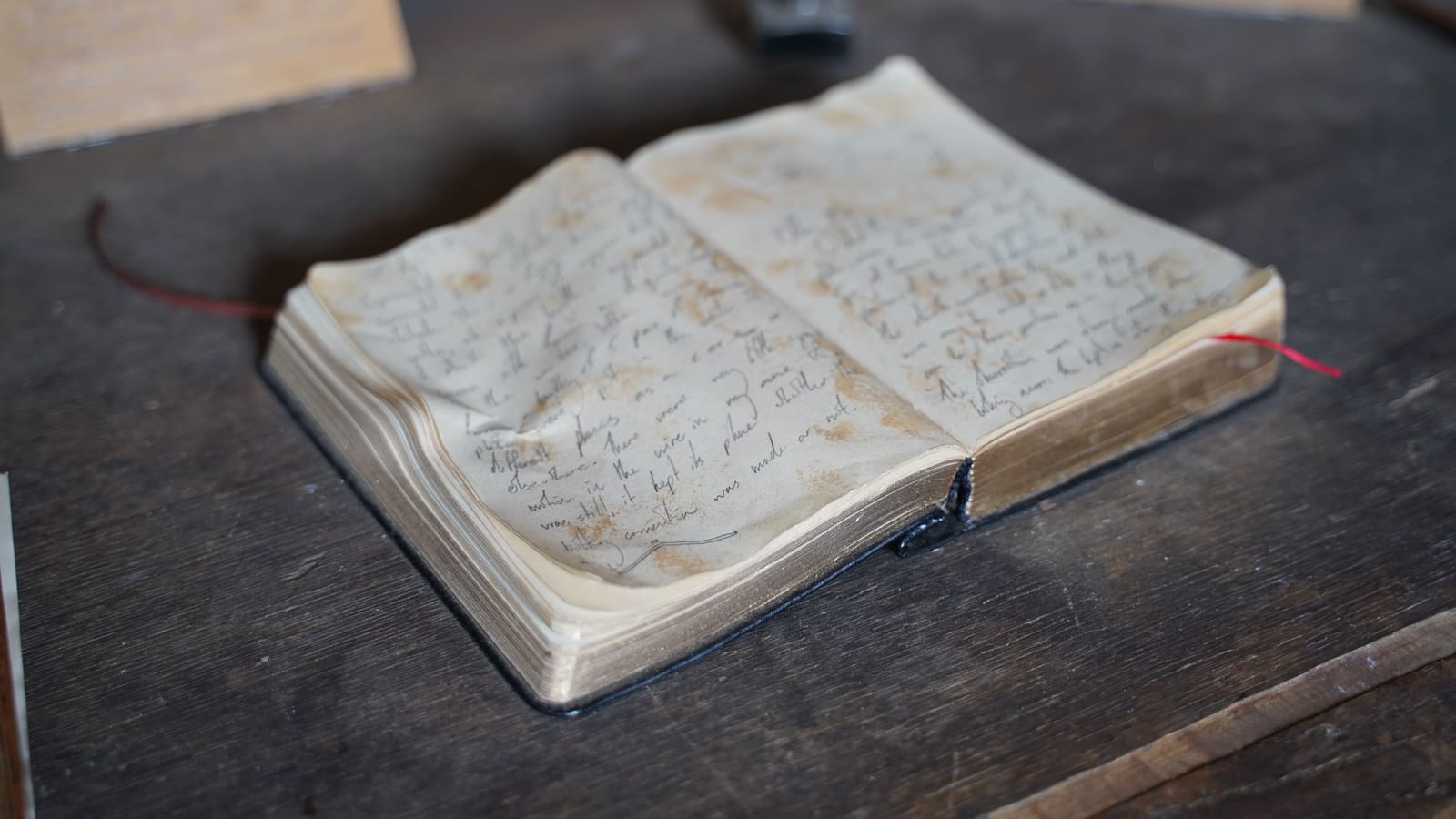
On April 9, 1853, a farm wife named Amelia Stewart Knight pulled out of Monroe County, Iowa, with her husband Joel, seven children, and what a wagon could carry. She was pregnant. She kept a diary in pencil, and it's one of the plainest documents in American life.
She writes about rain. She writes about mud to the hubs, about cattle straying in the night, about a child sick with fever, about washing clothes at a river crossing after a full day of walking. She rarely complains in so many words. She just records, the way a woman records a ledger she expects somebody to check.
The diary runs about five months and ends in Oregon. The final entry mentions, almost in passing, that her eighth child was born, and that the family then moved on and took a house. No exclamation point. No paragraph about what it took. She had walked and ridden roughly two thousand miles while carrying that child, and she gave it two lines.
That's the frontier record. Not statues. Notebooks.
What the road actually cost
The overland trails ran about two thousand miles from the Missouri River jumping-off towns to the Willamette Valley or the Sacramento. Four to six months, if things went well. You left in April so the grass was up for the oxen, and you had to clear the Sierra or the Blue Mountains before the snow closed them.
Indians weren't the main danger, whatever the movies taught you. Disease was. Cholera swept the trail hardest in the years around 1849 to 1852, and it killed fast, sometimes inside a day. Accidents took a steady share too: children under wagon wheels, drownings at river crossings, guns discharging in camp. Historians' best estimate of the toll on the Oregon and California trails runs around one in ten of the people who set out.
Here's the part the diaries make clear and the paintings don't. A woman's work didn't pause for the journey. It got harder. Cooking happened over buffalo chips when timber ran out, in wind, on a fire that had to be coaxed twice a day. Laundry happened at river camps, kneeling, with lye soap and cold water, after a day of walking beside the wagon because riding in it beat you to pieces.
And when a husband went down with fever, the wife drove the team. Plenty did.
The ten-dollar biscuit
Luzena Stanley Wilson came overland to California in 1849 with her husband and two small boys. She told her story decades later to her daughter, and memoirs written from memory always shine a few facts. Read it with that in mind. Read it anyway.
Her account of arriving in Sacramento is famous. She was cooking over an open fire when a miner stopped and asked to buy the biscuits she was making. He offered five dollars. She hesitated, thinking about her hungry family, and he doubled it. She took the ten.
That's the moment she figured out where the money actually was. Wilson went on to run boarding houses and hotels, first in Nevada City, then in Vacaville, feeding men who had come to dig and had no idea how to keep themselves alive. She fed two hundred men at a time at long plank tables. Fire wiped her out at least once. She started over.
The gold rush is remembered as a story about men and rocks. A good part of it was a story about women who sold them dinner and kept the receipts.
Two feet of dirt over your head
Past the hundredth meridian, on the Kansas and Nebraska plains, there weren't trees to build with. So you built out of the ground.
A sod house meant cutting the prairie into strips with a breaking plow, stacking the blocks like brick, walls close to two feet thick. It was warm in January and cool in July, and it cost almost nothing but labor. That's the good part.
The bad part is in every account that survives. The roof leaked, and it kept leaking for two or three days after the rain had stopped outside, because the sod held the water and let it down slowly. Women cooked under an open umbrella. They stretched muslin across the ceiling to catch the dirt that sifted down, and they took it outside and shook it. Snakes came through the walls. So did mice.
A woman who had kept a painted parlor in Ohio was now sweeping a dirt floor and calling it home, and the nearest neighbor was four miles off. The loneliness broke some of them. That's in the record too, and pretending otherwise insults the ones who held.
Tamsen Donner stayed
The Donner Party is the frontier's worst night, and everybody knows the cannibalism and almost nobody knows Tamsen Donner.
She was forty-five, a schoolteacher, well read, a collector of plant specimens who had packed books and watercolors because she meant to open a school for girls in California. When the relief parties finally reached the camps in the spring of 1847, she was offered a way out.
Her husband George was dying at the Alder Creek camp with an infected arm. Tamsen sent her three young daughters out with the rescuers, into the arms of strangers, over the pass. Then she went back to her husband and stayed with him until he died.
She never came out. Her body was never recovered.
You can argue she chose wrong. Her girls lived, all three. What she did was look at a situation with no good options and decide which promise she was going to keep.
The honest ledger
Not every frontier story ends in vindication, and BRO doesn't do sanded-down history.
Narcissa Whitman crossed the Rockies in 1836 with Eliza Hart Spalding, the two of them among the first white women to make the overland trip, and settled at Waiilatpu in what's now Washington to run a mission among the Cayuse. Her only child, Alice Clarissa, drowned in the river beside the mission at age two. The mission converted almost nobody.
Then, in 1847, measles came west with the emigrant wagons. The Cayuse had no immunity and it tore through their children. Marcus Whitman was the doctor. His white patients tended to recover and theirs died, and under Cayuse practice a healer who lost patients could be held to account for it. In November the Whitmans and eleven others were killed, and the war that followed changed the Northwest.
Narcissa's letters east are worth reading because she doesn't perform. She writes about wanting a woman to talk to. She writes about missing her mother. She had courage and she had blind spots, and the story cost people on both sides of it dearly. Both halves belong in the same paragraph.
A quarter section in her own name
The Homestead Act of 1862 handed 160 acres to anybody who'd live on it five years and improve it, for something like eighteen dollars in fees. Single women, widows and women heading their own households qualified on the same terms as men. Go through the land office ledgers of Colorado, Wyoming or the Dakotas and you'll find their names.
Elinore Pruitt Stewart was one. A widow with a small daughter, she went out to Burntfork, Wyoming, in 1909 as a housekeeper for a rancher named Clyde Stewart, filed on a claim of her own, and married him a few weeks later. Her letters ran in the Atlantic Monthly and became a book in 1914, and she made a case for homesteading that still reads like a challenge: any woman who can stand her own company, who loves growing things, and who'll give the land the hours she gives the washtub will end up with a home of her own.
The honest footnote, which she later admitted herself, is that her claim adjoined her husband's and the proving up was a family effort. Fair enough. Most of it was. The frontier was a two-person job, and the second person usually got the smaller share of the credit and the larger share of the laundry.
Their names are in county courthouses, diaries in university archives, headstones in Wyoming grass. Go read Amelia Knight's diary. It's four dollars and about an hour, and it'll spoil you for the movie version forever.
Nina Castellan
BRO for Her
Runs the women-facing desk. Same standard, same tools, written for a different reader — not a softer one.

Watch
Worth an hour of your evening
More from History.
From channels we rate. Plays on YouTube.
Read next