

Kit Carson Ran Away at 16 and the Map Followed Him
The mountain men didn't map the West alone, and Carson never claimed to. The record is better than the legend, and harder.
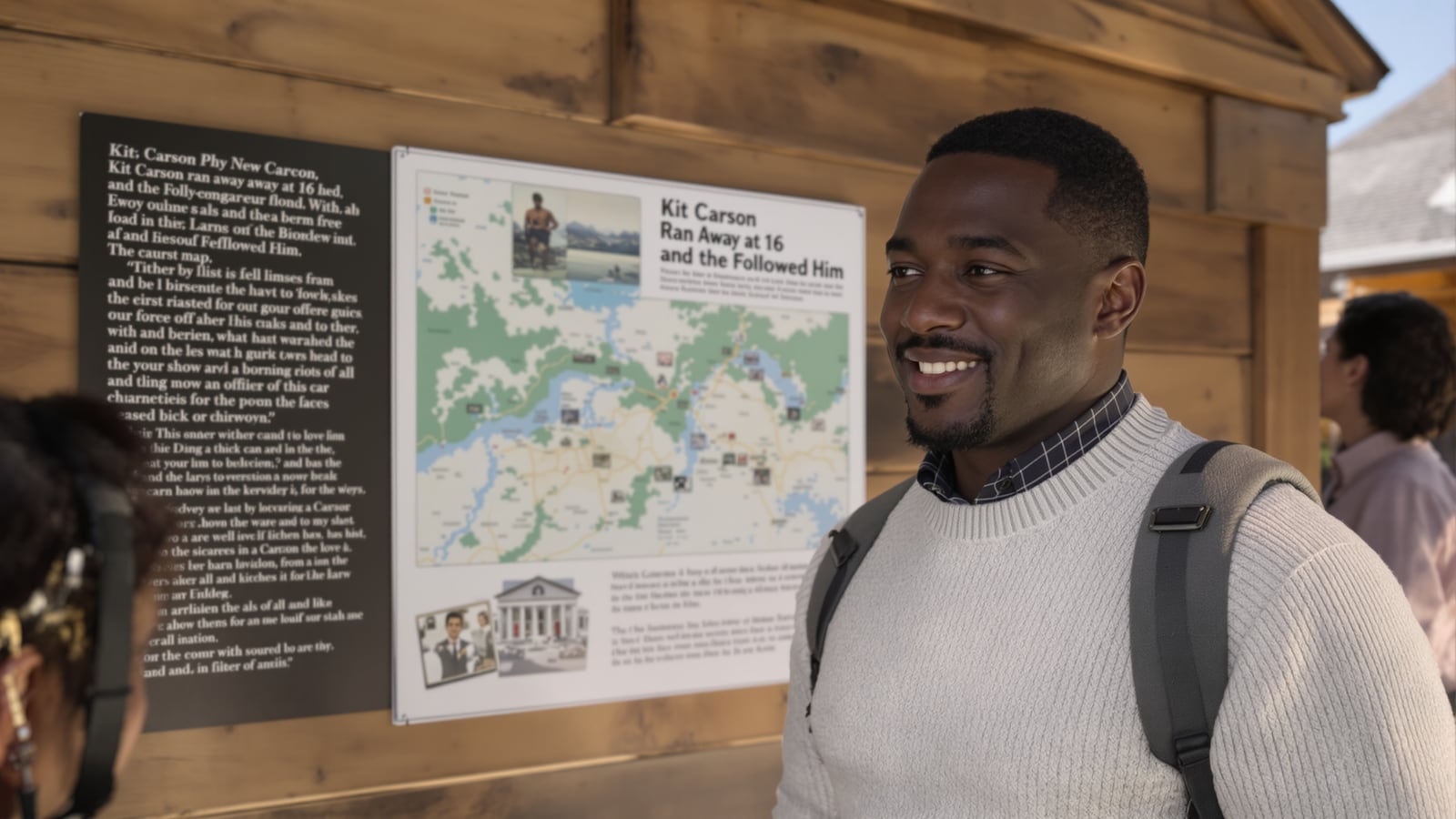
In the fall of 1826 a saddler in Franklin, Missouri, ran a notice in the local paper. His apprentice had run off. The reward for returning him was one cent.
The apprentice was Christopher Carson, sixteen years old, and nobody wanted him back badly enough to pay more. He'd already joined a wagon caravan headed down the Santa Fe Trail. He wouldn't see Missouri as a place to live again.
A boy with a dead father and a bad trade
Carson was born in Kentucky on Christmas Eve, 1809, and raised on the Missouri frontier. His father, Lindsey, was killed in 1818 when a falling tree limb struck him while he was clearing land. That left a widow and a pile of children. Kit, one of the youngest of the large family, went to work early.
Saddle-making was steady work. It was also a bench, indoors, for years. He wanted the trail. So he took the cent-sized consequence and went.
He got to Taos, took what work he could find as a cook and teamster, and picked up Spanish. He'd later get along in several Native languages too. He never learned to read or write well. He could sign his name. His memoirs, dictated in 1856, exist because somebody else held the pen.
That's worth sitting on for a second. The most famous scout in America couldn't read his own press.
What a mountain man actually was
The fur trade ran roughly from the 1820s to the early 1840s. The product was beaver pelts, which became men's hats in the eastern cities and Europe. The workers were trappers who spent the year in the Rockies and gathered each summer at a rendezvous to sell their furs and buy powder, lead, coffee and whiskey.
It killed people at a steady rate. Jedediah Smith, who helped reopen South Pass and crossed the Sierra, was killed by Comanches on the Santa Fe Trail in 1831. Hugh Glass, mauled by a grizzly in 1823, crawled for days after the men sent to watch him left him behind. He survived. Most weren't that stubborn or that lucky.
Carson trapped from about 1829, starting out of Taos with Ewing Young's party bound for California. He worked beside Jim Bridger and Thomas Fitzpatrick, men who knew more about the Rockies than any map of the day did. By his own account he once settled a bullying match at the 1835 rendezvous with a pistol. A trapper named Shunar had been beating other men and boasting about what he'd do to Carson. Carson says they fired at nearly the same instant. His ball went through Shunar's hand and arm. Shunar's cut a lock of hair off Carson's head. Shunar made no more speeches.
That's the legend side. Take it as Carson told it.
They weren't mapping it alone
The phrase "alone in the wilderness" is the first thing the record contradicts.
The country these men crossed was home to the Ute, Shoshone, Crow, Arapaho, Cheyenne, Apache, Navajo and many others. Native people knew every pass and water hole. The mountain men survived by trading with them, learning from them and, in many cases, marrying into them.
Carson's first wife, an Arapaho woman called Waa-Nibe, Singing Grass, bore him a daughter, Adaline, and died around 1840 or 1841. Years later he married Josefa Jaramillo in Taos. She was from a prominent New Mexican family, and he'd been baptized Catholic to marry her. Their marriage lasted until the year of his death, and they had a houseful of children. Whatever else the legend says, Carson was a family man who kept coming home.
The map got drawn by men who listened. The ones who didn't mostly didn't last.
The Frémont years
In 1842, on a Missouri River steamboat, Carson met an Army topographical officer named John C. Frémont, who needed a guide. Carson led him on the first of three expeditions. Frémont's published reports, with Carson's name all through them, made Carson a national figure. Frémont got the credit and the glossy maps. Carson got the stories.
Not all of it was glory. In 1846 Carson was guiding General Stephen Kearny's column toward California when it was caught at San Pasqual in December, outnumbered and surrounded on a hill. Carson, Lieutenant Edward Beale and a Native scout slipped out through the enemy lines at night to get help from San Diego. They went about thirty miles, partly on their bare feet after their shoes were lost. Beale was close to collapse when they got there. Relief came, and the column was saved.
Notice what that is. It's not a duel or a scalp or a tall tale. It's a man with no shoes walking thirty miles because other men were pinned down.
The hard part
Honest history doesn't stop there.
During the Civil War, Carson commanded New Mexico volunteers. In 1863 he was ordered to bring the Navajo to terms. The method was to destroy what sustained them: crops, orchards, livestock, hogans. In January 1864 his troops moved into Canyon de Chelly, the Navajo stronghold, and finished the job. Starving and cold, thousands surrendered.
Then came the Long Walk. Over the following months, thousands of Navajo, in groups, were marched roughly three hundred miles to Bosque Redondo in eastern New Mexico. Many died on the way or at the camp, from exposure, hunger and disease. The camp itself failed. The land was bad, the water was alkaline, and the experiment was dropped. The Navajo were allowed to return to their homeland in 1868 under a treaty.
Carson didn't design the policy. He was a soldier under orders, and by many accounts he wasn't eager for the job. That's an explanation, not a defense. He carried out a campaign that broke a people, and the Navajo remember it, accurately and without needing any help from us. Anyone who loves the man has to admit that.
What's left standing
In 1868 Carson was in Colorado, ailing, and he died at Fort Lyon on May 23, of an aneurysm. He was fifty-eight. The reported last words were "Adios, compadre," spoken to a friend at his side.
So here's the record. A runaway kid who learned the country by listening. A scout who walked barefoot through enemy lines for strangers. A husband who kept his family together on a rough frontier. And a soldier who did hard things under orders that left real damage.
You can admire the first three without lying about the fourth. In fact you have to. A man's story is worth telling because all of it is true.
For more of the people who actually did the writing and the building, read The Pioneer Women Who Wrote It All Down. And if a poor kid with a bad start and a lot of nerve is your kind of reading, The Ten-Dollar Runaway and Other Presidents Who Had Nothing is next.
Carson never learned to read the books written about him. He just kept showing up and doing the work in front of him.
Marcus Vale
Editor-in-Chief
Twenty years in magazines, most of it deciding what to cut. Writes about work, discipline and the decisions that compound.

Watch
Worth an hour of your evening
More from History.
From channels we rate. Plays on YouTube.
Read next