

How to Prepay Your Funeral So Your Family Isn't Left the Bill
Write down your wishes, price three funeral homes, pay through a protected account, and put the paperwork where your family can find it in the first hour.
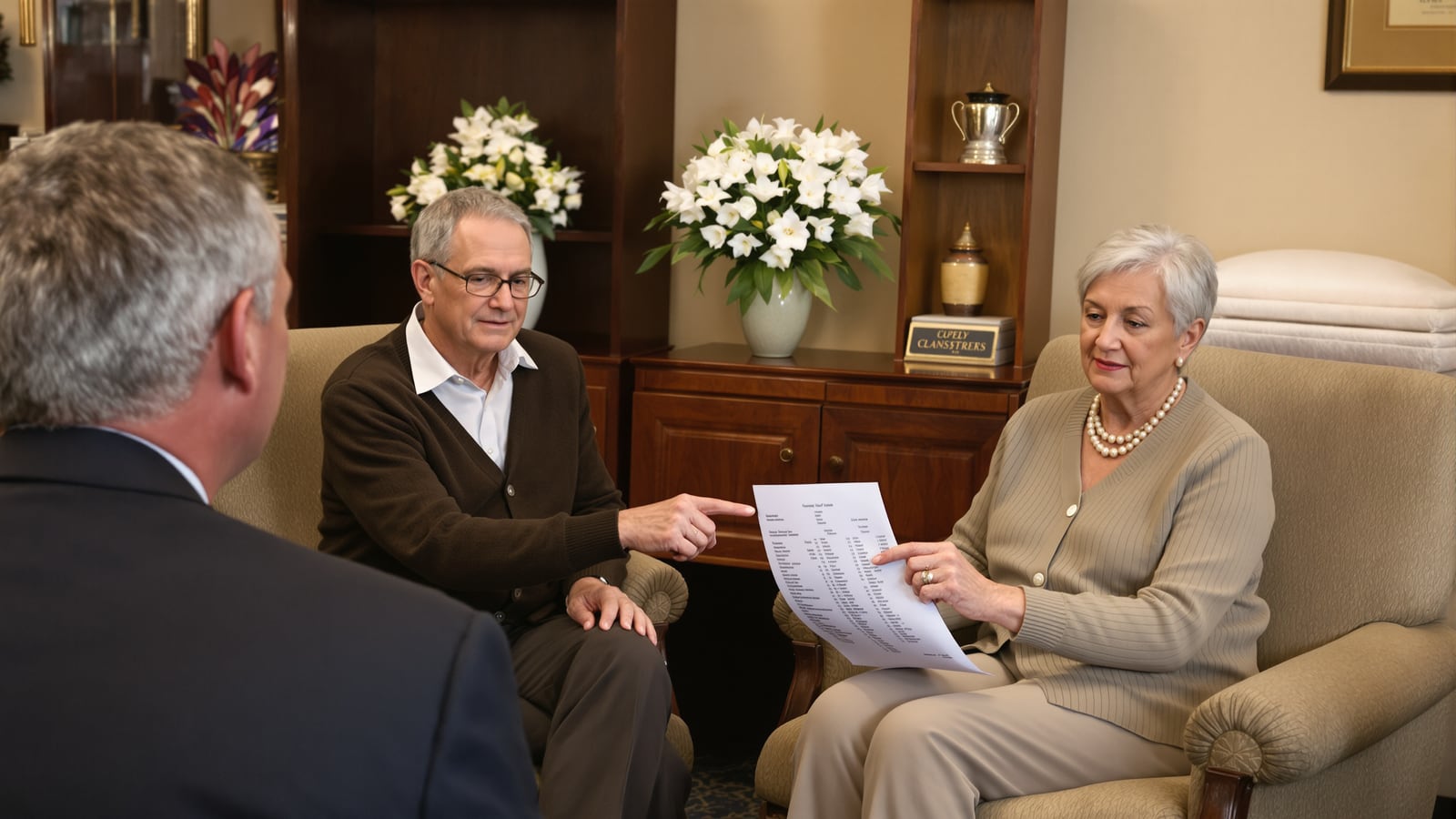
You create a funeral plan in four moves. Write down what you want. Price it at three funeral homes using the price list federal law makes them hand over. Pay for it in a way that's protected under your state's rules. Then put the paperwork where your family can lay hands on it within an hour of your death. Do those four and nobody has to make forty decisions in three days while grieving, and nobody has to put it on a credit card.
The cost is real. The National Funeral Directors Association's recent surveys put the median burial with a viewing at roughly $8,000 and cremation with a viewing at roughly $6,000. The cemetery plot, headstone and several other charges usually come on top. That's a bill most families pay inside a week.
Step 1: Decide what you want, and write it down
Start with the big fork. Burial or cremation. Then the service: a viewing, a graveside service, a church service, a gathering at the house, or something small.
Write down the specifics. Where you want to be buried or where the ashes go. Who you'd like to speak or officiate. Any music. Whether you'd rather have flowers or donations to a cause you care about. Whether you want an open casket.
Say it to your spouse and your grown kids out loud, too. A page they've never heard about is a page nobody thinks to look for.
If you served, add one line: "I'm a veteran, and I want military honors." More on that in Step 3.
Step 2: Get the price list from three funeral homes
The FTC's Funeral Rule (16 CFR Part 453) is your best tool here. Every funeral home must give you an itemized General Price List when you start talking about arrangements in person. They must also quote prices over the phone if you ask. You don't need to explain why or visit first.
Call three. Ask for the General Price List and write down these numbers:
- The basic services fee. It's the one charge you can't decline, and it covers overhead, the paperwork and the staff's time.
- The cost of direct cremation or immediate burial, which are the stripped-down options.
- Casket prices, if you're choosing burial. They're on a separate list.
Know your rights before you walk in. A funeral home can't require embalming for a simple cremation or an immediate burial. It can't refuse a casket you bought elsewhere or charge you a fee for using one. It can't make you buy a package when you only want a few items.
Prices swing a lot between homes in the same town. The Funeral Consumers Alliance (funerals.org) is a nonprofit that publishes price surveys and has local affiliates in many areas. Check it before you pick.
Step 3: Handle the cemetery and veterans benefits separately
The cemetery isn't covered by the Funeral Rule, and it has its own bill. Expect a charge for the plot, another for opening and closing the grave, and often one for an outer burial container or vault. That vault is usually a cemetery requirement, not a law. Ask for the cemetery's price sheet in writing.
If you or your spouse served, check this before spending a dollar. VA national cemeteries provide the grave, the headstone or marker, and a burial flag at no cost to an eligible veteran, and a spouse can often be buried alongside. You can apply ahead of time with VA Form 40-10007, the Application for Pre-Need Determination of Eligibility. Attach a copy of the DD-214 discharge paper. If you can't find yours, request it through the National Archives before you need it.
Military funeral honors, which means a flag folding and Taps, are available for eligible veterans. The funeral home normally coordinates it.
Step 4: Choose how you'll pay
You've got three main routes, and they aren't equal.
A payable-on-death bank account. You set aside the money, name a beneficiary, and keep full control. It's flexible, it's portable if you move, and it's easy to change. The downside is that nothing locks in today's prices, and a family member has to be willing to spend it on the funeral.
A preneed trust contract with a funeral home. You pay the funeral home, which puts the money in a trust. State law decides how much must be protected, and some states require all of it. You may lock in prices for the goods and services the home provides. It's the cleanest route if you're sure about the home.
Preneed or final-expense insurance. You pay in a lump sum or monthly. It's regulated by your state insurance department. Read the fine print. Some final-expense policies pay only back premiums if death comes in the first two years, and that's a limit worth finding before you sign.
Whichever you choose, ask these questions and get the answers on paper:
- Is it refundable if I change my mind or move?
- Is the price guaranteed, and for which items?
- What happens to my money if this funeral home closes or gets sold?
- Does it cover the charges the home pays to others, such as the obituary, flowers, clergy honorarium, and certified death certificates? Those often aren't price-locked.
Rules vary by state: how much must be held in trust, whether you can cancel and what you'd get back, and whether the home pays interest. Your state funeral board, attorney general's consumer office, or insurance department can tell you what yours requires.
If you're doing this for an aging parent who may need Medicaid for long-term care, talk to an elder law attorney first. In many states a properly structured irrevocable funeral contract is an exempt asset, but the details change from state to state, and a mistake can cost a lot.
Step 5: Read the contract and keep the copy
Before you sign, ask for the Statement of Goods and Services. It's the itemized list of what you're buying. Check it against the price list you collected. A figure that's higher than the quote is a reason to ask why, not to pay.
Skip the pressure. A funeral home that pushes a same-day decision is telling you something. So is a free "planning seminar" that ends with a sales pitch. If a stranger on the phone offers a deal on prepaid funerals, don't give them a card number. Ours on reporting a scam call or text and protecting your parents covers that pitch.
Step 6: Put it all in one folder and tell people where it is
Gather these into a single folder:
- Your written wishes
- The preneed contract or insurance policy
- Bank account details if you used a POD account
- The cemetery deed or plot paperwork
- VA Form 40-10007 and a copy of your DD-214
- The names and numbers of the funeral home, your pastor or officiant if you have one, and your lawyer
Then tell your spouse and at least one adult child exactly where the folder lives. A fireproof box at home works. A safe deposit box does not. It may be sealed or hard to open right after a death, and the bank may need paperwork your family doesn't have yet.
Keep your will in its own place. Your will is worth writing even on a budget, but it often isn't read until after the funeral. Never use it to carry funeral instructions.
Order your family up to a dozen certified death certificates when the time comes. You'll need them for banks, insurers and the title on the truck, and the price per copy runs about ten to twenty-five dollars in most states, set by the state or county.
The mistake that undoes all of it
People prepay, then tell nobody.
It happens constantly. Dad signs a contract in 2019. He dies in 2026. His kids pick another funeral home, pay again, and discover the first contract months later, if they ever do. Getting a refund from a preneed contract can be a fight, and it's a fight nobody wants during the worst week of their life.
Don't be the man who paid twice because he kept it to himself. Put the folder in someone's hands, and review it once a year. Check it after a move, a death in the family or a change in your finances.
Doing it now is the last thing you'll do for them, and it's one of the better ones.
Ray Okonkwo
Money & Business
Former commercial banker turned small-business owner. Covers salary, credit, margins and the arithmetic nobody does before signing.

Watch
Worth an hour of your evening
More from How To.
From channels we rate. Plays on YouTube.
Read next