

A fish story has a growth schedule, so keep to it
The bass was fourteen inches on the dock and nineteen by Thanksgiving. There's a right way to do that, and a way that gets you caught.
Quick answer: Grow the fish, never the facts. Add about an inch per telling, stop when the witness walks in, and let the one that got away do the heavy lifting.
The fish on the dock is the honest one
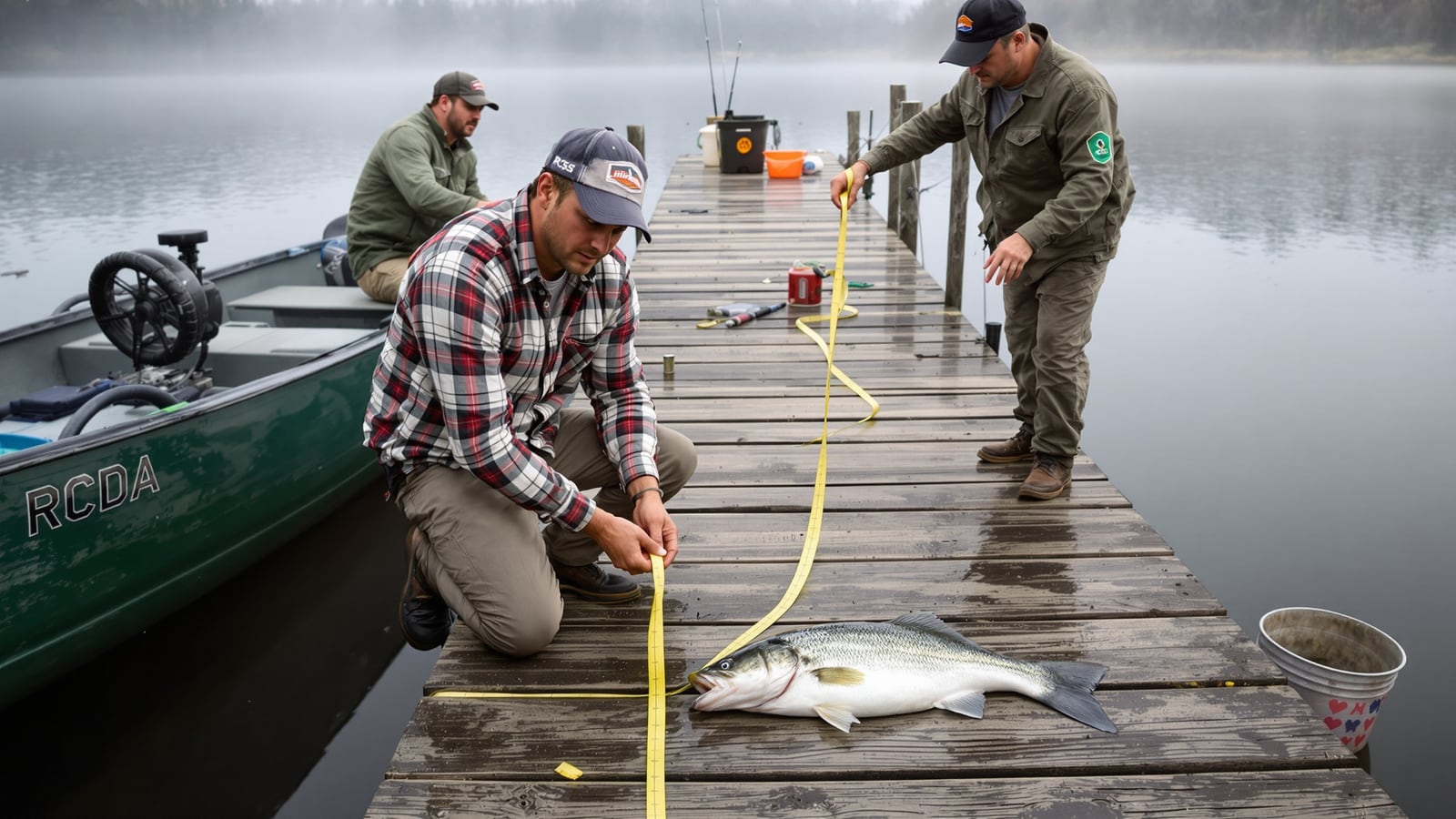
Say you pull a largemouth out of a farm pond on a Saturday morning. Fourteen inches. A good fish. You hold it up for your cousin, who's in the boat and holds the phone. He says, "Nice one." You say, "Yep, nice one." Fourteen inches, no notes.
That's the original. It's the only version that will ever be admissible in court.
By Saturday dinner, it's closer to sixteen. Nobody planned it. You're telling your wife about the morning, and fourteen sounds a little modest for the trouble you went through, so the number comes out of your mouth with a mind of its own. She nods. She's heard it before, from you, about other fish.
By Thanksgiving it's nineteen inches and it has a name.
This isn't dishonesty. It's erosion in reverse. Every telling sands off the boring parts (the forty minutes of nothing, the knot you tied wrong twice) and leaves the good parts a little bigger than they started. The fish doesn't get longer so much as the story gets heavier. And the story is the thing you're actually bringing home.
The schedule
Here's a rough timeline that most families seem to follow without ever being told:
- At the dock: Accurate within an inch. A tape measure may be involved. Someone else is holding the phone.
- That night: Add one or two inches. The fish now "fought." Previously it merely "was caught."
- The next family gathering: The fish gets a nickname. The weather gets worse than it was. The rod, which was a perfectly fine rod, is now "barely holding together."
- Year two: You're telling it to someone who wasn't there. This is where the fish really finds its stride.
- Year ten: Your grandkids can recite it. Nobody remembers the real number, and nobody wants to.
Pace matters. A fish that goes from fourteen to thirty in one weekend isn't a story. It's a confession. The listener can feel the ambition, and the whole thing collapses.
The witness rule
Every fishing story has a witness. Usually it's the guy who was in the boat with you, and he's the single biggest threat to your material.
You have two options.
Option one: Tell the story only when he's not at the table. This works fine for most of the year. It stops working at his own kid's birthday party, where he'll walk in halfway through your sentence, say "Fourteen inches" in a flat voice, and take a sip of his drink.
Option two: Recruit him. This is the better move. Before the next gathering, call him up and say, "When the story comes up, you remember it bigger than I do." Now he's a co-author. His number will be higher than yours, which makes yours sound restrained, which makes you look like the reliable narrator. It's the most elegant play in the sport.
Return the favor, naturally. A man who lets his buddy's fish grow has earned a little growth of his own. It's the old rule of leaving things better than you found them, applied to a largemouth.
Where it stops being funny
There's a line, and it's easier to find than you'd think.
Grow the size. Don't grow the facts. If you caught it on a Tuesday, it was a Tuesday. If you were using a spinnerbait, you were using a spinnerbait. The audience will forgive a bigger fish. They won't forgive being told you were somewhere you weren't, or that your brother-in-law was there when he was at work. A story that bends its own timeline gets caught, and then the fish is dead for good.
Don't use it on strangers who might believe you. A kid asking how big the fish was deserves a straight answer, or at least a wink. A fishing story is a game that everyone at the table knows they're playing. The second someone doesn't know the rules, stop. Nobody's ever been improved by being fooled over a bluegill.
Never use it to one-up someone else's fish. Tell your story. Let theirs stand. A man who answers a nine-year-old's first catch with "that's cute, I once pulled in..." should have his tackle box confiscated.
The photo is the only legal lie
Hold the fish out at arm's length toward the camera. This is the most respected trick in the sport, and it's called perspective. The fish isn't any bigger. It's just closer to the lens, and your hand is further back and looks smaller.
It's the only form of exaggeration with a physics degree behind it. Use it. Then, when someone asks about the picture, tell the truth: "Camera angle." That one line is worth more than any inch you could add, because now you're the guy who admitted it, and everything else you say gets the benefit of the doubt.
The one that got away is a different animal
Fish you landed have a ceiling. There's a photo, a cousin, maybe a cooler. They can only grow so far before someone checks.
The one that got away has no ceiling at all. Nobody saw it. Nobody measured it. It was visible for maybe four seconds, a long dark shape near the lily pads, and it took your lure and half your line with it.
That fish is as big as you need it to be, and it'll get bigger every year. This is the one to save for the good dinners, the long ones, the ones where the plates are cleared and somebody says, "Tell the one about the big fish."
Lean in. Lower your voice. Slow down before the part where the line goes tight. If you've read the piece on why the pause does more work than the punchline, you already know that the silence is where the fish actually grows.
Passing it down
Eventually the story stops belonging to you. Your kid tells it. Then your kid's kid. The fish gets a little bigger in every set of hands, and every set of hands also leaves in a little of you: how you waited, how you laughed when it got away, how you stood in the shallows telling everyone to be quiet.
That's an inside joke with a long shelf life, and it's load-bearing for a family in a way most people don't notice until a chair is empty. It's also the same machinery behind the grandpa jokes that refuse to die. You're not lying to the next generation. You're handing them a good one and trusting them to keep it going.
So the fish was fourteen inches. Write that down somewhere, in the margin of a tackle box or the back of a photo. Then go to dinner and tell it like it was nineteen.
Just make sure your cousin's on your side first.
Marcus Vale
Editor-in-Chief
Twenty years in magazines, most of it deciding what to cut. Writes about work, discipline and the decisions that compound.

Watch
Worth an hour of your evening
More from Humor.
From channels we rate. Plays on YouTube.
Read next