Hiking After Sixty Without Trashing Your Knees
The climb isn't what hurts you. It's the walk back down, and a few grams of aluminum in each hand change everything.
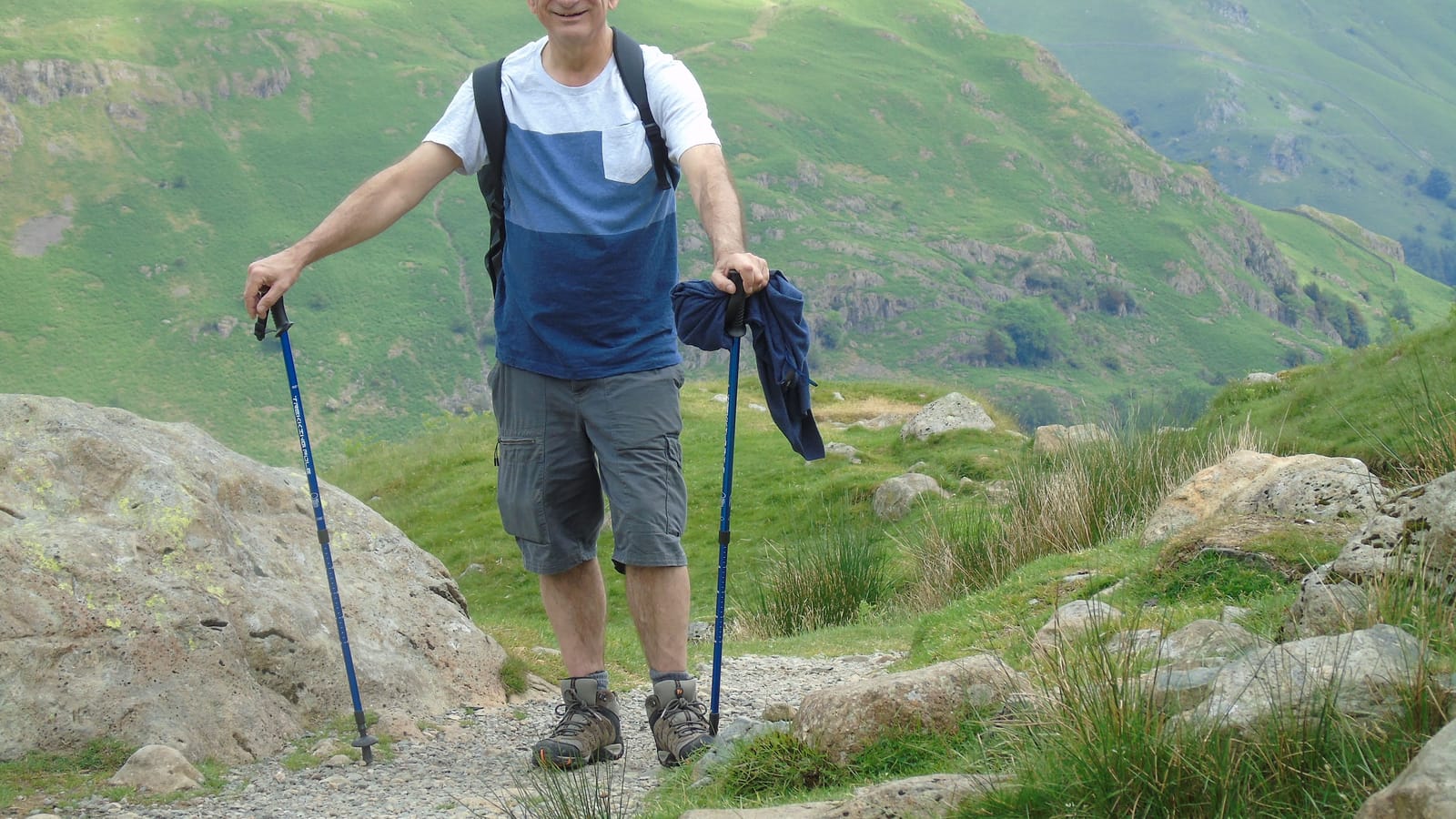
The knees don't quit on the way up. They quit on the way down, somewhere around mile four, when your quads are cooked and every step lands a little harder than the last one. Ask anybody who has come back up Bright Angel from the 1.5-Mile Resthouse. That's roughly 1,100 feet of climbing on the return, and the people who look worst at the trailhead aren't the ones who went slow. They're the ones who went out fast and paid the vig on the descent.
So plan the descent first. Everything else in this piece follows from that.
Pace by the clock, not by how you feel at the start
The old rule of thumb is about 2 miles an hour on flat ground, plus 30 minutes for every 1,000 feet of climb. It's a decent starting point and it's usually optimistic after sixty, especially if you're carrying a pack or hiking above 7,000 feet. Add a third. If the math says four hours, budget five and a half, and tell somebody at home what time you'll call.
Use the talk test. If you can't say a full sentence out loud without gasping, you're above the pace you can hold for four hours. Slow down before you have to, not after.
The rest step is worth learning and takes about ten minutes to get right. Step up, then straighten the back leg completely and pause for a half beat with your weight stacked on bone instead of muscle. Your quad gets a micro-break every stride. On a long grade like the Stony Man climb in Shenandoah it's the difference between summiting fresh and summiting annoyed.
One more clock habit: sit down for ten minutes every hour, off your feet, pack off, something in your mouth. Not leaning against a tree. Actually sitting. The people who "just keep moving" are the ones who bonk at 2 p.m.
Poles, and how to actually set them
Two poles, not one. A single stick is a prop. A pair is a suspension system, and it takes real load off your knees on every downhill step, which is exactly where the damage happens.
Cascade Mountain Tech carbon poles turn up at Costco for around $40 a pair and they're genuinely fine. Black Diamond's cork-grip Trail series runs north of $130 and the locks are better, the grips absorb sweat, and they'll last a decade. Either works. Cork or foam grips over rubber, because rubber will blister a damp hand.
Setting them:
- On the flat, elbow at about 90 degrees with the tip on the ground.
- Going up, shorten by 4 to 6 inches so you're not reaching.
- Going down, lengthen by the same and plant ahead of you, not beside you.
- Use the straps properly. Hand comes up through the loop from underneath, then down onto the grip. Now you push down on the strap and stop white-knuckling the handle.
- Pull the rubber tips off on dirt and rock. Carbide points bite. Leave the rubber on for pavement and boardwalk.
The honest trade-off: poles are a nuisance with a camera, they're in the way on anything you'd call a scramble, and they take a week to stop feeling foolish. Stow them on your pack for the rocky bits. Deploy them the second the trail tips downhill.
Feet and the fall you don't see coming
The serious injury on a day hike is almost never cardiac drama. It's a fall. Ankle rolls on loose rock, a slip on a wet root, a trip on the last quarter mile when your feet stop lifting because you're tired.
Three things cut that risk. Footwear with real tread and a toe box wide enough that your foot doesn't slide forward on descents. Poles, again. And balance work at home, which is dull and works anyway: stand on one leg while you brush your teeth, 30 seconds a side, then try it with your eyes closed once it's easy. Two minutes a day. It shows up on wet granite.
Trim your toenails short the night before a big descent. That one's free, and every hiker who has lost a nail on a long downhill learns it exactly once.
If you're on blood pressure medication, a diuretic, or a blood thinner, or you've got a heart or lung condition, talk to your doctor before you plan anything at altitude. Thin air and heat stress are a different animal than a walk in the county park, and that conversation takes fifteen minutes.
Trails that pay you back
Effort should buy you something. These do.
Stony Man, Shenandoah National Park, Virginia. About 1.6 miles round trip off Skyline Drive, modest climbing, and a rock ledge with the whole Shenandoah Valley laid out underneath. Best view-per-step ratio on the East Coast.
Jenny Lake to Hidden Falls, Grand Teton, Wyoming. Take the shuttle boat across. From the west dock it's roughly half a mile to the falls, a little more and considerably steeper to Inspiration Point. The boat saves you a 4-mile lakeshore walk you don't need to prove anything with.
Ocean Path, Acadia National Park, Maine. Sand Beach to Otter Point, about 2.2 miles one way, mostly gentle, with Thunder Hole and pink granite cliffs the entire way. Walk it at 7 a.m. and you'll have it nearly to yourself.
Riverside Walk, Zion National Park, Utah. A little over 2 miles round trip, paved, flat, canyon walls going straight up on both sides. This is the one to do when your knees have voted no.
Bear Lake and Sprague Lake, Rocky Mountain National Park, Colorado. Both short loops, both under a mile, both with postcard water and peaks. Bear Lake sits around 9,475 feet, so give yourself a day at altitude first and drink more than you want to.
And a concession: a 0.8-mile loop around a lake with a bench in the middle is a hike. Anybody who tells you otherwise has never had to earn it back.
The pack, and the pass
Carry more water than the distance suggests, because thirst gets less reliable with age and dehydration shows up as clumsiness before it shows up as thirst. Two liters for a half day in warm weather. Salty snacks, not just sweet ones.
Add a headlamp even on a three-hour hike, a small first aid kit with blister dressings, an extra layer, and any medication you take on a schedule, in the pack, not in the car. A satellite messenger like the Garmin inReach Mini makes sense if you hike where cell service dies, though it's a device plus a monthly subscription, so it's a real decision and not an impulse buy.
If you're a U.S. citizen or permanent resident and 62 or older, the America the Beautiful Senior Pass costs $80 for lifetime access or $20 for a year. It covers entrance at the national parks and it's the best bargain the federal government offers.
Go midweek. Park at 7 a.m. Stay on the trail and don't cut the switchbacks, because the shortcut you take is the gully somebody repairs next spring.
My father-in-law started hiking at 64 because his doctor suggested it and he's stubborn. He's now the guy who tells everyone else where to park. That's the arc available to you, and it starts with a 1.6-mile trail and a pair of $40 poles.
Wes Dunbar
Country & Skills
Grew up on an acreage and never quite left. Covers trucks, trades, land, and how to do the thing yourself.

Watch
Worth an hour of your evening
More from Outdoors.
From channels we rate. Plays on YouTube.
Read next