Scout with a kid before you ever hunt with one
Three Saturdays, no gun, one kid with a map. It's the best hunting prep you'll do, and it teaches more than opening day will.
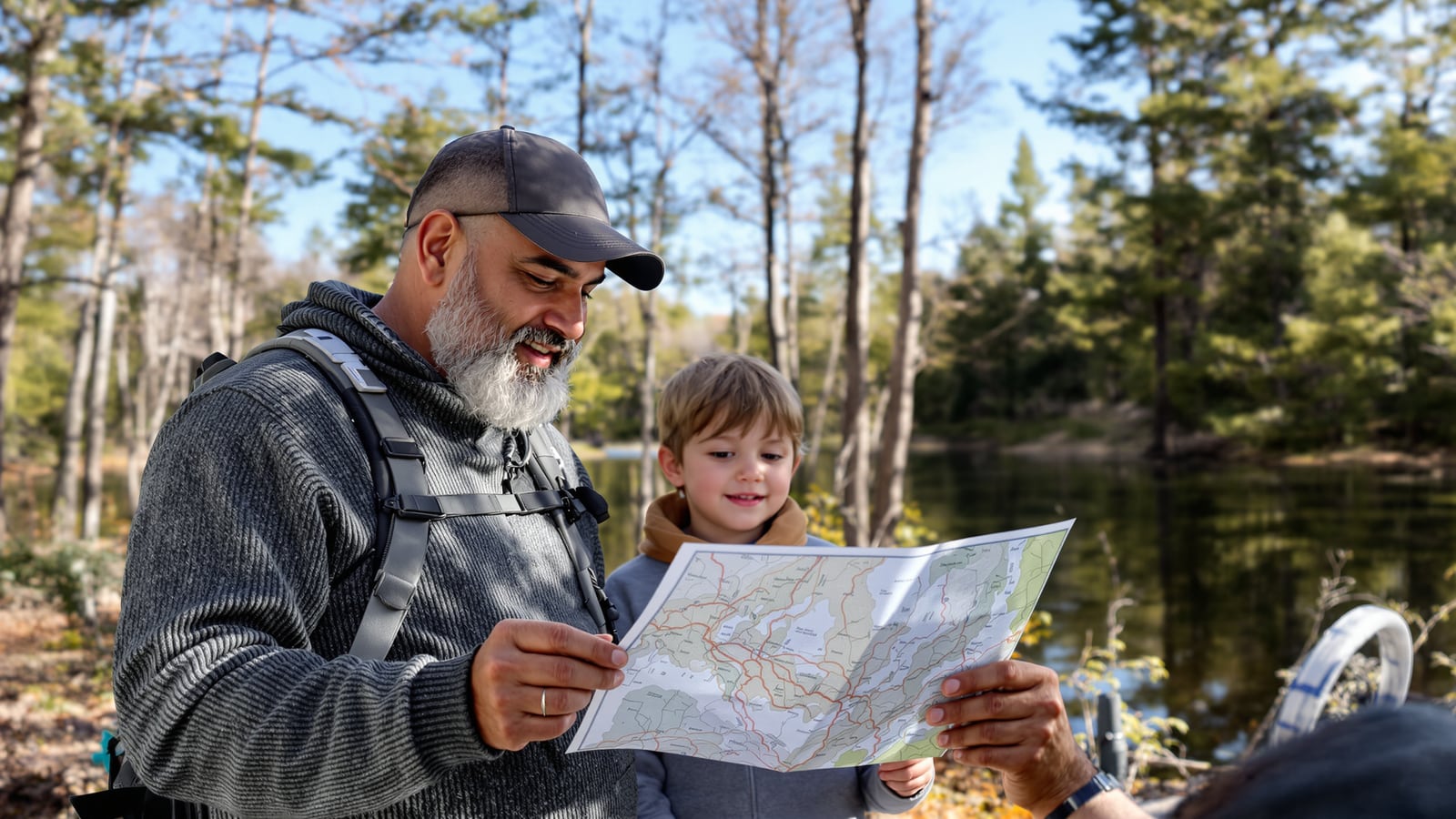
Quick answer: Spend three Saturdays before opening day on the land with no gun. Map it Saturday one, walk it Saturday two, sit and watch it Saturday three. Hand the kid a real job each time. By opening morning they'll know the ground better than you do.
Why the walk matters more than the hunt
Most hunters scout to find a deer. Do that with a ten-year-old beside you and you'll spend the day hushing them and checking your watch.
Scout to teach them to see instead. A kid who can look at a patch of woods and say "they come through that gap, they bed on that slope, they feed in that corner" has learned something no one can take from them. Shooting is a skill. Reading ground is an education.
It's also cheap. A pair of boots, a map and a few hours.
Saturday one: the kitchen table
Start indoors. Pull up the property on a satellite map. Google Earth works. So does onX Hunt if you hunt public ground and want boundaries and ownership on your phone. Print it, too. Phones die in the woods, and a kid likes a paper map he can write on.
Mark four things together:
- Where the food is: crop edges, oak flats, old orchards, clear-cuts with new growth.
- Where the cover is: thick brush, cedar stands, creek bottoms, steep ground nobody wants to climb.
- Where those two are joined by something narrow: a saddle in a ridge, a fence gap, a strip of timber between two fields. Deer take the easy line, and narrow places force the easy line.
- Where the boundary runs, in ink.
That last one is the lesson inside the lesson. Know exactly where you're allowed to be. If it's private land, the permission should be settled before anyone steps out of the truck.
Asking permission with a kid at your side
If you don't own the ground, go knock on the door. Take the kid.
Dress like you respect the place. Take your cap off. Say who you are, what you'd like to do, how many people, and which days. Offer to share the meat or to help with work around the farm. Ask what they don't want you to do, and then do exactly that. Get it in writing if your state recommends it, and many do.
Some will say no. A kid who watches his father hear "no" and answer "I appreciate you hearing me out" has learned more about manhood than he would from any speech. A yes brings its own obligations. Close every gate the way you found it. Park where you're told. Send a note after the season.
Saturday two: the walk
Go in midday, with the wind in your face if you can manage it, and stay on edges. Here's the annoying part about scouting. Walk straight through a bedding area three weeks before opening day and you've pushed deer off the very ground you wanted to hunt. Stay out of the thick stuff. Read the edges and let the binoculars do the rest.
Give the kid the job of finding sign. Don't tell him what it is. Ask.
Tracks. A whitetail track is a split heart, pointed end forward. Soft mud near creek crossings and field edges holds them best. Big, deep tracks with dewclaws showing in the print suggest a heavy animal, though it's no guarantee.
Droppings. Firm pellets mean dry browse. Clumped, softer droppings mean the deer have been on lush green food. Fresh ones look wet and dark. Old ones are bleached and crumbly. Let him pick one up with a stick and decide how old it is.
Rubs. Bucks scrape the bark off small saplings with their antlers. Strips of fresh wood showing white or green mean recent work. A line of rubs along a ridge often traces a travel route.
Scrapes. A pawed-out patch of bare dirt under an overhanging branch. They're mostly a fall story, so you may not find fresh ones yet. Mark them and come back.
Beds. Oval, flattened patches in grass or leaves, about the size of a big dog curled up. Note where they sit. Deer like to bed with a view downhill and cover at their back. Then walk away from them.
Trails. Narrow, worn lines through brush, usually with a notch in the vegetation about knee high. Follow one for fifty yards and he'll start to see how the ground funnels them.
Sign tells you where deer were. It doesn't tell you where they'll be. That's the contrarian part, and it's worth saying aloud to a kid: be suspicious of a tidy story. Check it again next Saturday.
Treat the tick and heat risk as real if early fall is warm. Long pants tucked into socks, a once-over at the truck, and plenty of water. Tell someone where you're headed and when you'll be back, and carry the basics. If you've never sorted a kit, the ten essentials cover it, and a kid should carry his own whistle and a spare layer from his first walk. Check the forecast the night before as well. The weather that kills hikers applies to hunters, too, and nobody wants a front catching a ten-year-old in cotton.
Saturday three: sit still
This is the one most dads skip, and it's the best of the three.
Pick the spot your map and your walk agree on. Get there well before last light. Put the kid in a folding stool or against a tree trunk with a clear view and the wind in his face. Hand him the binoculars.
Then say nothing for two hours.
It will be the longest two hours of his life. It's also where he learns to hold still, to listen, to catch movement in the corner of his eye, to tell a squirrel from a deer from a shadow. Bring a thermos and sit on something thicker than a log, because the ground steals your heat faster than the air does and a cold kid quits fast.
If a deer walks out, you'll both remember it for decades. If nothing does, you'll have an honest evening to talk about whatever he wants. Both are a win.
The code stays on the ground
Leave it better than you found it. Pack out everything you carried in, and a piece or two that wasn't yours. Stay on one path in and out so you aren't beating down the edges. Don't flag every tree with tape. Take a few pictures on your phone and remove any marker you set before you leave. Check your state's rules on trail cameras and on how early you may put up a stand, because they vary and the fine is on you.
Safety is no extra. Finish hunter education before anyone carries anything, and look up your state's mentored hunting rules, since many states allow supervised first hunts for newcomers. Know the orange requirement for your season and wear it. Treat every firearm as loaded and keep your muzzle pointed somewhere safe. That's the standard you teach, and you'll be the one he copies.
What he'll remember
He won't remember the map. He'll remember that you asked a stranger's permission with your hat in your hand, that you let him be wrong about a rub, and that you sat in the cold for two hours and didn't check your phone once.
Opening morning, give him the stool and the good seat. You already know where the deer walk. He found them.
Wes Dunbar
Country & Skills
Grew up on an acreage and never quite left. Covers trucks, trades, land, and how to do the thing yourself.

Watch
Worth an hour of your evening
More from Outdoors.
From channels we rate. Plays on YouTube.
Read next