The Ground Steals Your Heat Before the Air Ever Does
Below zero, warmth is a system you build in daylight — pad R-value, a dry sleeping layer, hot water at your feet, and a stove that actually lights.
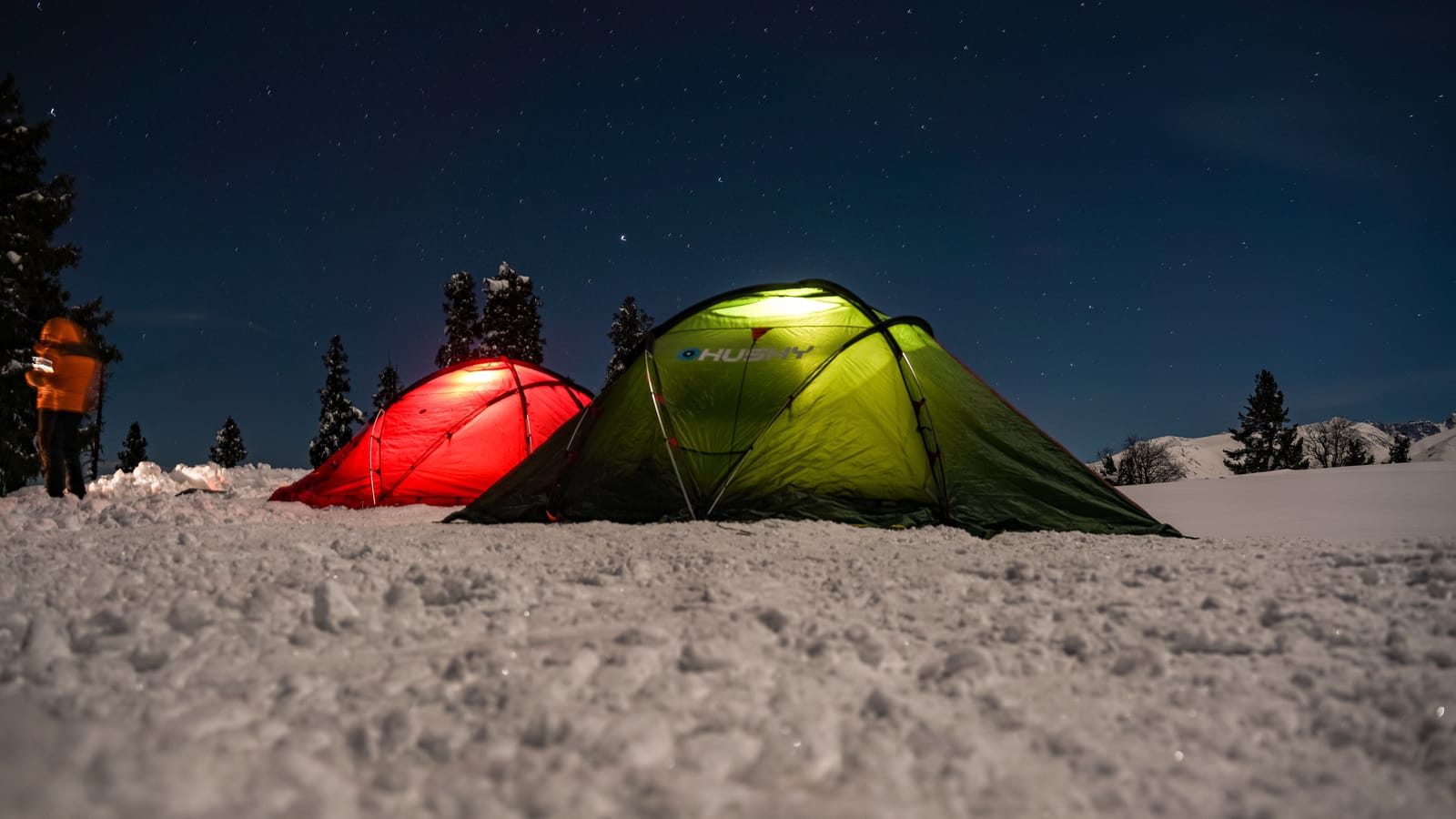
Two pads. Not one.
A closed-cell foam pad flat on the snow, an inflatable on top of it. R-values stack, so a Therm-a-Rest Z Lite Sol at roughly R 2 under a NeoAir XTherm at north of R 7 puts you somewhere around 9. That number decides whether you sleep or whether you lie there at 3 a.m. doing math about how many hours until sunrise. Air temperature gets all the headlines. The snow four inches under your hip is what's actually pulling heat out of you, by direct contact, every minute you're lying on it.
The foam pad has a second job, too. When your inflatable springs a leak at 1 a.m. — and one eventually will, usually from a stove ember or a cheap tent stake — you still have something between you and the ice. Cheap insurance. Strap it to the outside of the pack and stop worrying about the extra bulk.
Read the second number on the bag tag
Most quality bags carry an ISO or EN rating with two temperatures on it. The comfort rating is where an average cold sleeper stays comfortable. The limit rating is where an average warm sleeper is curled up, still asleep, and not much more than that. Manufacturers love to print the limit number on the hangtag because it's the flashier one.
Buy for the comfort number, then give yourself another 10 to 15 degrees of margin below the forecast low. Forecasts are for valleys and airports. Your campsite isn't an airport.
Down or synthetic is a real trade-off and anyone who tells you otherwise is selling something. Down is warmer per ounce and packs smaller, which matters when you're already hauling a four-season tent. But down that gets wet is a wet towel with feathers in it, and in deep cold you can't dry anything. For a single overnight, take the down. For four days in a damp coastal range with no sun, synthetic will treat you better even though your pack weighs more.
Get in the bag warm, with fuel in you
A sleeping bag doesn't produce heat. It traps yours. Climbing into it cold and waiting is a losing strategy.
Ten minutes before bed, do something: fifty jumping jacks, a lap around camp, haul a few armloads of snow for the morning melt. Get your blood moving right up to the edge of sweating, then stop. Eat something with fat in it — a few squares of chocolate, cheese, a spoonful of peanut butter straight from the jar. Your furnace runs all night and it wants something slow to burn.
Then boil a liter of water and pour it into a hard-sided Nalgene. HDPE, not a soft bladder, not a thin single-wall bottle. Screw the cap down hard, hold it upside down over the snow outside the tent for ten full seconds to confirm the seal, then shove it in the foot of your bag. Frozen feet are the number one reason people wake up miserable. That bottle buys you five or six hours, and in the morning it's unfrozen drinking water instead of a block you have to melt.
Dry is the entire game
Sweat is the thing that will actually hurt you. You hike in, you're working, you feel great, and you arrive at camp with a damp base layer. Twenty minutes later you're standing still and that moisture is stripping heat out of you faster than the wind.
So start cold. Leave the trailhead slightly underdressed, shed layers before you're hot, and open pit zips and collar vents early. If you're sweating, you're overdressed, even at 5 degrees.
Then carry a dedicated sleeping layer — a heavyweight merino or synthetic base, plus dry socks — sealed in a stuff sack and never, ever worn during the day. That's a rule with no exceptions. Change into it in the tent. The clothes you hiked in go inside your bag with you or into a sack at your feet where they won't freeze into origami.
The morning problem nobody warns you about
Boots. Leather boots left in the vestibule at 10 below turn into concrete, and there's no dignified way to get your foot into one. If you're wearing pac boots, pull the liners at night and sleep with them inside your bag. If you're in single-wall leather, put the boots in a stuff sack and wedge them inside the bag by your knees. It's uncomfortable. It's still better than the alternative.
Same rule for anything with a battery. Lithium AAs hold up in cold far better than alkalines, but even good batteries sag hard. Headlamp, phone, GPS, spare batteries — all inside the bag. A phone at 20 percent in a cold pocket can shut off without warning, and a dead phone is a dead map.
Your stove will quit before your bag does
Standard upright canister stoves lose pressure as they get cold. Down near and below zero, an isobutane canister sitting in the snow may simmer weakly or refuse to run at all. Options: white gas, like an MSR WhisperLite International or an XGK, which doesn't care what the thermometer says; or a remote-canister stove with a preheat tube that lets you run the canister inverted for liquid feed. Whatever you bring, know how to field-strip it in gloves, and practice that at the kitchen table, not at the campsite.
Melting snow eats fuel. Plan on roughly double what a summer trip would take. And always put an inch or two of liquid water in the pot before you add snow, or you'll scorch the bottom and everything you drink for two days will taste like a campfire.
Bottles go into insulated sleeves and get stored upside down — ice forms at the top of the water column, which is now the bottom of the bottle, so the threads stay free. Leave the hydration bladder at home; the hose freezes solid in about fifteen minutes. And don't bring a hollow-fiber water filter. A single freeze cracks the fibers internally, you can't see the damage, and the filter is done. Melt and boil instead.
Pitching on snow
Stamp out a platform bigger than your tent footprint with your boots or skis, then walk away for half an hour. Disturbed snow sinters and hardens as it sets, and a platform you pitch on immediately will turn into a lumpy crater by morning.
Regular stakes are useless. Use deadman anchors: bury a stuff sack full of snow, a stick, or a snow picket with the guyline girth-hitched around it, stomp it in, and let it freeze. It'll be there at dawn.
Dig a knee-deep foot well in the vestibule so you can sit on the tent floor with your legs down, boots on, and cook without contorting. Best twenty minutes of work you'll do all trip.
Leave the vents open. Every time. Shutting a tent down tight in the cold feels right and it's wrong — four people's breath turns into frost on the canopy, and the first person who bumps the wall makes it snow indoors.
Know when it stopped being fun
Shivering is your body doing its job. Shivering that stops while the person is still cold isn't improvement, it's a warning. Slurred speech, fumbling with zippers, stumbling, arguing about obvious things — that's the picture of hypothermia, and it belongs in a doctor's hands, not a group text. Get the person into a dry bag with hot bottles and warm sweet drinks, and get moving toward help. Tell someone your route and your turnaround time before you leave the truck.
What melts out in April
Winter hides everything, and then spring puts it all back on display. Pack out every orange peel, every bit of foil, every scrap of cord. Camp on deep snow or durable ground rather than on the fragile stuff underneath. Don't cut live branches for bedding — you don't need them and the tree does. If you burn anything, pack out the ash instead of leaving a black scar that shows up on bare ground in May. In heavy-use areas like the Adirondack High Peaks or Rocky Mountain National Park, check the local rules on human waste before you go, because in deep snow country the answer is frequently that you carry it out.
Your first below-zero night should be a hundred yards from a vehicle. A state park campground with a plowed road, or honestly, your own backyard in January. Test the whole system where the consequence of a failed stove is walking inside.
Do that once, get it right, and July campgrounds start to feel awfully crowded.
Wes Dunbar
Country & Skills
Grew up on an acreage and never quite left. Covers trucks, trades, land, and how to do the thing yourself.

Watch
Worth an hour of your evening
More from Outdoors.
From channels we rate. Plays on YouTube.