How to paddle a canoe as a pair and still like each other
The stern steers, the bow sets the pace, and the single-carry rule saves your weekend. What to pack, how to portage, and where it usually goes sideways.
A portage sign in canoe country doesn't give you yards or meters. It gives you rods. One rod is 16.5 feet, which is roughly the length of a canoe, and 320 of them make a mile. So when the sign says 140 rods, you're looking at about a half mile of mud, roots and one hill you didn't budget for, with a boat on your shoulders and a pack on your back.
That number is the single most useful thing on your map. Learn it first.
Plan the route by portages, not miles
Two people in reasonable shape can cover 10 to 12 miles of flat water in a day without suffering. Add portages and that number collapses fast. A 90-rod carry with gear costs you the walk over, the walk back, and the walk over again if you're double-carrying. Call it 25 minutes per portage, every time, and you'll be honest with yourself.
For a first trip together, pick a loop with four portages a day, none longer than 120 rods. That's a real day. You'll be in camp with light left and enough energy to enjoy it, which is the whole point.
Resist the urge to plan the ambitious version. Nobody has ever gotten off the water at 7:30 p.m. in a drizzle, setting up a tent by headlamp, and thought "glad we added that extra lake."
The boat's weight is the trip
A Kevlar tandem runs in the 40 to 50 pound range. A plastic or Royalex hull is 65 to 80. An old aluminum rental can be heavier still, and it will ring like a church bell every time you tap a rock.
On flat water, none of that matters much. On a portage trail, it's the difference between a carry and a death march. If you're renting and there's a lightweight option for a bit more per day, take it. Your shoulders are paying the bill either way.
Check the yoke before you leave the outfitter. If it's a bare wooden bar with no pads, ask for pads or buy a set. A bare yoke on a bony shoulder at rod 80 is a specific kind of misery, and it's entirely avoidable.
Three bags, and that's it
The system that works is simple. One big pack for shared gear. One food container. One small personal dry bag each.
The shared pack. Tent, tarp, stove, fuel, cook kit, first aid, rope, saw. A traditional canvas Duluth-style pack sits flat against your back and slides under the seats. Frame packs with tall tops fight the canoe and catch every branch on the trail.
Food. A hard-sided barrel with a harness is the standard in bear country for a reason: it seals, it sits upright, and it doesn't leak fish smell into your sleeping bag. Bring a rope for hanging if the rules where you're going require it.
Personal bags. Sleeping bag, sleeping pad, clothes, headlamp. The sleeping bag goes in a dry bag inside the pack. Not a trash bag. An actual roll-top dry bag, because the day you swamp is the day that decision pays for itself.
Clothes: two shirts, one pair of pants, one insulating layer, rain shell, rain pants, one dry set of sleep clothes that never, ever get worn in the boat. Wool socks over cotton, always. You're not dressing for a week. You're dressing for one wet day, repeated.
Add duct tape wrapped around a paddle shaft, a second map in the other person's pack, and a compass you actually know how to use. Phones die. Maps don't.
If your route crosses into Canada, understand that your carry permit doesn't travel with you. Handguns are effectively off the table up there, and the penalties for showing up at a border crossing with one in the pack are serious. Know the rules of the jurisdiction you're paddling into before you load the truck, not at the ranger station.
Bow and stern, and who gets to complain
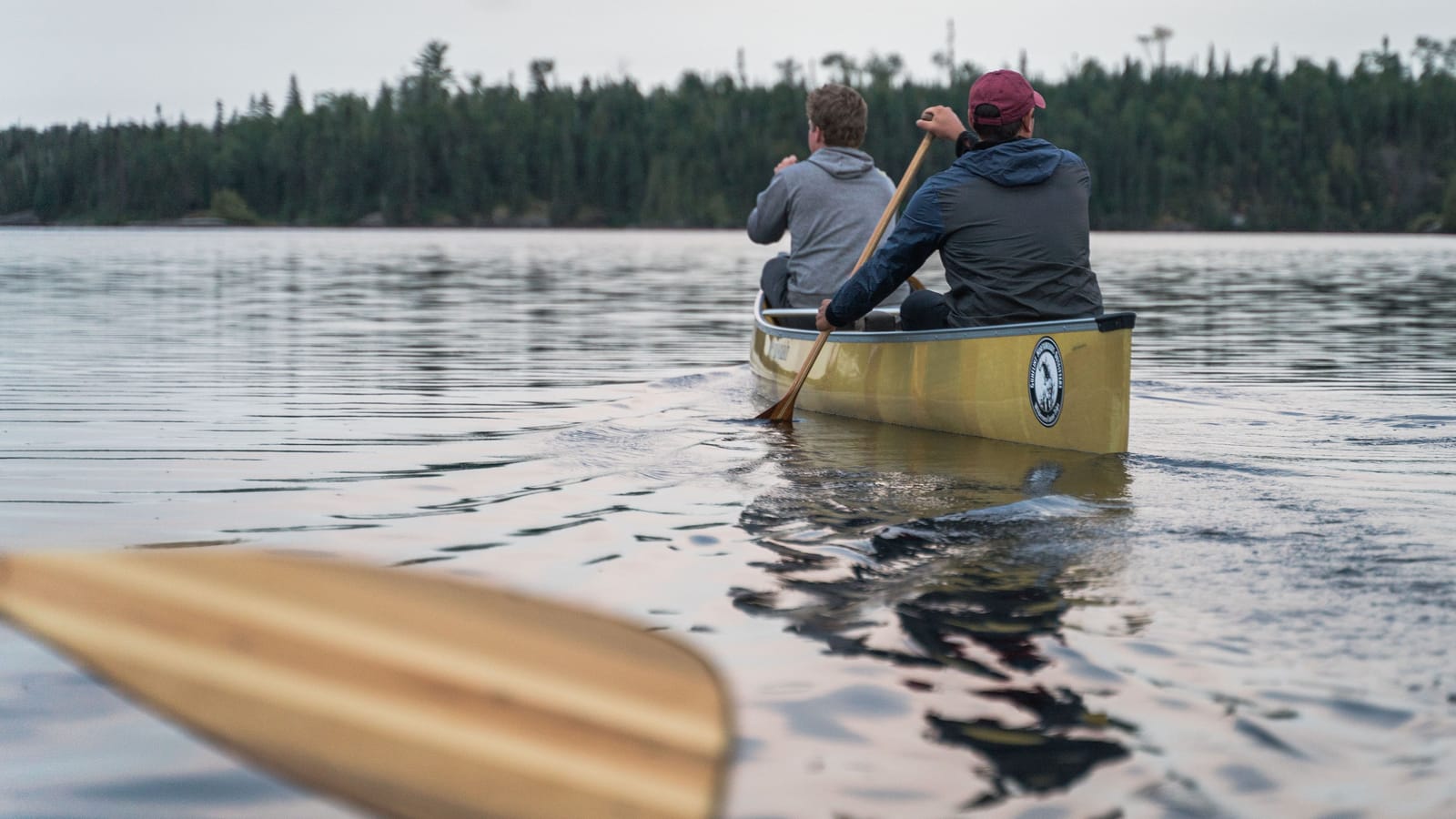
The stern paddler steers. The bow paddler is the engine and the eyes. That division only works if both people agree to it before the first lake, because the alternative is two people correcting the same boat in opposite directions while a headwind pushes them into a reed bed.
Put the heavier paddler in the stern most of the time. You want the boat trimmed close to level, maybe a hair light in the bow on flat water. In a headwind, shift weight forward so the bow bites instead of skating.
The bow calls obstacles. Rock right, deadhead dead ahead, shallow. Short words, said early. The stern calls the line and the side switches.
And the stern doesn't coach. That's the rule that saves marriages. If your partner's stroke is inefficient, you'll have three days to mention it kindly on shore. Not over their shoulder at mile four.
Two strokes and one word
You need the forward stroke done properly: paddle vertical, top hand over the water, power from your torso rotating, exit at your hip. Most people paddle with their arms and quit early. Rotate and you'll go farther on less.
Then the J-stroke for the stern. Slight outward twist of the blade at the end of the stroke to correct the boat's natural turn. It's clumsy for about an hour and automatic after that.
The word is "hut." Paddle the same side in unison, and when the stern calls hut, both of you switch sides on the next stroke. Roughly every eight to twelve strokes. It's faster than fighting the boat with constant correction, and it keeps both sets of shoulders from wearing out unevenly. Matching cadence matters more than raw power. Two people paddling out of sync bang blades and cancel each other out.
In real wind, get off the seats and kneel. Lower center of gravity, better control, less chance of going over. Your knees will complain. Your capsize count will be zero.
The portage, done properly
Single-carry if you can. Packs on backs, canoe on the stronger set of shoulders, paddles carried under the yoke arms or lashed in. One trip means a 90-rod portage costs you eight minutes instead of twenty-five.
If you can't single-carry, do it deliberately: one person takes the canoe straight through, the other takes the heavy pack, and whoever finishes first walks back for the rest. Don't leave gear scattered at both ends.
Lifting the boat solo is a technique, not a feat of strength. Roll it onto your thighs, grab the near gunwale, and swing it up and over in one motion so the yoke lands on your shoulders. Have your partner help for the first few until it clicks. If your back is a question mark, do the two-person lift every time and don't be a hero about it.
Scout the landing before you unload. Muddy landings swallow a boot. Rocky ones will chew a Kevlar hull if you drag it even five feet.
Off the water by four
The best decision you'll make all trip is stopping early. Camp by four gives you daylight to hang food, gather wood, dry socks on a line and actually sit down. Good sites go early on popular lakes, and the person still paddling at six is the person taking the site nobody wanted, on a rock shelf, in the wind.
Then the loons start. Nobody talks for a while. That's what you came for, and it only shows up if the schedule left room for it.
Somewhere around the third day, one of you will say something honest that never would have surfaced at a kitchen table. Canoes do that. Something about facing the same direction, doing the same work, with nothing to look at but water.
Marcus Vale
Editor-in-Chief
Twenty years in magazines, most of it deciding what to cut. Writes about work, discipline and the decisions that compound.

Watch
Watch how it's done
Picked for this article.
From channels we rate. Plays on YouTube.
PaddleTV
How to Paddle a Tandem Canoe | Tandem Canoeing Essentials
NFB
Path of the Paddle: Doubles Basic
Read next