How Much Water to Store for an Outage and How to Keep It Safe
One gallon per person per day is the official number. Here's what that actually looks like stacked in your garage, and how to keep it drinkable.
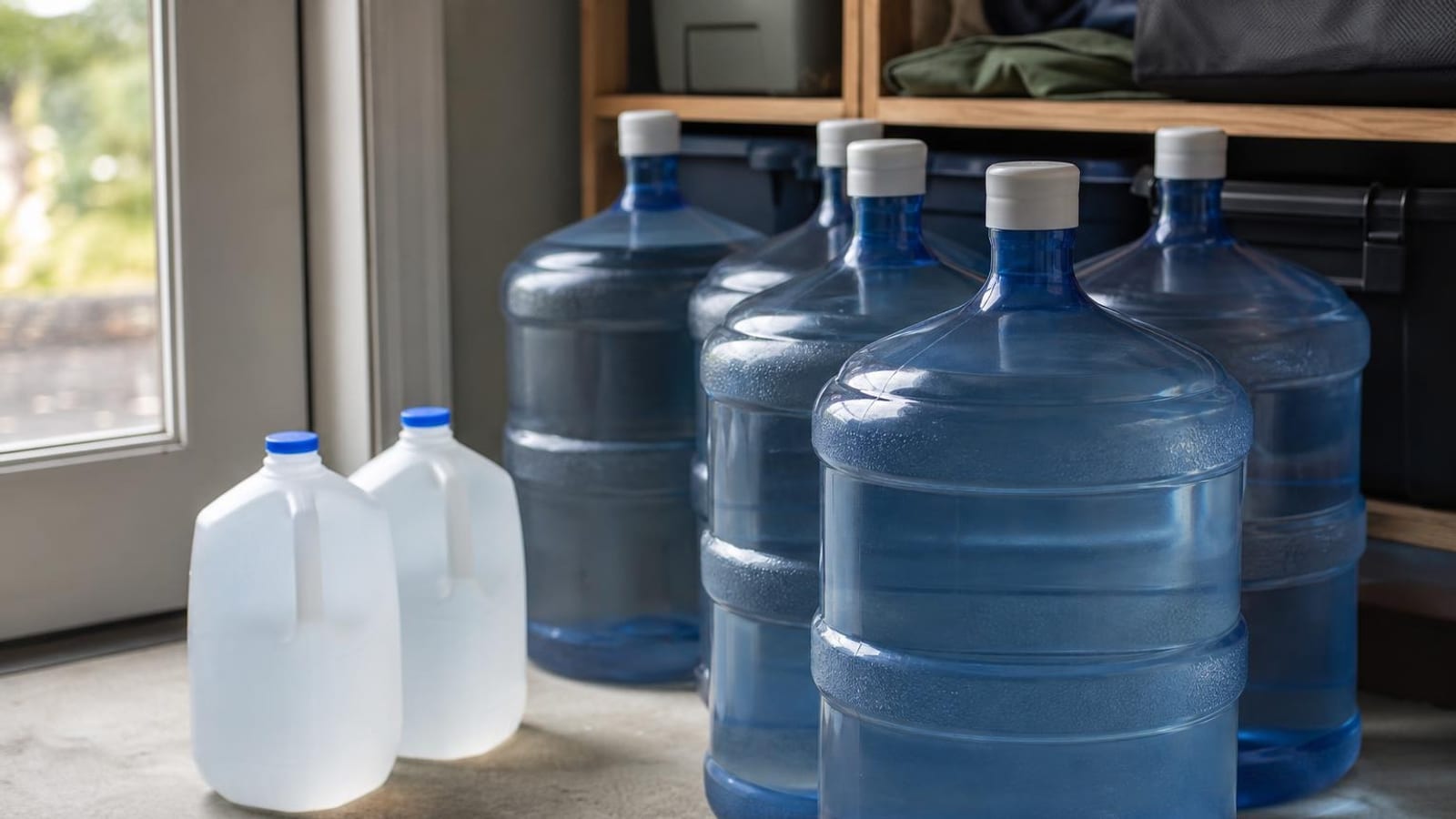
One gallon per person per day. That's the federal guidance from Ready.gov, and it's the only number you need to memorize. Three days minimum if you might have to leave. Two weeks if you're staying put, which most people are.
Run the math for a family of four and you get 56 gallons. That's 467 pounds of water sitting somewhere in your house. Nobody tells you the weight part, and the weight part is why most people's water plan stops at four cases of bottled water in the pantry closet.
A case of 24 half-liter bottles is about 3.2 gallons. So your pantry stack of four cases is 13 gallons. For a family of four, that's three days and change. Fine for a bad Tuesday. Not fine for a February ice storm that takes the county water system down with it.
Start with what a gallon per person actually covers
Half of that gallon is drinking. The rest is cooking, taking medication, brushing teeth, wiping down a counter. It doesn't cover flushing a toilet, washing a load of clothes, or a shower. Those are separate, and they're the reason people run dry faster than they planned.
Add more if anybody in the house is nursing, sick, or elderly. Add more if it's August in Texas and the AC is off. Kids go through more than you think, and a hot house without power is a dehydration machine.
Pets count too. A 60-pound dog drinks a little under half a gallon a day in normal weather. Write it into the total instead of finding out on day four.
Containers, and the one people get wrong
Store-bought bottled water is the easiest win. Leave it sealed, keep it in the original packaging, and use the date on the bottle. It doesn't go bad so much as the plastic starts picking up flavors and the bottle can weep over years. Rotate it.
If you're filling your own, use food-grade containers. The 7-gallon rigid jugs with a spigot are the sweet spot for most garages. Full, one weighs about 60 pounds. You can move it. You can't move a full 55-gallon drum, which is 460 pounds and will live exactly where you put it forever, so decide that on purpose.
Two-liter soda bottles work and they're free. Rinse them well.
Here's the one to avoid: milk jugs and juice cartons. The CDC says don't reuse them, and the reason is that milk protein and fruit sugar don't rinse out of the plastic completely. You're building a bacteria culture with a handle. Cardboard milk cartons also break down and leak. Ask anybody who's opened a storage tub after eight months.
Sanitize the container, then fill it
The CDC's method is one teaspoon of unscented liquid household chlorine bleach in a quart of water. Pour it in, cap it, shake it so the solution touches every surface, let it sit at least 30 seconds, then dump it and let the container air dry. Rinse with clean water if you'd rather not taste the chlorine later.
Then fill from your tap. If your water comes from a municipal system, it's already chlorinated and you don't need to add anything. If you're on a well, treat it before you store it.
Cap it tight. Label it with the date in marker, right on the container, because you won't remember.
Swap self-filled water every six months. Put it on the calendar with the smoke detector batteries and dump the old stuff on the garden.
Where you put it matters more than you'd guess
Cool, dark, and out of the way. Light grows algae in translucent plastic, and heat speeds up everything you don't want happening.
Keep it far from gasoline, kerosene, paint thinner, and pesticides. Vapors from those will migrate straight through polyethylene and into your drinking water. A garage shelf next to the mower gas can is the wrong shelf.
Put a sheet of plywood or a scrap of cardboard between the containers and a bare concrete floor. Concrete stays cold and sweats, and plastic in constant contact with it can pick up an off taste over months.
Split the stash. Some in the basement, some in a closet, a few gallons in each vehicle. If a tree comes through your garage roof, you didn't just lose your entire supply.
The water already in your house
You're standing on more than you think.
Your water heater holds 40 or 50 gallons of drinkable water. To get at it, kill the power or gas to the unit first so you don't burn out an element on an empty tank. Shut the cold water intake valve. Open a hot water faucet somewhere in the house to let air in, then open the drain valve at the bottom of the tank. Run the first bit into a bucket, because there's usually sediment.
Ice in the freezer counts. So does the water in your pipes, which you can drain from the lowest faucet in the house after opening the highest one.
The tank of your toilet is clean water, assuming you don't use those blue drop-in cleaner pucks. The bowl isn't, ever, and not for pets either.
Your pool isn't drinking water. Chlorine levels are wrong and the stabilizers aren't meant to be swallowed. But 15,000 gallons of pool water will flush toilets and wash clothes for a very long time, and that frees up every drop of the good stuff for drinking.
Treating water you're not sure about
Boiling is the gold standard. Rolling boil for one minute. Above 6,500 feet, make it three minutes. Let it cool on its own and don't add ice made from suspect water.
If the water is cloudy, filter it through a clean cloth or a paper coffee filter first, or let it settle and pour off the clear part. You're not sterilizing mud.
No way to boil? Unscented household bleach works, the plain kind with 5 to 9 percent sodium hypochlorite and nothing else. No scent, no splash-less, no color-safe, no added cleaners. For 6 percent bleach, that's 8 drops per gallon of clear water. For 8.25 percent, 6 drops. Double it if the water is cloudy or very cold. Stir, then wait 30 minutes. It should smell faintly of chlorine when it's done. If it doesn't, repeat the dose and wait another 15.
Bleach loses strength on the shelf. A bottle more than a year old is a guess, not a treatment.
And know the limit: boiling and bleach kill organisms. Neither one removes gasoline, solvents, pesticides, or heavy metals. If you suspect chemical contamination, that water is out. No amount of boiling fixes it.
Do the boring part this weekend
Count the people in your house, multiply by 14, add the dog. Buy or fill that many gallons. Write the date on them.
It's an hour of work and maybe one trip to the store. The family down the street will be standing in a line for a pallet of bottled water that ran out twenty minutes before they got there, and you'll be home making coffee on the camp stove.
That's the whole job. Quiet, unglamorous, and the reason your kids will remember the outage as an adventure instead of the week Dad got scared.
Wes Dunbar
Country & Skills
Grew up on an acreage and never quite left. Covers trucks, trades, land, and how to do the thing yourself.

Watch
Watch how it's done
Picked for this article.
From channels we rate. Plays on YouTube.
The Provident Prepper
Stored Water Gone Bad - How to Store Water That Never Needs to Be Rotated
City Prepping
3 Mistakes Preppers Make When Storing Water
Read next