Why Salt Melts Ice, and Why It Quits When It Gets Cold
Salt doesn't heat anything. It rigs a molecular tug of war, and the rigging has a limit around 15 degrees that every driveway eventually finds.
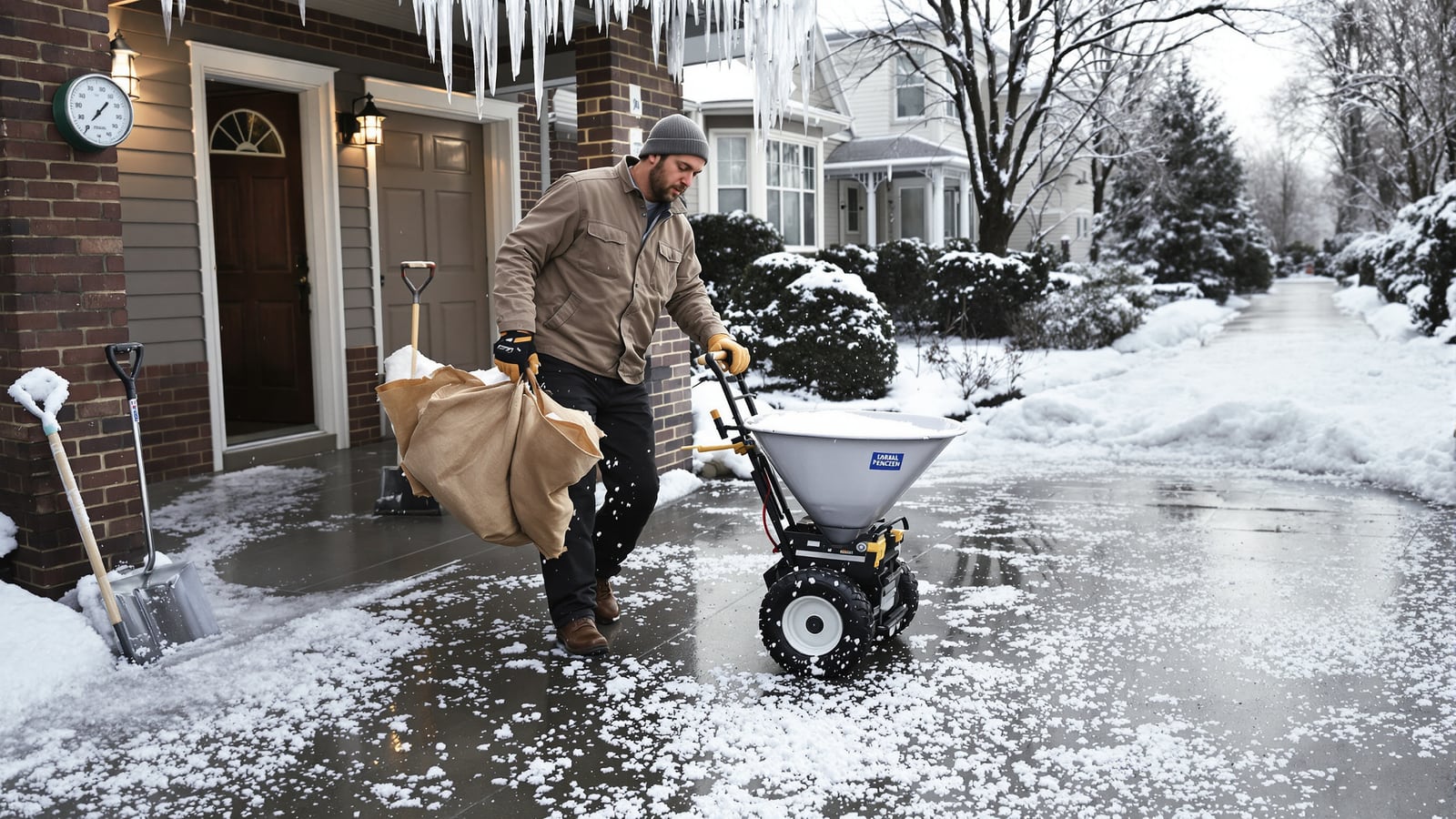
Quick answer: Salt dissolves into the thin film of water on ice and makes it harder for water molecules to re-freeze, so melting wins. Colder weather means less liquid to dissolve into and a stronger brine needed to keep it liquid. Plain rock salt gets feeble near 15°F and runs out entirely at -6°F.
You've seen the failure. It's 10 degrees, the plow has been through, a truck has salted the intersection, and the road still looks like a skating rink with gravel scattered on it. The salt is there. It's just not doing anything.
To see why, you have to drop the idea that salt "burns" through ice. It doesn't. Salt doesn't make heat. If anything, it steals it.
Ice is never really still
Ice at 32°F isn't frozen solid in the way a brick is solid. At the surface, water molecules are constantly breaking loose from the crystal and turning to liquid. Other molecules from the liquid film are constantly landing back on the crystal and locking in.
At exactly the freezing point, those two traffic flows are equal. Nothing gains, nothing loses. The ice just sits there.
Now throw salt on it. Sodium chloride dissolves into the liquid film and splits into sodium and chlorine ions, charged particles that wander through the water. They crowd the film. Water molecules trying to rejoin the crystal now have to find a spot among all those intruders, and fewer of them manage it.
The molecules leaving the ice don't care. They keep leaving at the same rate. So the balance tips, the ice melts, and more water exists to dissolve more salt. It feeds itself until the salt runs out or the solution gets too weak to keep going.
Chemists call this freezing point depression, and it works on the number of dissolved particles, not on what kind they are. Salt is a good deal because each unit splits into two. Seawater is the proof. It's about 3.5 percent salt and freezes at roughly 28.4°F, which is why the ocean stays liquid on mornings when a lake is locked up.
The part that surprises people
Melting ice takes energy. That energy comes from whatever's touching it, including the salty slush itself. So a salted pile of ice gets colder than 32°F as it melts.
Anyone who has cranked an old-fashioned ice cream maker has used this on purpose. You pack the outer bucket with crushed ice and rock salt, and the brine that forms can drop well below freezing, cold enough to turn cream and sugar into ice cream in the can inside. No freezer, no electricity. Just somebody's arm getting tired.
Which tells you something about winter. Every pound of salt you spread is pulling heat out of the surface it sits on. When the air is already cold, there's not much heat to pull.
Why it quits
There's a hard ceiling. A solution can only be so salty. Plain table-style salt tops out at about 23 percent by weight in solution, and the freezing point of that brine is about -6°F. It's called the eutectic point. Below it, salt and ice don't mix at all. They freeze together into a solid. Nothing the salt does can turn it back.
You'd think that means salt works fine down to -6°F. On paper it does. On pavement it doesn't, and the reasons are mundane.
- There's little liquid to start with. Colder ice has a thinner film of water on its surface, so the salt has less to dissolve into.
- The brine has to be strong. At 30°F, a weak brine keeps ice from freezing. At 10°F, you need something close to saturated, which means far more salt per pound of ice melted.
- It's slow. The process runs on thermal energy, and there's less of it. Salt that would clear a driveway in twenty minutes at 28°F can take hours at 15°F, and by then traffic has polished the ice flat.
Road crews work around 15 to 20°F as the practical floor for plain rock salt. Below that, they use something else, mix in something else, or give up on melting and scatter sand for traction. Sand does nothing chemical. It just gives tires something to bite.
What works colder
The trick is to use a salt that dissolves into more particles and lets a stronger solution stay liquid at lower temperatures.
Calcium chloride has an eutectic point near -59°F. It also releases heat when it dissolves, which jump-starts the melting instead of stealing warmth from the pavement. It works at temperatures where rock salt is a decoration. It costs more, which is why it shows up in bags labeled for low temperatures, and why road crews use it sparingly.
Magnesium chloride goes down to about -28°F. It's gentler on some surfaces and shows up in a lot of premium ice melts.
Plain rock salt remains the default for one reason. It's cheap, and most winter days aren't cold enough to beat it.
Airports skip salt altogether, since it corrodes aircraft. They spray glycol-based fluids that lower the freezing point of water by the same principle. The chemistry is the same, the rulebook is different. If you're curious why the aircraft itself is the thing to protect, why airplanes fly covers what a bit of ice on a wing does to lift.
What to do at your own house
Skip the idea that more salt is better. It isn't.
- Shovel first. Salt works best on a thin layer of ice, not a six-inch slab. Clear what you can, then salt what's left.
- Salt before the storm if you can. Spreading a light layer ahead of time keeps ice from bonding to the pavement, which makes shoveling easier. Road crews do the same thing with liquid brine.
- Scatter, don't pile. A light, even layer is enough. If you can see heaps, you wasted salt and you'll be sweeping it out of your garage in March.
- Check the temperature. Below about 15°F, switch to a calcium chloride blend, or use sand and wait for a warmer afternoon.
- Go easy near new concrete. Concrete poured within the last year is more vulnerable to salt damage, so most contractors say to keep deicers off it during its first winter. Use sand.
The tradeoff is real. Salt that washes off your driveway ends up in the soil and the storm drain, and it eats at concrete and steel. Bridge decks suffer most because the chemistry that rescues drivers also corrodes the reinforcing steel inside. What holds a bridge up and what eventually takes one down goes into how that damage builds over decades.
So the next time you stand at the edge of a driveway at 8 degrees, staring at salt crystals that haven't moved, you're not looking at a bad bag. You're looking at the physics running out of room. Sweep it up, grab the sand, and go inside for coffee. The ice will still be there when it warms up. So will the salt.
Dean Shaw
Gear & Garage
Reads the warranty, the parts list and the long-term owner reviews before anything else. Trucks, tools, watches, and the cheap version that costs more.

Watch
Worth an hour of your evening
More from Science & Space.
From channels we rate. Plays on YouTube.
Read next