Why your fire dies when you add the big log
Wood doesn't burn the way you think it does. Once you know what's actually on fire, building one that stays lit gets easy.
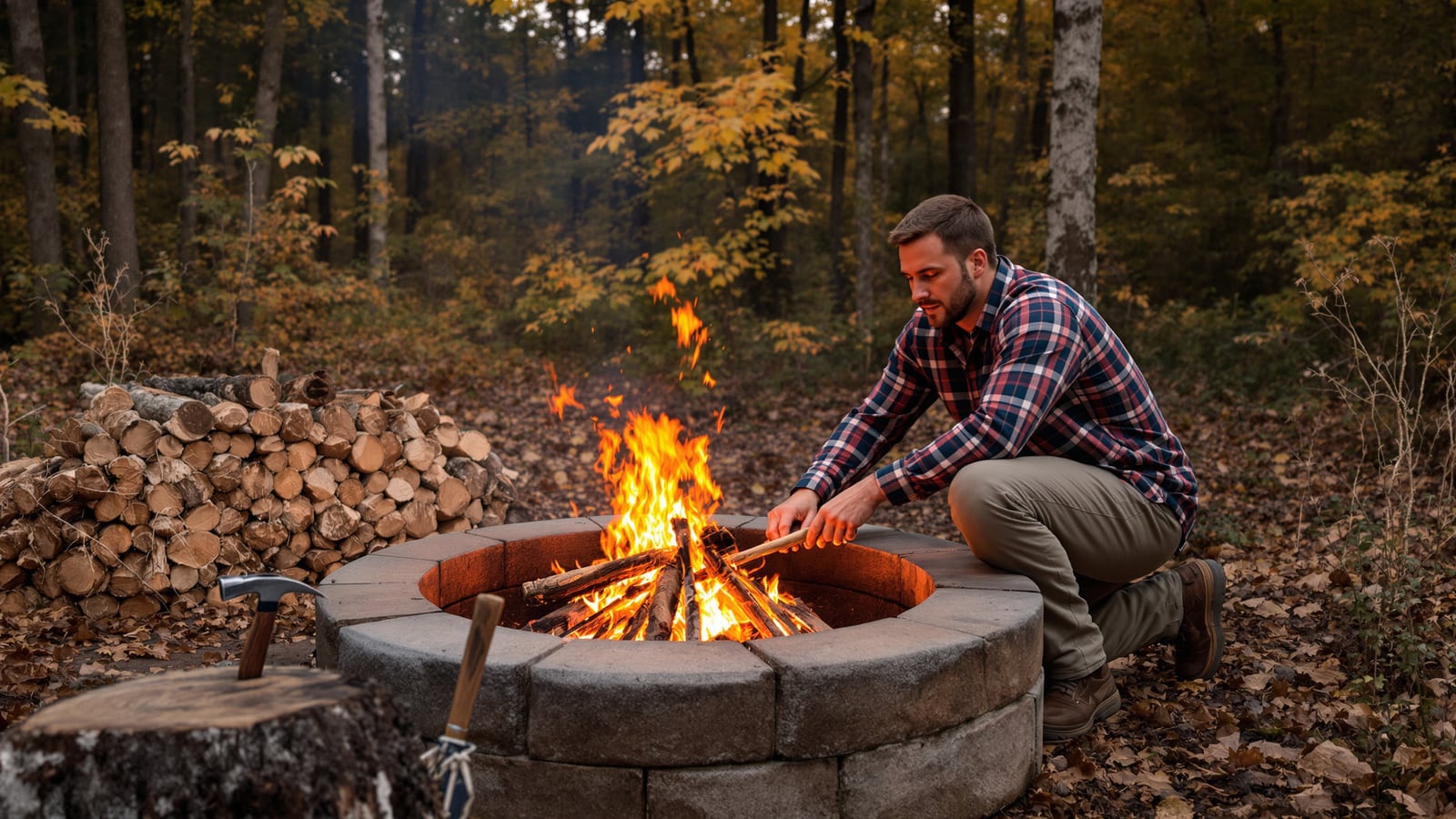
Quick answer: A fire survives by making enough heat to cook the next piece of wood into gas. Dry wood, small pieces first, and air underneath. Add fuel in steps, never in jumps.
You've done this. The fire's roaring on kindling, so you drop on the thick split of oak you've been saving. Ten minutes later you're on your knees blowing on a few orange specks and wondering what went wrong.
You didn't run out of fuel. You ran out of heat.
Wood doesn't burn. Its gas does.
Strike a match to a solid log and nothing much happens. Wood itself doesn't ignite. What burns is the vapor that wood gives off when it gets hot enough to break apart, a process called pyrolysis.
Wood is mostly three materials. Hemicellulose starts breaking down first, somewhere around 400°F. Cellulose follows at roughly 570°F and up. Lignin, the stiff stuff that holds the fibers together, decomposes across a wide range and leaves most of the charcoal behind. Those temperatures are approximate, and they shift with the species and how fast you heat it.
The gases that come off meet oxygen, catch, and become the flames you're staring at. Those flames radiate heat back onto the wood, which makes more gas, which makes more flame. That loop is the whole fire.
When the flames die down, the gas is mostly gone and what's left is charcoal. It glows and burns without much flame, and it holds heat for a long time. Those are your coals.
Why the same fire runs hot one night and cold the next
A typical open wood fire has flames somewhere in the range of 1,100 to 1,800°F. A well-built stove with controlled air can run hotter. A smoldering one runs far cooler and smokes. Three things decide where you land.
Water. Freshly cut wood can be close to half water by weight. That water has to boil off before the wood can get above about 212°F, and boiling takes a lot of energy, roughly a thousand BTU per pound. Your fire is paying that bill instead of heating itself. Wet wood hisses, smokes and sulks because the heat is going into steam. Seasoned firewood, dried six months to two years depending on species and climate, sits around 15 to 20 percent moisture.
Species. Pound for pound, dry wood of nearly any kind holds about the same heat, around 8,000 BTU. The difference is density. A split of oak or hickory packs far more wood into the same space than a split of pine, so a cord of oak delivers noticeably more heat and burns longer. Softwoods like pine and fir light easily and burn fast, and the resin makes them pop and spit. Hardwood is slow to start and slow to quit.
Size and air. A pencil-thick stick has a lot of surface for its weight, so it heats through quickly and gives off gas fast. A wrist-thick log has to heat all the way in, and its surface loses heat to the air as quickly as it gains it. That's why small stuff burns hot and big stuff takes its time. Airflow decides how much oxygen meets that gas. Too little and you get smoke, which is unburned fuel going up the sky.
It's the same trade you'd find in a battery, where stored chemical energy comes out at a rate that depends on how it's built. Why Your Phone Dies at 30 Percent and EV Batteries Don't covers that side of it. A log is just a battery you release all at once.
The big log mistake
Back to the oak. Dropping a big, cold, dense split on a small flame does three bad things at once. It soaks up heat the fire needs for itself. It blocks the airflow that was feeding the flames. And it gives off gas too slowly to make up for either.
The flame shrinks, the loop weakens, and the fire never recovers.
The fix is to step up in size. Each size should be about one notch bigger than the one before.
- Tinder: dry grass, birch bark, a cotton ball rubbed with petroleum jelly, or fatwood shavings. It catches from a match and burns for seconds.
- Kindling: pencil-thick sticks, dry and snappy. Plan on a good double handful.
- Small fuel: thumb-thick, then wrist-thick, added once the kindling is burning hard.
- Main fuel: the big splits, laid on a bed of coals or a strong flame, not a hopeful one.
If a stick bends instead of snapping, it's too damp to use yet.
Three layouts, three jobs
Teepee. Lean kindling against each other over the tinder. It lights fast and burns hot, because the flames climb straight up the sticks. It also collapses fast. Good for getting going.
Log cabin. Stack pairs of sticks in alternating squares with tinder in the center. It burns more evenly and holds a pot or a grate better. It takes longer to get established.
Top-down. Stack the biggest splits on the bottom, then smaller layers, then kindling and tinder on top, and light it from above. The fire burns downward, igniting each layer as it goes. It's slower to light and nearly tends itself. If you don't want to babysit a fire, this is the one.
For any of them, leave gaps. A fire can't burn what it can't breathe. Build with the wind at your back and light the upwind side, so the breeze pushes the flame through the pile.
When everything's damp
Rain doesn't make a fire impossible. It makes you pick better wood.
- Take dead branches still hanging in trees over ones lying on the ground. The ground wicks moisture up.
- Split what you've got. The inside of a wet log is often drier than its bark, and fresh faces catch faster.
- Shave thin curls off a dry stick, or scrape a feather stick, for extra tinder.
- Build the fire on a platform of sticks or flat stone, not bare wet dirt.
- Keep feeding in small pieces, and set damp wood near the fire to dry before it goes on.
At home, a cheap moisture meter will tell you whether firewood is ready. Under 20 percent is where you want it. Burning wood that's wetter than that in a fireplace or stove leaves more creosote in the chimney, and that's a fire hazard of its own.
One trade-off worth admitting
Softwood is a pain at the woodpile and a gift at the match. It's also the reason most people have a good first ten minutes and a bad third hour. The old pattern works for a reason: start with pine or other softwood, then hold it with oak or hickory once you've got a bed of coals. Don't expect hardwood alone to light from a match.
Put it out like you meant it
Check local burn bans before you strike anything. Clear a ring of at least ten feet down to bare dirt, with no overhanging branches.
To put it out, pour water, stir the ashes, and pour again. Do it until nothing hisses, and until the ashes are cold enough to hold in your bare hand. Buried coals can stay hot for hours and restart in a wind.
Then leave the site better than you found it. Pack out any trash, even somebody else's, and stack a few dry sticks for the next person. A stranger arriving in the rain will be glad they were there.
If you want to understand why a timber beam bears load the way it does, What Holds a Bridge Up and What Eventually Takes One Down is a good next read. The same fibers that make a fire are what make a beam strong.
Build small, add in steps, and don't smother what you've just started.
Dean Shaw
Gear & Garage
Reads the warranty, the parts list and the long-term owner reviews before anything else. Trucks, tools, watches, and the cheap version that costs more.

Watch
Worth an hour of your evening
More from Science & Space.
From channels we rate. Plays on YouTube.
Read next