
Quick answer: Pick a group that meets every week, go three times before you judge it, and then volunteer for one small, unglamorous job. The job is what turns you from "the new person" into someone people look for.
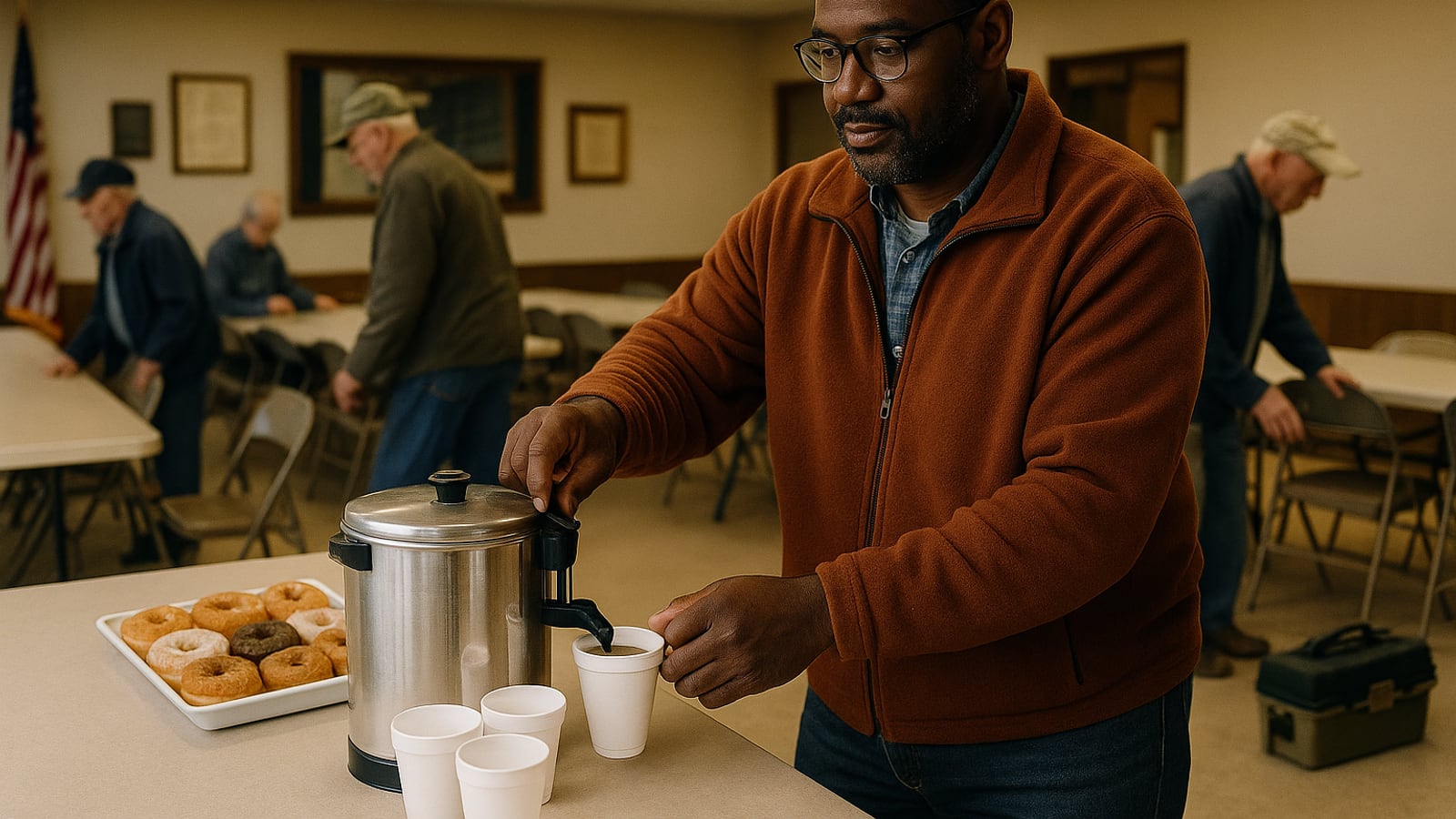
Picture a Tuesday night in the back room of a VFW hall. Twenty-two members of a bass club are drifting in. The coffee urn is cold because the man who always filled it moved to Arizona in March. Nobody has replaced him.
The newcomer who walks in at 6:40, finds the urn and has it perking by seven won't be a newcomer by Christmas.
That's the whole secret, and most people miss it. They join for the hobby, sit politely at the edge for two months, feel invisible and quit. Talent doesn't get you in. You can sing flat or cast into a tree and still belong. What gets you in is being useful in a small, regular way.
Where the groups actually are
They're closer than you think. Most never advertise past a bulletin board.
- Your city or county parks and recreation catalog. It lists classes, leagues, pickleball, painting, walking groups, and often a community band or chorus. Many have an older-adult section.
- The public library. Check the events calendar and the physical corkboard by the door. Book clubs, genealogy groups, chess, knitting circles and writing workshops live there.
- Your county extension office. Most run a Master Gardener program through the state's land-grant university. There's training, then volunteer hours, and a built-in crowd of people who love dirt.
- Your state fish and wildlife agency. Look for learn-to-fish events and volunteer instructor programs. Many states also offer reduced or free fishing licenses for residents past a certain age, and the rules vary, so check your state's site.
- Community college continuing education. Woodworking, watercolor, conversational Spanish, digital photography. Classes end, but the people often keep meeting.
- Your local senior center. Call the Eldercare Locator at 1-800-677-1116 or visit eldercare.acl.gov to find the nearest one, plus rides if you need them.
- The counter at the shop that sells the gear. Fly shops, fabric stores, music stores and lumberyards all know which clubs are active and which are three members and a mailing list. Ask the person at the register. They'll tell you.
Choose by the calendar, not the passion
You might want to fight me on this one.
A group you're lukewarm about that meets every Thursday will give you more friends than your favorite hobby's club that meets four times a year. Friendship runs on repetition. You need to see the same faces often enough that "Good to see you" turns into "Where were you last week?"
So a weekly community choir beats a quarterly photography society. A woodworking guild with an open shop every Saturday morning beats a monthly lecture. A fishing club is fine if it pairs its monthly meeting with regular outings.
The exception is a group with a monthly meeting and a real project running in between, like a quilting guild making charity quilts for a children's hospital or a model railroad club building a layout. The project is the weekly contact.
If you're married, think about one group each and one together. You'll come home with stories to trade, and neither of you has to love the other's hobby.
Go three times before you decide
The first visit is always awkward. You don't know where to sit, who's in charge, or why everyone laughs when somebody mentions "the incident at Lake Guntersville."
The second visit, a couple of people recognize you.
The third visit tells you the truth. If nobody has spoken to you by then, it's a closed group, and that's their loss. Leave without guilt and try the next one on your list. But don't leave after one. Almost every group feels cold the first night.
Arrive fifteen minutes early each time. The early crowd is smaller, looser and more talkative. The people who set up are usually the people who run things.
Then take the job nobody wants
After your third visit, ask one question: "Is there anything that needs doing?"
Every club has a list of small jobs that fell through the cracks. A few examples:
- Choir: folding chairs after rehearsal, loading the risers, filing sheet music, sending the reminder email about concert dress.
- Fishing club: running the weigh-in scale, writing up tournament results, helping at a kids' fishing day, keeping the club boat's logbook.
- Woodworking or quilting guild: sweeping the shop, sharpening the shared chisels, keeping the fabric closet organized, tracking the charity project's deadlines.
- Garden club or book club: keeping the sign-in sheet, calling the members who've gone quiet, bringing snacks on a rotation.
Pick one. Just one.
A job gives you a reason to talk to everybody. The sign-in sheet means you learn forty names in a month. The weigh-in scale means every angler has to come see you. Folding chairs puts you in the last-ten-minutes crowd, and that's where the real conversations happen, the ones about grandkids and hip replacements and who's selling a boat.
Do the job a little better than it was done before. Sharpen the chisels and oil them. Leave the room cleaner than you found it. Bring the coffee in a thermos when the urn breaks. People notice, even when they don't say so.
Serve, but don't get swallowed
Clubs have a well-known habit. The person who says yes once gets asked forever. Within a year you're treasurer, newsletter editor and the guy or gal who drives the trailer to every event.
Take one job for a set term, say a year, and say so out loud when you take it. When someone asks for a second job, it's fine to say, "I'm doing the scale this year. Ask me next spring." You joined to enjoy the hobby and the people. You didn't join to become unpaid staff.
The same goes for club politics. Every group has a feud about bylaws, the budget, or who gets the good parking spot at the lake. Stay friendly with both sides and out of the middle. Your reputation should be "reliable," not "on a team."
The practical snags, and how to handle them
Hearing in a loud hall. Sit near the front or near whoever's leading. Nobody minds, and it keeps you in the conversation instead of nodding along.
Driving at night. Ask whether anyone carpools. Somebody always lives near you, and a twenty-minute ride together each week is a friendship in itself. If you need a regular ride, the Eldercare Locator can point you to local transportation.
Cost. Most clubs charge modest yearly dues. Don't buy gear before your third meeting. Members often have spare rods, extra fabric or a second music stand, and they're happy to lend. Return it cleaner than it came to you.
Keeping up with the group text. Clubs often organize by text or email now. If the print is small or the alerts are driving you up a wall, set your phone up for your own eyes and ears first.
Online groups. Facebook groups and forums are useful for finding clubs, but meet in person before you trust anyone. A new "fellow enthusiast" who wants money, a gift card or help with a shipping problem isn't a club member. If it happens, call your bank before anyone else.
If the first try doesn't take
Some groups won't fit. Some will fit for a few years and then fade as people move or pass on. That's normal, and it's a good reason to keep one foot in a second place too. The piece on becoming a regular somewhere covers the diner-and-coffee-shop side of that.
If you're coming to this after losing a spouse and the evenings feel heavier than any club can fix, that's real, and you don't have to carry it alone. You can call or text 988 anytime to talk to someone. Veterans can press 1.
For most readers, though, the road back to a full calendar is shorter than it looks. A fishing club in a VFW hall doesn't remember who caught the biggest bass three years ago. It remembers who got there early and had the coffee going.
This is general information to help you think things through, not medical, legal or financial advice. Please check with your doctor, pharmacist or a qualified adviser before making a change.
Sam Ortiz
Dads & Family
Father of three. Writes about presence, discipline and the long game, without pretending any of it's tidy.

Watch
Worth an hour of your evening
More from BRO Seniors.
From channels we rate. Plays on YouTube.
Read next