
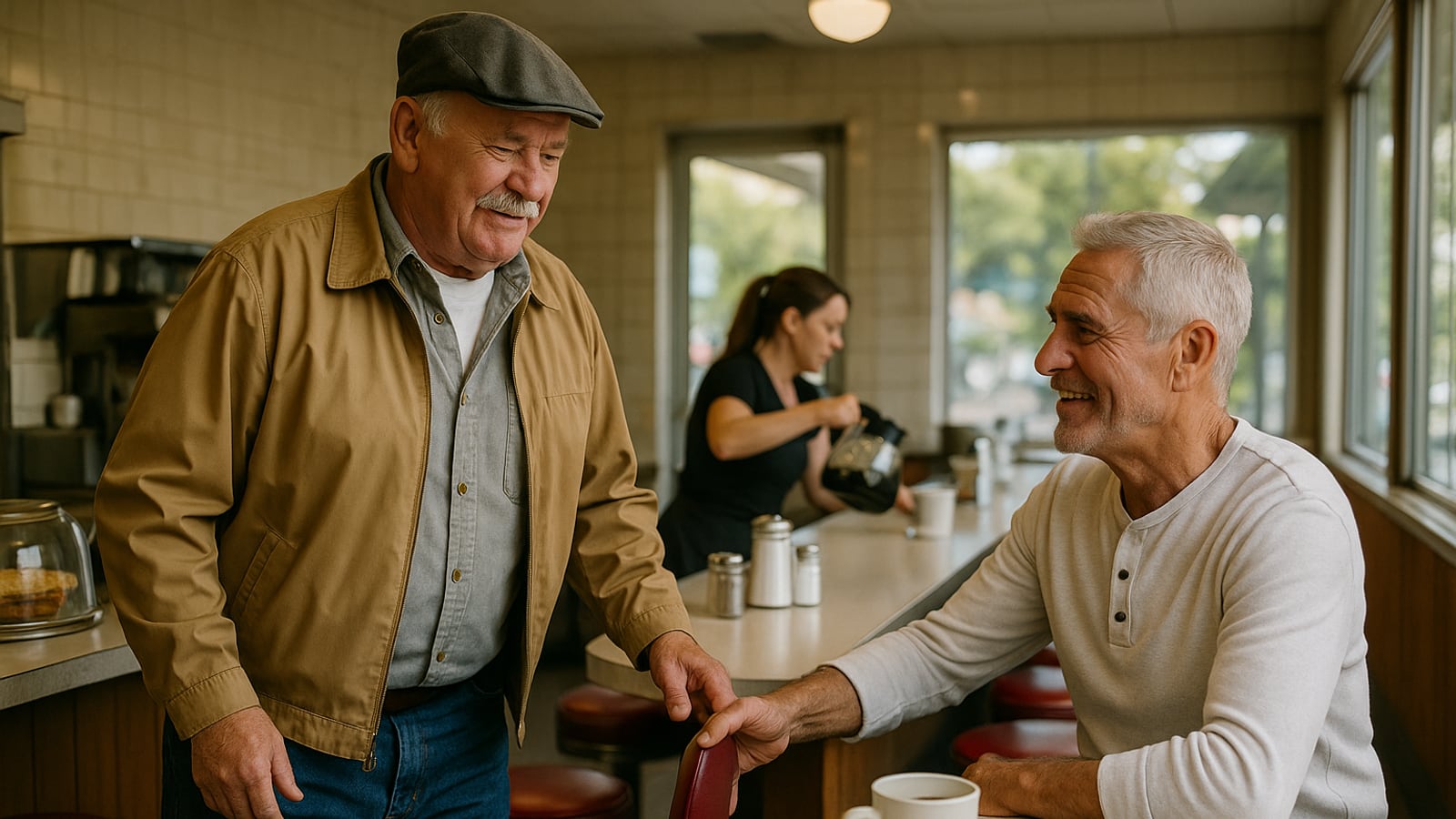
Quick answer: Pick one place and go at the same time every week for two months. Most friendships at this stage grow out of repetition, not courage.
Work used to schedule your friendships for you. You never had to decide to see the fellow from accounting or the woman at the front desk. They were just there, Monday through Friday, eight to five, and forty years of coffee-pot conversation added up to something. Then the retirement cake got cut, and the schedule went with it.
Loss does the same thing, only faster. Maybe your wife was the one who kept the calendar full. Maybe your husband was the one who had the neighbors over every Fourth of July. When the person who ran the social side of your life is gone, the phone gets very quiet. It isn't because people stopped caring. They're waiting for a signal. So are you.
The quiet is real, and it can hurt more than anyone warned you. Nothing's wrong with you for feeling it.
Why "go make friends" doesn't work
Most advice tells you to join a club, put yourself out there, be brave. That asks for a fresh burst of courage every single time. Courage runs out by the second Thursday.
What works is dull. Same place. Same time. Every week.
The fourth time you show up, somebody nods. The eighth time, somebody asks where you were last week. That's the moment that matters. Once you're somewhere you'd be missed, you're not a visitor anymore. You're a regular.
Step one: pick your spot
Choose one place you can reach easily and would enjoy anyway. Some that work well:
- The early swim or walking track at the YMCA or community center
- A diner with a counter, not just booths
- The library's weekly book club or chess table
- Your local senior center's lunch, which in many towns is low-cost or by donation
- A farmers market on Saturday morning
- The hardware store at the same hour, if that's your idea of a good time
Counters beat tables. Classes beat lectures. Anything where you sit shoulder to shoulder with a small task gives conversation an easy way in.
Then pick a time and write it on the calendar like a doctor's appointment. Tuesday, 9:30. Not "sometime this week."
Now picture the first month honestly. You walk into the pool at 7 a.m. The same five people are there, and they already know each other. Nobody talks to you the first week, and you drive home feeling foolish. The second week, the woman in the next lane says the water's cold today. The third week, the man by the lockers tells you about his knee replacement. By week six you know three names and somebody's grandson's Little League schedule.
The first two visits are the price of admission. Pay it.
Step two: say one more sentence
When the clerk says "Have a good one," say one more sentence back. Ask the name of the man who always takes the corner stool, or the woman who brings her own crossword. Then write it down when you get to the car. Good salespeople have done that for a hundred years.
These small ties matter more than they look. The mail carrier, the pharmacist, the neighbor with the Labrador. They aren't a substitute for close friends. But they're the ground close friends grow in, and they make a day feel lived in rather than waited out.
Step three: take a job, not a seat
Mixers are hard at any age. Standing around with a paper cup trying to be interesting is nobody's favorite evening. A job is easier. When your hands are busy, talk happens on its own.
Look for volunteer work with a regular shift. Stocking shelves at a food bank. Shelving books with your library's Friends group. Swinging a hammer with Habitat for Humanity. Ushering at the community theater. AARP Foundation Tax-Aide trains volunteers every year to help neighbors with their tax returns, and it's a fine fit if you've got a head for numbers. If you spent a career running a shop, a crew or a household of five, a local school or youth program may be very glad to have you.
The real prize is being counted on. When you're on the Wednesday schedule and you don't show, somebody calls to check. That call beats any pep talk ever written.
Step four: reopen one old line a week
Everyone has a list of people they meant to call. The old fishing buddy. The college roommate. The sister-in-law you always liked better than your brother did.
Pick one a week. Don't explain the gap. Don't apologize for the years. Just start: "I was thinking about that trip to the Outer Banks in '98 and wanted to hear your voice."
Most people are glad. A few won't call back. That stings, and it's almost always about their life, not yours.
Step five: borrow something
This one sounds odd, and it works. Ask a neighbor if you can borrow a ladder, a pie tin or a folding table. Asking for small help tells people you trust them, and it gives them an easy reason to knock on your door later.
Then return it better than you got it. Wipe the ladder down. Bring the pie tin back with a pie in it. Few things start a friendship on a street faster.
If you've lost a spouse
The couple friends may drift. It isn't always coldness. Often they simply don't know whether to invite you to things that were built for four. Make it easy on them. Invite one of them to something specific: "I've got two tickets to the high school's spring musical Friday night. Want to come?" A date and a time beat "let's get together sometime" every time.
Plan the hard hours first. For many widows and widowers it isn't the anniversary or the holiday that hurts most. It's Sunday afternoon, or the hour you used to eat dinner together. Put something in those slots on purpose, even if it's a standing phone call with a grandchild.
Grief shows up differently in different people. Some want to talk it through over coffee. Others go quiet and stay busy in the garage or the garden. Neither is wrong. What matters is that at least one person knows how you're really doing.
If getting out is hard
Maybe you've stopped driving, or your spouse needs you home. The same rules work by phone. A call at the same time each week is its own kind of regular, for you and for the person on the other end.
The Eldercare Locator at 1-800-677-1116 or eldercare.acl.gov can point you to rides, senior center programs and caregiver support near you. Many areas also run friendly caller or visitor programs. Ask what's available where you live.
When it's more than lonely
Loneliness and depression aren't the same thing, but they often keep company. If for more than a couple of weeks you've lost interest in things you used to enjoy, you're sleeping badly, or everything feels heavy, tell your doctor. Medicare Part B covers a yearly depression screening in a primary care office. If you're not sure what Part B includes, Medicare's four parts are laid out plainly here.
And if a night ever comes when you're thinking about not being here, you can call or text 988, the Suicide & Crisis Lifeline. Veterans can press 1. It's there for exactly that kind of night.
A fair word for solitude
Not every quiet day is a problem. Plenty of people love their own company, read for hours, tinker happily in the workshop and want nothing more. Alone isn't the same as lonely. The test is simple. Do you miss people? If you do, that's worth acting on.
And if a group turns out to be a poor fit, give it three honest visits and then walk away without guilt. The book club that spends every meeting arguing about the news isn't your only option. There's another one across town.
Somewhere near you there's an empty counter stool at 9:30 on Tuesday mornings. Go sit on it. Then go back next week.
This is general information, not medical advice. If your mood worries you, talk with your doctor.
This is general information to help you think things through, not medical, legal or financial advice. Please check with your doctor, pharmacist or a qualified adviser before making a change.
Nina Castellan
BRO for Her
Runs the women-facing desk. Same standard, same tools, written for a different reader — not a softer one.

Watch
Worth an hour of your evening
More from BRO Seniors.
From channels we rate. Plays on YouTube.
Read next