
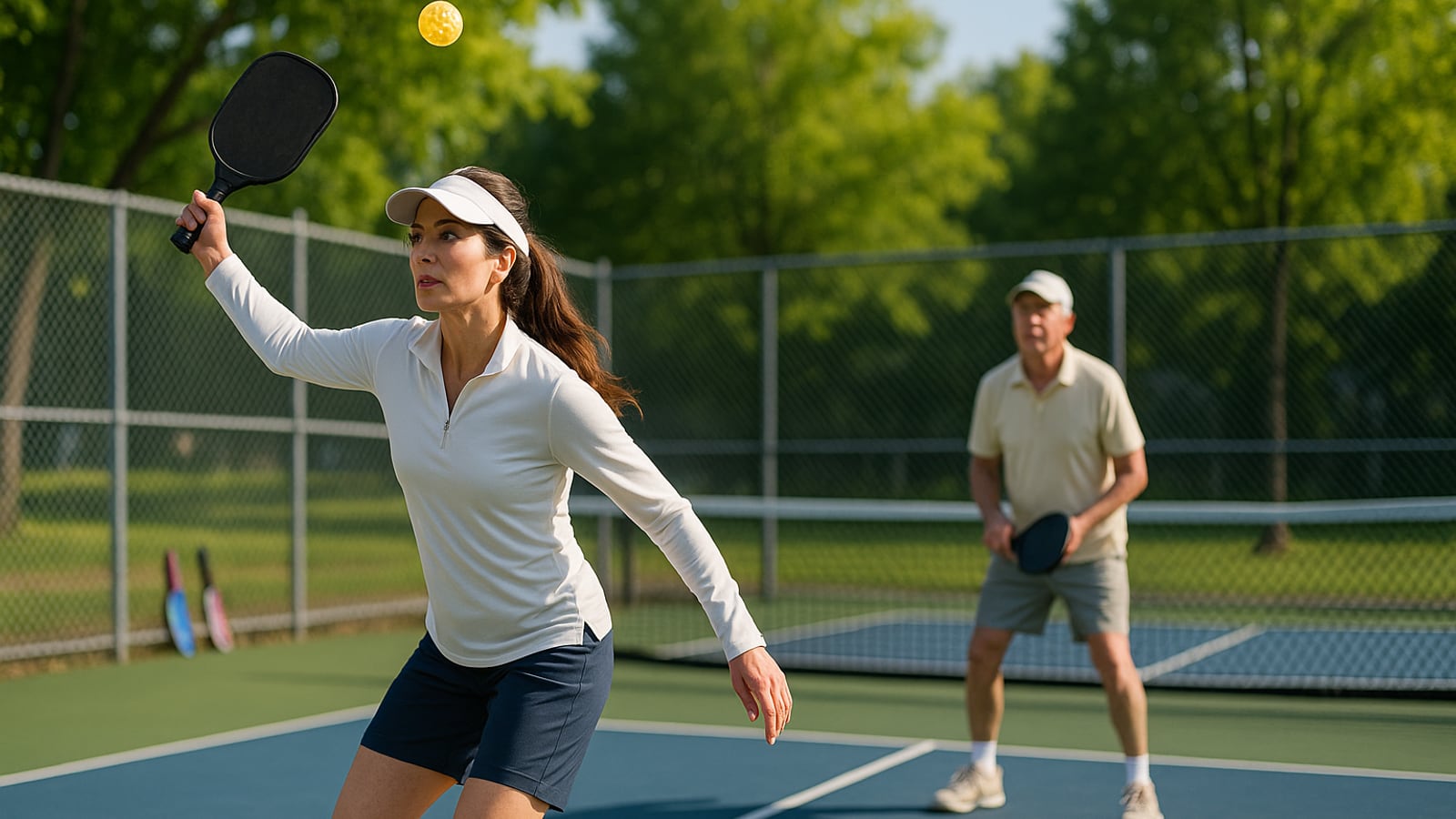
Quick answer: Pickleball is one of the best things you can take up after seventy, because the court is small and the game is social by design. Wear court shoes, protect your eyes, and never backpedal for a high ball. That last rule does more to keep you playing than anything else.
Tuesday, eight in the morning, a rec center gym. A row of paddles leans against the fence in the order people arrived. A retired schoolteacher is explaining the score to a man who ran a trucking company for forty years and has never been told what to do on a court in his life. He's listening. Twenty minutes later he's arguing about a line call and laughing. That's the game.
Why it suits this stage of life
The court is 20 by 44 feet, the same size as a badminton doubles court and about a quarter of a tennis court. You aren't sprinting. The serve is underhand. And a strip seven feet deep on each side of the net, called the non-volley zone or "the kitchen," stops anyone from standing at the net and smashing everything. So the best points turn into soft, patient exchanges close to the net, called dinks, where touch beats power.
That's why a seventy-four-year-old grandmother with good hands can beat a forty-year-old who hits hard and thinks slowly. Experience counts here.
Be honest with yourself about the other side, though. It's still a quick sport. Balls come at your hands fast at the net, and you'll twist, lunge and stop suddenly. It's gentle compared with tennis. It isn't gentle.
The move that ends seasons
Most serious pickleball injuries in older players don't come from overdoing it. They come from one bad reflex.
Your opponent lobs the ball over your head. Your instinct is to shuffle backward, eyes up, paddle raised. Your heels catch, there's nothing behind you, and you go down backward. You throw a hand out to stop the fall, and that's how wrists break. If the hand doesn't catch you, your hip or the back of your head does.
So make it a rule before you ever step on a court:
- Never backpedal. If a lob goes over you, turn sideways and walk or jog back, the way you'd turn to go up a staircase.
- Or let it go. Losing one point costs you nothing. A broken wrist costs you the summer.
- Talk to your partner. Call "yours" or "mine" early. The partner who's already behind the ball should take it.
- Stay low and balanced at the net. Knees soft, weight forward, paddle up in front of your chest.
Tell your regular partners you play by this rule. Most good players over sixty already do, and they'll respect it.
If balance is already a question for you, work on it off the court too. What actually keeps knees and hips going past seventy covers the simple daily work that makes a lunge safer.
Before your first game
Talk to your doctor first if you have heart trouble, osteoporosis, a joint replacement, balance problems, or you take a blood thinner, since a fall means more when you bruise and bleed easily. Most people get a yes, sometimes with conditions. Ask what those conditions are.
Then get these right:
- Court shoes, not running shoes. Running shoes are built to go forward and their soft, raised heels roll over when you slide sideways. Tennis or pickleball shoes have flatter soles made for lateral movement. This is the one purchase worth spending on.
- Eye protection. A ball off a paddle at the net can hit you in the eye before you can blink. Sports glasses or shatter-resistant safety glasses are cheap insurance. If you wear prescription lenses, ask your eye doctor about sports frames.
- A midweight paddle to start. Something around 7.5 to 8 ounces is forgiving on the elbow and shoulder. Many rec centers keep loaner paddles, so borrow before you buy.
- The right ball. Outdoor balls are harder with smaller holes. Indoor balls are softer with bigger ones. Your group will already have a favorite.
- Water, and a snack if you'll play more than an hour.
If you're playing outdoors
Morning courts in Arizona or Florida mean two hours of steady sun, and a visor won't cover it.
Wear a broad-spectrum sunscreen of SPF 30 or higher every time. Any one of those beats skipping it, because sun damage is a proven cause of skin cancer. Reapply every two hours and after you've sweated through a few games. A wide-brimmed hat and shade between games help too.
If you're choosing, pick a mineral sunscreen made with zinc oxide or titanium dioxide. They sit on top of the skin, cover both kinds of UV, and are gentler on sensitive skin. They're also the only two filters the FDA proposed in 2019 as "generally recognized as safe and effective," while it asked makers of the other filters for more safety data. FDA studies published in JAMA in 2019 and 2020 found several common chemical filters absorbed into the bloodstream, though the FDA and dermatologists still consider approved chemical sunscreens safe and effective. The honest trade-off is that some mineral formulas leave a white cast. Tinted ones fix that. Blue Lizard Sensitive Mineral SPF 30, EltaMD UV Physical SPF 41 (tinted) and Neutrogena Sheer Zinc SPF 50 are all easy to find.
How open play actually works
Walking into open play the first time is the hard part. Nobody explains it, and everyone else seems to know the system.
Usually it goes like this. You put your paddle in the rack or line at the end of the queue. When a game ends, the four players step off and the next four paddles go on. Some groups mix everyone, and others split courts by level, often using a self-rating from 2.0 for a beginner up to 5.0 and beyond. Rate yourself low. Nobody minds a humble 2.5 who turns out better. Everybody minds a "3.5" who can't return a serve.
A few rules to know before you start:
- The serve is underhand, hit below the waist, and goes diagonally past the kitchen.
- The serve has to bounce, and so does the return. After those two bounces, anyone can hit the ball in the air.
- You can't hit the ball in the air while you're standing in the kitchen.
- Games usually go to 11, and you have to win by 2.
Scoring in doubles is three numbers: the serving team's score, the receiving team's score, and which partner is serving, 1 or 2. Games start at "zero, zero, two." It'll confuse you for about a week, and then you'll be the one explaining it to the next newcomer.
If your rec center or senior center runs a beginner clinic, take it. An hour of instruction saves a month of bad habits. USA Pickleball, the sport's governing body, has a court finder on its website if you don't know where people play near you.
The friendships are the point
The rotation is what does it. You can't play with the same three people all morning, so you end up partnered with strangers, and strangers become the people you have coffee with afterward.
A widower who hasn't said much to anyone since the funeral finds he has somewhere to be at eight on Tuesdays and Thursdays, and people who notice when he doesn't show. A couple who retired to a new town gets to know the neighborhood in a month instead of a year. A grandfather teaches his twelve-year-old granddaughter the game over Thanksgiving, and for once she's the one asking him to play.
Be the player people are glad to see. Arrive a few minutes early and help put up the portable nets. Stay afterward to take them down. Bring a can of new balls when the group's are getting soft. Partner with the nervous beginner, because someone once did that for you.
Stand your ground, too. If a partner lectures you after every point, you're allowed to say, kindly, that you're here to enjoy yourself, and to put your paddle in a different line next time. And if something hurts in a sharp or new way, stop. Nobody worth playing with will think less of you.
Starting smart
Play two or three mornings a week at first, not every day. Warm up for ten minutes before your first game with brisk walking, arm circles, some gentle side steps and a few easy dinks. General stiffness the next morning is normal. Pain in one spot that gets worse, or a joint that swells, isn't. Get it looked at.
The players who last into their eighties tend to do some strength work on the days they don't play. What to keep lifting after sixty, and what to stop is a good place to start.
The trucking man from Tuesday? He bought his own paddle by the third week. He still argues line calls. He also brings the donuts.
This is general information, not medical advice. Talk with your doctor before starting a new sport, especially if you have heart, bone or balance concerns.
This is general information to help you think things through, not medical, legal or financial advice. Please check with your doctor, pharmacist or a qualified adviser before making a change.
Cal Brennan
Fitness
Strength coach. Trains fathers, tradesmen and desk workers, which means programmes that survive a bad week.
Watch
Worth an hour of your evening
More from BRO Seniors.
From channels we rate. Plays on YouTube.
Read next