
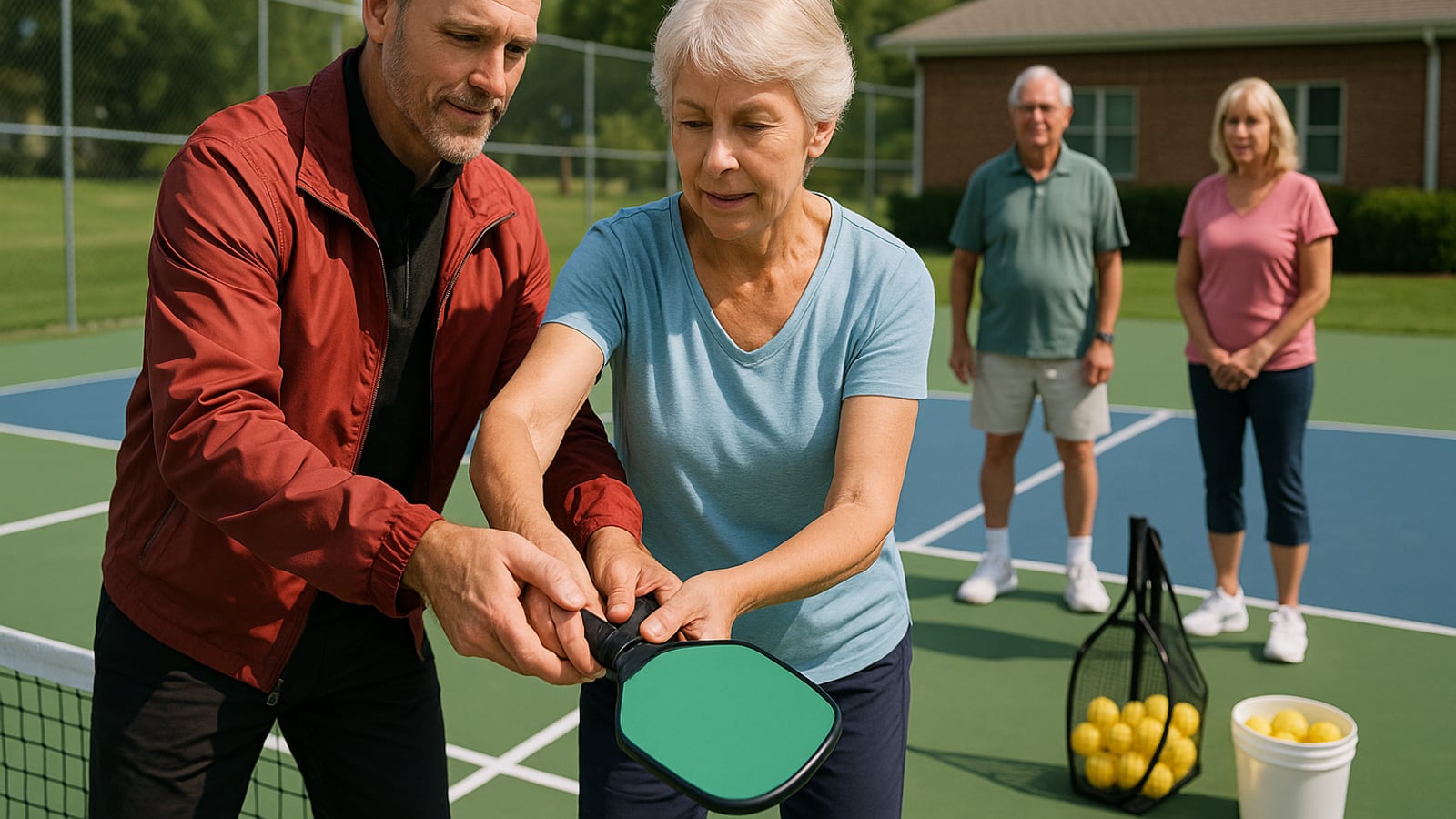
Quick answer: Get a standing court time approved before you recruit anyone, buy loaner paddles so nobody has to spend money to try it, and run a separate beginner hour. Most new groups don't fail for lack of players. They fail because the good players scare off the new ones by the second session.
A pickleball court is 20 by 44 feet, the same size as a doubles badminton court. That's smaller than you'd think. It fits in a lot of places your community already has, and that's where you start.
The problem nobody plans for
Picture the first Tuesday. Eleven people show up. Three of them played tennis for thirty years and already own good paddles. Five have never held one. The other three came to watch and got talked into it.
The tennis players are friendly. They're also hitting hard, calling "out" fast, and quietly pairing up with each other because the games are better. By the end of the morning, the retired pharmacist who was nervous to begin with has sat out four games in a row. She won't say anything. She just won't come back.
Every piece of advice below is built around keeping her.
Get the court before you get the players
Go to the activities director or the management office first, not the bulletin board. Ask for three things in writing:
- A standing time slot. Same days, same hours, every week. "Tuesdays and Fridays, 8:30 to 10:30" beats "whenever the court's free." People build habits around fixed times.
- Permission to mark lines. Painter's tape or vinyl court tape works indoors on a gym or multipurpose floor. Sidewalk chalk works on an outdoor slab. Don't paint anything permanent without written approval.
- What the insurance covers. Ask whether resident-run activities fall under the community's coverage and whether they want participants to sign a waiver. Let them decide. That's their job, and asking protects you.
Look past the obvious spot. An unused tennis court can usually take two pickleball courts comfortably, sometimes four. A shuffleboard area, a clubhouse floor or a quiet corner of a parking lot can work too.
Then say the annoying part out loud: pickleball is loud. That hollow pop carries, and noise complaints have soured more than a few communities on the sport. If the court sits near anyone's bedroom window, knock on their door before you start. Agree on hours. No play before 8 a.m. is a reasonable offer. Neighbors who were asked first rarely complain later.
What to buy, and what to skip
You need less than the sporting goods aisle suggests.
What we'd buy:
- A portable regulation net. It should set up at 36 inches high at the sides and 34 in the middle. Check the height with a tape measure the first time, because cheap ones sag.
- The right balls. Outdoor balls are harder with smaller holes. The Franklin X-40 is the one you'll see on most outdoor courts. Indoor balls are softer with bigger holes. Using the wrong one makes the game feel off and nobody can tell why.
- Six to eight loaner paddles. Mid-weight composite paddles in a bin by the court. Nobody should have to spend money to find out whether they like the game.
- A paddle rack. A simple wall rack or a bench works. More on this below.
What we'd skip:
- Expensive paddles for the group. Let players upgrade on their own once they're hooked.
- Matching shirts, a logo or a club name. Wait until you've made it past three months.
Ask whether the community's activity budget will pay for the net and balls. Many will, once you show up with a sign-up sheet already full. If not, split it among the first dozen players and keep the receipts in a folder.
Run two sessions, not one
This is the single decision that keeps a group alive.
Beginner hour comes first, say 8:30 to 9:30. Slower balls if you can get them. Rules taught as you go. Experienced players are welcome only if they're there to rally gently and coach. Many will happily do it if you ask them directly. "Would you run the beginner court on Tuesdays?" lands far better than a general plea for help.
Open play follows. Anyone, any level, rotating partners.
For open play, use the paddle rack. Players waiting to play put their paddles in the rack in order. When a game ends, all four players come off, and the next four paddles go on. Nobody gets to "hold" a court with their favorite partner. It keeps things fair without anybody having to be the bad guy.
Keep games to 11, win by 2. That's about fifteen minutes. Short games mean shorter waits and more mixing.
Teach three rules, not thirty
A new player needs three things on day one. The rest can wait.
- The serve. Underhand, contact below the waist, diagonally into the opposite service box.
- The two-bounce rule. The serve has to bounce. The return has to bounce. After that, you can hit it out of the air.
- The kitchen. The 7-foot zone on each side of the net. You can't hit a ball out of the air while standing in it.
Scoring confuses everyone for about three weeks, including people who taught high school math. Have the server call the score out loud before every serve. It sinks in.
Safety, plainly
Pickleball is gentle on the body compared with tennis. The real danger isn't the game. It's the fall.
- Don't backpedal. Most serious pickleball injuries come from stepping backward for a lob and going over. Make it a group rule: turn and move, or let it go. Nobody should lose a hip over a point.
- Wear court shoes. Running shoes are built for moving forward. Court shoes are built for side to side. The difference matters on a quick lateral step.
- Consider eyewear. A ball off a paddle at close range can reach an eye before you can blink. Sports glasses or even plain safety glasses help.
- Know where the defibrillator is. Find out where the nearest AED hangs and who on staff is trained to use it. Post it on the court.
- Warm up for five minutes. Walk the court, swing easy and do a few gentle lunges before the first game.
- Heat and water. Outdoors in summer, play early and keep a cooler of water by the net.
If your knees or hips are already on your mind, what actually keeps knees and hips going past seventy is worth reading before you commit to three mornings a week. And the strength work in what to keep lifting after sixty, and what to stop pays off directly on the court.
Keeping it going past the first season
Groups fade when the one person who organized everything goes on a cruise. Plan for that from the start.
- Name a backup. One organizer and one backup who can open the court, set up the net and run the rack.
- One place for news. A group text or a sign-up sheet on the bulletin board, whichever your people actually check. Not both.
- A weather rule. Decide once what cancels play (rain, wind, temperatures above a set number) so nobody has to make a call at 7 a.m.
- A welcome person. Someone whose only job is spotting a new face and getting them on a court within ten minutes.
- Leave the court better than you found it. Roll the net, collect every ball, sweep the leaves and return the loaner paddles to the bin. The group that treats the space well is the group that keeps its time slot.
The competitive players will eventually want harder games. Give them their own court during open play or an extra session. That isn't a split. It's a sign the thing is working.
Then add coffee afterward. It's the cheapest thing you'll organize, and it's often what brings people back. The widower who moved in last spring and the grandmother from building C may start with the game and stay for the table.
You'll know you got it right in about a month. It won't be the good players who prove it. It'll be the person who said she'd only watch, back on the third Tuesday with a paddle she bought herself.
This is general information, not medical advice. Check with your doctor before taking up a new sport, especially after a joint replacement or with a heart condition.
This is general information to help you think things through, not medical, legal or financial advice. Please check with your doctor, pharmacist or a qualified adviser before making a change.
Cal Brennan
Fitness
Strength coach. Trains fathers, tradesmen and desk workers, which means programmes that survive a bad week.

Watch
Watch how it's done
Picked for this article.
From channels we rate. Plays on YouTube.
PlayPickleball.com
How to Play Pickleball in 5 Minutes
Briones Pickleball Academy
How To Play Pickleball For Beginners | Rules and Scoring Explained
Read next