
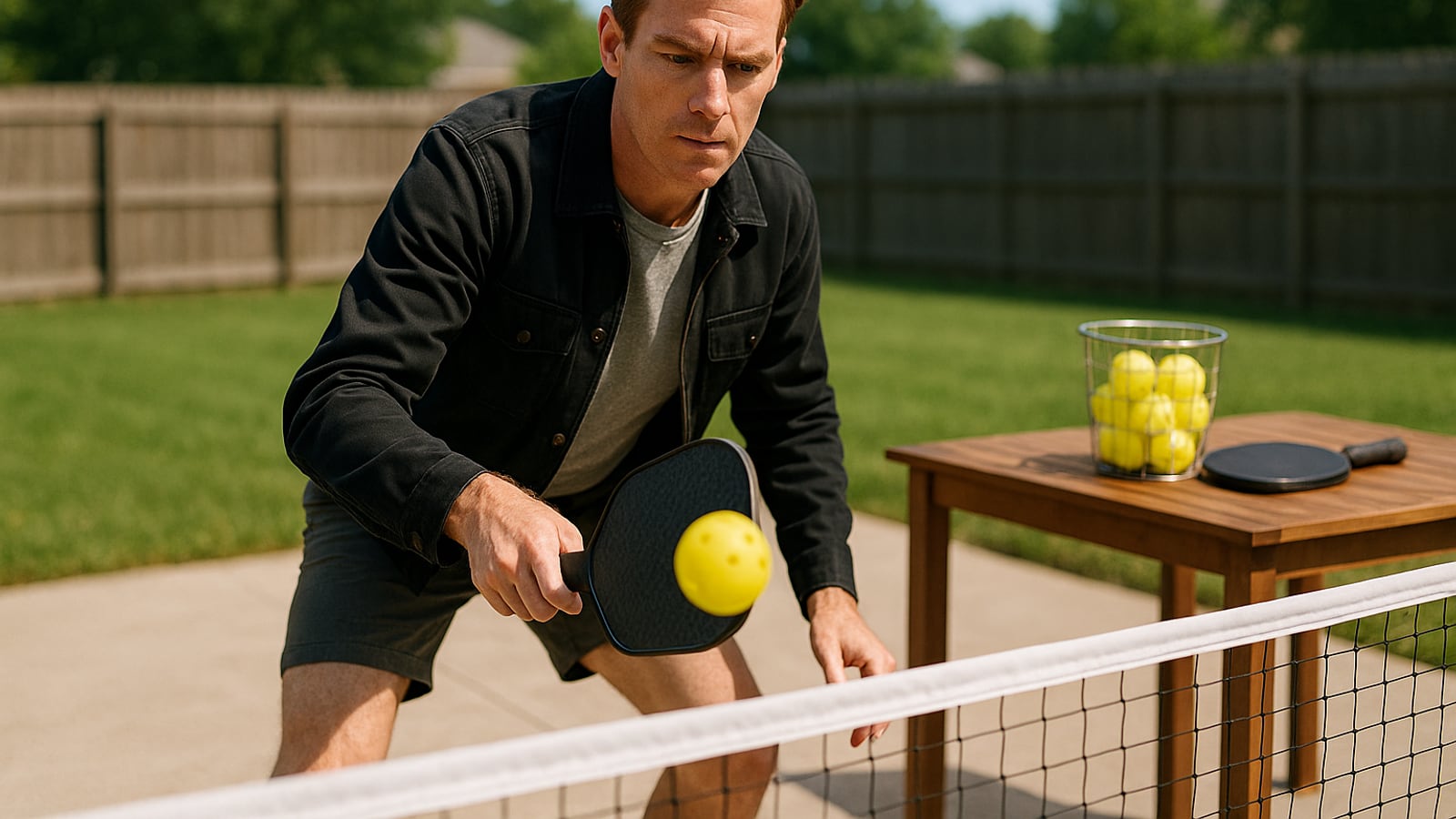
Quick answer: If you've played fewer than a couple dozen times, buy a midweight fiberglass or composite paddle for under fifty dollars and play it until you can say exactly what you don't like about it. Carbon is worth the money once you're rallying at the kitchen line on purpose and not by accident.
Every rec center in America has the same guy. Three weeks into the sport, he shows up with a raw carbon paddle north of two hundred dollars, the same model he saw a pro swinging on YouTube, and he still pops every dink six inches too high. The paddle didn't do that to him. But it didn't save him either, and he paid a lot to learn it.
Fiberglass and carbon do opposite jobs
Most people assume carbon is the "better" material, the upgrade, the pro stuff. That's only half right. The two faces aren't a good-better ladder. They're built for different things.
Fiberglass is springy. It flexes when the ball hits it and gives some of that energy back. You get more pop for less swing. That's great for a new player whose drives lack pace, and it's forgiving when you catch the ball a little off center. The cost is control. A springy face sends soft shots a bit farther than you meant, which is exactly the wrong direction when you're trying to drop the ball into the kitchen.
Carbon is stiff. It flexes less, so the ball comes off truer and softer, and the paddle does less of the thinking for you. That rewards a player who already has a clean stroke and punishes one who doesn't. Raw carbon faces also have a gritty texture that grabs the ball for spin.
And the grit wears off. Nobody puts that on the box. Play a few times a week and the surface texture smooths out over months, and the spin goes with it. If spin is the reason you're paying for a textured carbon face, you're buying a consumable. Budget for that honestly.
So the pick isn't "cheap versus good." It's power versus touch. A beginner usually needs a little help with power. An intermediate usually needs a lot of help with touch.
The core matters as much as the face
Under that face, nearly every modern paddle has a polymer honeycomb core. What you want to know is how thick it is.
- 16mm cores are softer and quieter and absorb more of the hit. The sweet spot feels bigger. Dinks and resets are easier to keep low. This is where most people should start.
- 13mm cores are thinner and firmer. More pop, faster off the face, less forgiving. Players who live on drives and hand battles at the net often like them.
Put a fiberglass face on a 16mm core and you've got a friendly, all-around paddle. Put raw carbon on a 13mm core and you've got a sharp, demanding tool.
Then there's thermoforming. A lot of premium paddles are now heat-molded into one sealed unibody shell, which makes them stiff and powerful. Some of them got a reputation for playing "hot" as they broke in, hitting harder than they did new, and a few models were pulled off USA Pickleball's approved list after retesting. If you ever plan to play a sanctioned tournament, check that list before you buy, not after.
Weight and grip, the two things you'll actually feel
Face material gets all the attention. Weight and grip size decide whether your arm is happy.
Weight. Most paddles land roughly between 7.5 and 8.5 ounces, and midweight is the sensible default. Lighter paddles are quick at the net and easy on the shoulder, but they twist on off-center hits and give you less plow-through on drives. Heavier paddles are stable and powerful, and they get tiring by the third game. If you're unsure, go midweight. You can always add lead tape to the edge later. You can't take weight off.
Grip. Circumference usually runs from about 4 to 4.5 inches. Too small and you'll squeeze it, which is how you end up with a sore forearm. Too big and you lose wrist feel on dinks. Quick check: hold the paddle in your normal grip, and you should be able to fit one finger of your other hand between your fingertips and palm. A little too small is fixable with an overgrip. Too big isn't.
A note if your elbow or shoulder already talks to you: paddle weight and grip size can make that better or worse, but a paddle isn't a treatment. See a doctor or a physical therapist, and bring the paddle along.
What your level actually needs
First month, still learning to serve in. Almost anything USA Pickleball approved, midweight, 16mm. The two-paddle set with balls from a sporting goods store is fine here. Honestly, this is where the cheap one is right, and it's right for longer than the internet will tell you. Your problems are footwork and patience. No face material fixes either one.
Playing a few times a week, getting to the kitchen line, working on drops. This is the upgrade moment. A 16mm paddle with a carbon face will make your resets and dinks noticeably more consistent. This is also where a real mid-priced paddle from a mainstream maker pays for itself, because now you've got a stroke worth protecting.
Competitive, hand battles, playing people who punish high balls. Now thermoformed carbon, 13mm versus 16mm, elongated shapes for reach, and the whole spec sheet start to matter. By this point you'll know what you want better than any buying guide does.
The mistake is skipping straight to the third bracket. That extra power turns every nervous dink into a floater your opponent is going to enjoy very much.
What we'd buy, what we'd skip
Buy:
- For a first paddle, a midweight fiberglass or composite model from a mainstream maker like Franklin, Onix or Selkirk's lower-priced SLK line. Confirm it's on the USA Pickleball approved list.
- For the first real upgrade, a 16mm carbon paddle from a brand that stands behind its warranty. Selkirk, JOOLA and CRBN all sell well-regarded carbon paddles across a range of prices.
- A couple of overgrips. They're cheap, they fix a slightly small handle, and a fresh one feels like a new paddle.
Skip:
- The pro's signature thermoformed paddle as a first purchase. Brilliant tool, wrong stage.
- Any paddle that isn't on the approved list, if tournaments are anywhere in your future.
- Wood paddles. They're heavy and dead, and they belong in the garage bin with the croquet set.
Treat paddles like tires, not like heirlooms. There's nothing to repair on a paddle with a crushed core, which is why buy-it-for-life should mean repairable, not expensive, and a paddle just isn't that kind of purchase. It's the same logic as the cheap pry bar versus the cheap ladder: spend where a failure costs you, save where it doesn't. A dead paddle costs you a game. That's a cheap lesson.
Signs it's time to replace yours
- A dead spot that sounds flat or rattles when you tap the face.
- The texture is gone and your serve spin went with it.
- The edge guard is peeling or the face is lifting at the seams.
- It suddenly plays much hotter or much softer than it did a month ago.
One last thing. If you learned on a friend's spare paddle or the club's loaners, give it back with a new overgrip on it and a sleeve of balls tucked in the bag. That's the old rule. You leave borrowed gear better than you found it, and the guy who does that gets invited back every Saturday.
Buy the cheap paddle. Play fifty games. The paddle you want next will be obvious, because your worst shot will tell you exactly what's missing.
Dean Shaw
Gear & Garage
Reads the warranty, the parts list and the long-term owner reviews before anything else. Trucks, tools, watches, and the cheap version that costs more.

Watch
Watch how it's done
Picked for this article.
From channels we rate. Plays on YouTube.
Pickleball Warehouse
How to Choose a Pickleball Paddle | Shape, Thickness & Weight Explained
Pickleball Effect
A Data-Driven Comparison of Titanium, Carbon Fiber, and Kevlar Paddle Faces
Read next