
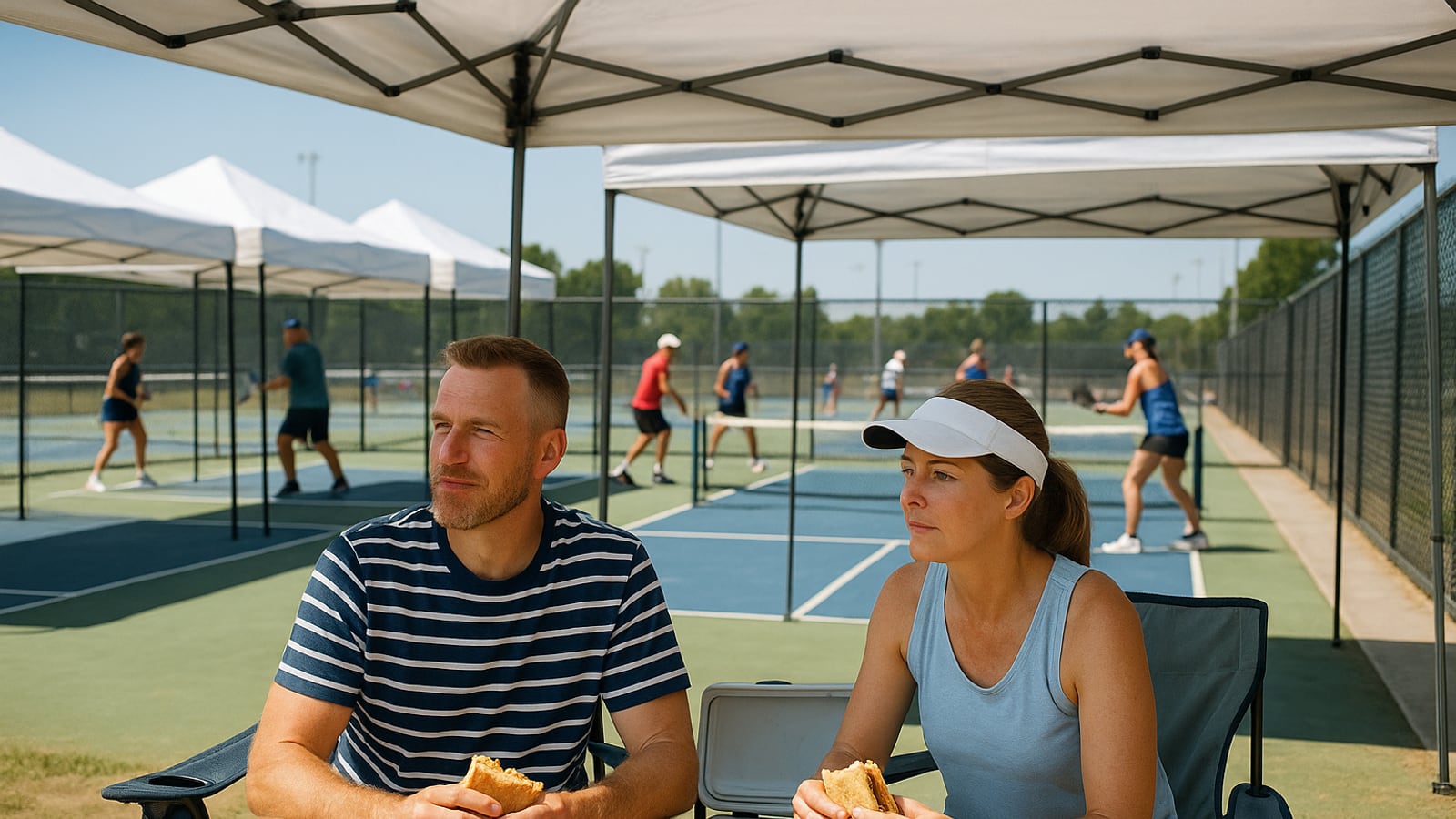
Quick answer: Enter one event at the level where you'd win about half your rec games against honest players. Pack for a nine-hour day, not a one-hour match. Food, shade and a second paddle matter more than your new overgrip.
Check-in is at 7:00. Your first match is at 7:40. You lose 11-6 to a pair of retired schoolteachers who never hit a ball harder than a firm handshake. Then you look at the bracket on your phone and realize your next match is at 11:15.
That's a tournament. Maybe ninety minutes of actual pickleball, spread across a day that starts before sunrise and ends when the gold medal match wraps. The players who do well at their first one aren't always the best players. They're the ones who planned for the waiting.
Read the format before you pay
Every tournament posts its format on the event page. Read it, because it tells you how long your day will be and how many matches you're guaranteed.
Round robin. You play every team in your pool. It's the best format for a first-timer, because you get several matches no matter what. Games are usually to 11, win by 2.
Double elimination. Lose once and you drop into the back draw, sometimes called the consolation bracket. Lose twice and you're done. Winners-bracket matches are often best two out of three games to 11. Back-draw matches are often a single game to 15. The formats vary by tournament, so don't assume.
Pool play into a bracket. A round robin in the morning, and the top teams advance to an elimination bracket in the afternoon. Long day if you're good. Short day if you're not.
Your first time, pick round robin if it's offered. You didn't drive ninety minutes to play two games.
Ratings, and the number that follows you
Pickleball skill levels run in half-point steps: 2.5, 3.0, 3.5, 4.0, 4.5, 5.0 and up. USA Pickleball publishes written descriptions of each level. Read them honestly. A 3.5 can dink with some patience and third-shot drop with some consistency. A 4.0 does both under pressure.
Most tournaments now lean on DUPR, the Dynamic Universal Pickleball Rating, which updates from match results. Many events require a DUPR rating to register or use it to place you in a skill bracket. If you don't have one, create a free account before you enter. Your tournament results will feed it either way, so the number you walk out with will follow you to the next event.
Now the part people don't like hearing. Don't sandbag. Entering 3.0 when you're a solid 3.5 might get you a medal, but everybody on that court knows it, and you'll have spent your day beating people who signed up to be tested fairly. It's poor sportsmanship. The medal won't feel like much either.
The opposite mistake is almost as common. Your home courts crowned you the best 3.5 in the neighborhood, so you enter 4.0 and get beaten 11-2 by people who play three tournaments a month. Local ratings are local. If you've only ever played the same eight people, drop half a point from what your ego says.
The rule of thumb: enter where you'd expect to lose about half your matches. That's where you'll learn the most and have the most fun.
Your partner matters more than your paddle
Choose a partner you like before you choose one who's better. You'll spend nine hours together, and three of them will be in a folding chair.
Before the day, settle three things:
- Who takes the ball down the middle. Most pairs give it to the forehand. Decide now, not after the third collision.
- Who calls "out" on balls near the sideline and baseline. Usually the player closest to the line.
- What you say after a bad miss. "Next one" is plenty. A lecture between points loses more games than a bad backhand.
Mixed doubles is a different game. The smart thing is to play to your team's strengths, and a pair that's decided that ahead of time is already ahead of most pairs in the draw.
Registration details that trip people up
Sanctioned tournaments require a USA Pickleball membership. Buy it before you register, not at the check-in table.
Fees are typically a registration fee plus a charge per event, so entering doubles and mixed costs more than entering one. Your first time, one event is enough. Two events means you might be scheduled on two courts at once, and the tournament desk won't hold a match while you finish the other one.
Your paddle has to be on the USA Pickleball approved list for sanctioned play. Most name-brand paddles are. That discount paddle from a website you've never heard of might not be. Check for the approval mark or look it up on the USA Pickleball site before you go.
The event page will also name the tournament ball. Outdoors it's often the Franklin X-40. If you've been playing with something softer, buy a sleeve of the tournament ball and use it for a week. Different balls bounce differently, and you don't want to figure that out in the first game.
What to pack
Pack like a parent at an all-day youth soccer tournament, because it's the same problem: short bursts of action and long stretches of sitting. If you've ever done a travel soccer weekend, you already know the drill.
The gear bag
- Two paddles. Edge guards crack. Faces delaminate. Your only paddle will pick the worst morning to go.
- Court shoes, not running shoes. Running shoes are built for forward motion, and pickleball is all side-to-side. Rolled ankles happen in running shoes.
- A sleeve of the tournament ball for warming up.
- A spare overgrip, a towel and a dry shirt. You'll want the shirt by noon.
- Whatever brace, sleeve or tape you use at home. Don't try anything new on tournament day.
The cooler
- More water than you think, plus an electrolyte drink.
- Food you can eat in small pieces all day. Bananas, a peanut butter sandwich cut in quarters, pretzels, a few granola bars.
- Skip the heavy lunch. A cheeseburger at 11:00 feels great until your 11:40 match.
The comfort kit
- A folding chair. Seating at most venues runs out by 8:00.
- A hat and sunglasses for outdoor events.
- Sunscreen. Wear some every time, since any broad-spectrum SPF 30 or higher beats skipping it. The one to buy is a mineral formula with zinc oxide or titanium dioxide. Those are the only two filters the FDA proposed in 2019 as generally recognized as safe and effective, while it asked for more data on the others. They sit on the skin and they're gentler if you sweat it into your eyes. Some leave a white cast, and a tinted one fixes that. Blue Lizard Sensitive Mineral SPF 30, Neutrogena Sheer Zinc SPF 50 and EltaMD UV Physical SPF 41 are all easy to find. Reapply every two hours and after you've been sweating, which is every two hours.
- A battery pack. Brackets and court assignments come through an app or website, and your phone will die by 2:00.
- Some cash. The food truck's card reader will be down.
How to act on the day
Check in early. Find the desk, find the bracket, find the bathrooms, in that order.
Most amateur matches are self-refereed until the medal rounds. Each team calls the lines on its own side. The rule is simple: if you didn't clearly see it out, it's in. Call the score loudly before every serve so nobody argues about it at 9-9.
Be generous. Give your opponents the close call. Hand them the ball. Tell them "good shot" when they've earned it.
But don't be a doormat. If an opponent's calls keep going one way and it's changing the match, stop politely and ask the tournament desk for a referee. That's what the rule is there for. Standing up for a fair game isn't bad sportsmanship. Stewing about it for three games and then snapping is.
When your match ends, get off the court fast. The next pair is waiting. Thank the ref if you had one. Pick up any stray balls.
And when your event is over, stick around. Watch the gold medal match in your bracket. Watch the level above yours and see what they do differently. Then fold a few chairs and help carry the nets. The volunteers running that tournament showed up at 5:30 so you'd have somewhere to lose 11-6 to two retired schoolteachers.
Leave the venue better than you found it, and next year they'll remember you as the guy who helped. Not the guy who went two-and-out.
Dean Shaw
Gear & Garage
Reads the warranty, the parts list and the long-term owner reviews before anything else. Trucks, tools, watches, and the cheap version that costs more.

Watch
Worth an hour of your evening
More from Sports.
From channels we rate. Plays on YouTube.
Read next