
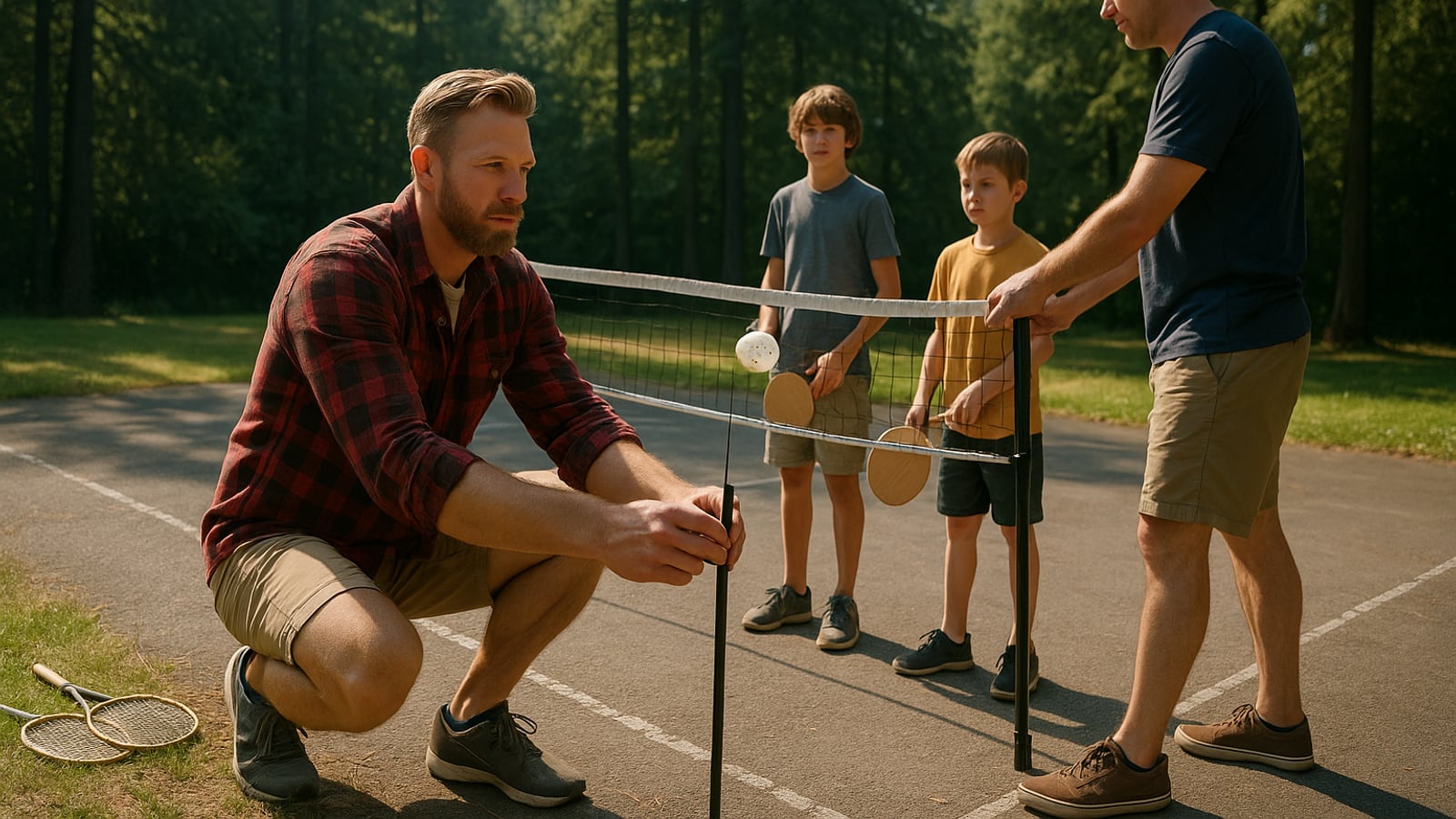
Quick answer: Pickleball was invented in the summer of 1965 on Bainbridge Island, Washington, by Joel Pritchard, Bill Bell and Barney McCallum. They built it out of spare badminton gear, ping-pong paddles and a plastic ball with holes in it, and they built it so their kids would stop complaining.
The best sports in America weren't designed by committees. They were improvised by somebody's dad on a Saturday.
In the summer of 1965, Joel Pritchard and his friend Bill Bell came back to Pritchard's place on Bainbridge Island, a short ferry ride across Puget Sound from Seattle, and found their families bored. There was an old badminton court on the property. There wasn't, however, a complete set of badminton rackets. Every parent has lived some version of this. The shuttlecock is on the roof, two rackets have broken strings, and the kids are staring at you like you're the entertainment.
So the men grabbed ping-pong paddles and a perforated plastic ball, the Wiffle-style kind, and started hitting it over the net. They played with the net at badminton height, about 60 inches, at first. The ball bounced well on the asphalt, so they dropped the net to 36 inches. That one change is basically the whole sport. Lower the net, let the ball bounce, and suddenly a ten-year-old and a forty-year-old can play the same game.
A few days later Barney McCallum joined in. McCallum was the practical one. The ping-pong paddles were flimsy and small, so he cut sturdier ones out of plywood. The three of them started writing rules, and their stated goal was a game the whole family could play together.
Keep that goal in mind. It explains everything that happened over the next sixty years.
About that name
Nobody agrees on it, and that's half the fun.
Joan Pritchard, Joel's wife, said the game reminded her of the "pickle boat" in crew, the boat filled with leftover rowers from other crews. Pickleball, stitched together from leftover parts of badminton, tennis and ping-pong, fit the description.
The other story is that the game was named after the Pritchards' dog, Pickles, who liked to chase the ball. It's a better story. According to the Pritchard family's account, it's also backward: the dog came along later and was named after the game. McCallum remembered it differently over the years. You'll hear both at any court in the country, usually from a guy who's very sure.
The long, quiet middle
What surprises people is how slowly this thing grew. It wasn't a craze for decades. It was a secret.
In 1967, the first permanent pickleball court was built in the backyard of Bob O'Brian, a Pritchard neighbor on Bainbridge. In 1972, the founders formed a corporation, Pickle-Ball, Inc., to protect the game they'd made. Magazine coverage trickled in through the mid-1970s. The first known tournament was held in 1976 at the South Center Athletic Club in Tukwila, Washington, and a lot of the players who showed up were college tennis players who had no idea what they'd signed up for.
Meanwhile, Pritchard's day job kept him busy. He served in the U.S. House as a Republican from 1973 to 1985, then as Washington's lieutenant governor from 1989 to 1997. Very few congressmen have invented a sport. Fewer have invented one that outlasted anything Congress passed that year.
The 1980s gave the game its spine. The U.S. Amateur Pickleball Association formed in 1984 and published the first official rulebook. That same year, a Boeing industrial engineer named Arlen Paranto built a paddle from the kind of composite honeycomb material used in aircraft. McCallum's plywood had done its job. Now the game had equipment people actually wanted to buy.
By 1990, it was being played in all 50 states. Almost nobody outside the courts noticed.
The retirees who saved it
Every sport needs a carrier. Baseball had the Civil War camps. Basketball had the YMCA. Pickleball had retirement communities in Arizona and Florida.
It makes sense. The court is small, 20 by 44 feet, the same size as a doubles badminton court. The serve is underhand. Rallies are long and social, and you can hear the person across the net talk. A man with a new hip and a lifetime of tennis could step onto a pickleball court and be competitive the same week. Places like The Villages in Florida turned it into a daily ritual, and the snowbirds carried it home to Ohio and Minnesota and everywhere else.
The organization reorganized as a nonprofit, USA Pickleball, in 2005. The first USA Pickleball National Championships were held in Buckeye, Arizona, in 2009. For a long stretch, "pickleball" was a punchline about Grandpa's new hobby.
Grandpa was ahead of everybody.
Then it exploded
The dam broke in the 2010s and blew wide open around 2020, when people were desperate for something to do outside, with a few friends, at a safe distance. A pickleball court turned out to be the perfect answer. The Sports & Fitness Industry Association began naming it America's fastest-growing sport, and it kept that title for several years running.
The money followed. The U.S. Open Pickleball Championships launched in Naples, Florida, in 2016. The national championships moved to the Indian Wells Tennis Garden in California, one of tennis's most famous venues, in 2018. Pro tours formed and fought and merged. Major League Pickleball, a team format, launched in 2021 and drew ownership investment from athletes including LeBron James and Tom Brady.
The game got real stars, too. Ben Johns became the dominant men's player of the era. Anna Leigh Waters turned pro at 12 and climbed to the top of the women's game as a teenager, often playing alongside her mother, Leigh. A family sport produced a mother-daughter doubles team at the highest level. Pritchard would've loved that.
In 2022, Washington made pickleball its official state sport. The game had come home.
The part nobody likes to say out loud
Commentary: Not everyone is thrilled, and some of the complaints are fair.
Pickleball is loud. That hollow pock of a hard paddle on a plastic ball carries, and neighbors near busy courts have fought it in city council meetings and in court. Tennis players have watched their courts get striped over with pickleball lines and resent it. When one sport grows this fast, it takes space from somebody.
But the reason for the growth is worth defending. Look at where youth sports have gone: year-round travel teams, specialization at nine, parents spending weekends in hotel lobbies. If you've read what the research says about one-sport kids, you know the costs. Or if you've just had a kid make a travel soccer team, you know the calendar.
Pickleball runs the other way. It's a game a family plays together, on the same court, at the same time. A grandfather can beat his grandson on Tuesday and lose to him on Saturday. Three dads built exactly that on purpose, and sixty years later it's still the thing the game does best.
Get on a court this week
You don't need much. A paddle, a few balls and a pair of court shoes. Running shoes grip poorly on lateral movement and roll ankles.
- Find a court. USA Pickleball runs an online court finder. Most towns have public courts now, often painted onto old tennis courts.
- Buy the right ball. Outdoor balls are harder with smaller holes. Indoor balls are softer with bigger ones. Using the wrong one is miserable.
- Learn the kitchen. The seven-foot zone on each side of the net is the non-volley zone. You can't hit the ball out of the air while standing in it. Every beginner steps in. Every beginner hears about it.
- Learn the two-bounce rule. The serve has to bounce, and the return has to bounce, before anyone can volley. It keeps the game from turning into a slugfest at the net.
And learn the etiquette, because it's where you show who you are. Open play usually runs on a paddle rack: you set your paddle in line and wait your turn. When your game ends and people are waiting, come off the court without being asked. Bring a spare ball for the group. Call the close ones in your opponent's favor. Leave the court cleaner than you found it, even if that just means picking up somebody else's water bottle.
Pickleball started as a way to make a summer afternoon better for everybody on the property. Play it that way.
Marcus Vale
Editor-in-Chief
Twenty years in magazines, most of it deciding what to cut. Writes about work, discipline and the decisions that compound.
Watch
Worth an hour of your evening
More from Sports.
From channels we rate. Plays on YouTube.
Read next