
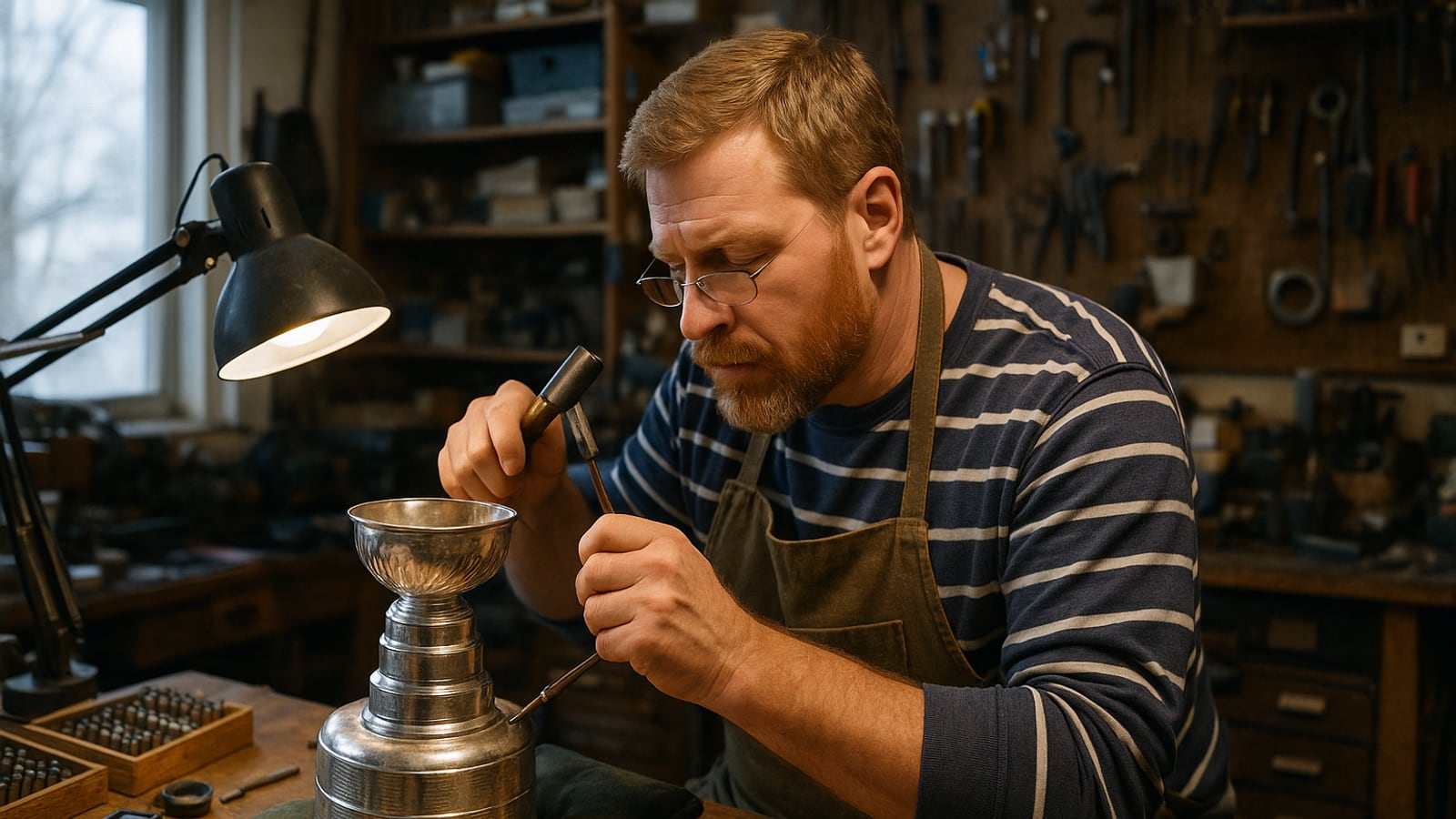
Win the Super Bowl and the league orders a brand-new Lombardi Trophy from Tiffany. You keep it. Next year somebody else gets a fresh one.
Win the Stanley Cup and you get the same trophy Henri Richard hoisted eleven times as a player. Your name goes on it, in small capital letters, right next to guys who died before your grandfather was born. Then you give it back.
That one fact explains nearly every tradition around the Cup. It isn't a prize. It's an heirloom that gets passed around a very small, very beat-up family.
Ten guineas and a man who never saw a Final
Frederick Arthur Stanley, Lord Stanley of Preston, was Canada's Governor General when he watched hockey at the Montreal Winter Carnival in 1889. His kids got hooked on the game, and so did he. In 1892 he paid ten guineas, roughly fifty dollars at the time, for a silver bowl from a London silversmith. He meant it as a challenge trophy for the best amateur club in Canada. It was first awarded in 1893, to the Montreal Hockey Club.
Here's the part that gets people. Lord Stanley never saw a single Cup game. He went home to England in 1893 when he inherited the title Earl of Derby, and that was that.
For its first few decades the Cup was a challenge trophy run by trustees, and all kinds of teams took a shot at it. The Seattle Metropolitans became the first American team to win it in 1917. The NHL effectively took control in 1926 and got it formally in 1947.
Only twice has nobody won. In 1919 the Final between Montreal and Seattle was called off during the Spanish flu, and Canadiens defenseman Joe Hall died days later. In 2005 a lockout wiped out the whole season. The empty spaces are on the Cup too. Hockey doesn't pretend those years didn't happen.
Your name on the silver
The 1907 Montreal Wanderers scratched their roster inside the bowl. Starting with the 1924 Canadiens, engraving every winning team became the tradition, and it's never stopped.
The rule for getting your name on it's plain. You play at least 41 regular-season games for the winning team, or you dress for a game in the Final. Teams can petition for exceptions, and they often do for a guy who missed time hurt.
The engraving is done by hand. By hand means mistakes, and the Cup has some beauties:
- "Toronto Maple Leaes" from 1963
- "Bqston Bruins" from 1972
- "New York Ilanders" from 1981
Nobody sands them off. The Cup keeps its typos the way a family keeps the story about the time Dad drove to the wrong wedding.
My favorite belongs to the 1984 Oilers. Owner Peter Pocklington had his father's name, Basil Pocklington, added though he had nothing to do with the team. The league had it struck out with a row of X's. It's still there, a permanent little lesson in not padding the résumé.
Then there's the math problem. The Cup can't grow forever, so the barrel carries five large bands of names. When the bottom band fills, the oldest band on top comes off and goes to the Hockey Hall of Fame in Toronto, and a blank one takes its place at the bottom. So being on the Cup isn't technically forever. It's about sixty-some years on the trophy and eternity in the Hall. Most of us would take that deal.
The Cup you see on TV isn't Lord Stanley's original bowl, either. That one got brittle and was retired to the Hall of Fame. The one the players lift is a presentation version, about 35 inches tall and roughly 34.5 pounds. If you've ever watched a captain skate a lap with it overhead after two months of playoff hockey, you know those pounds count.
A trophy with a criminal record
No trophy in sports has been treated worse by the people who love it most.
The story goes that a member of the 1905 Ottawa Silver Seven drop-kicked it into the Rideau Canal on a dare, and a teammate fished it out the next day. The 1907 Wanderers left it at a photographer's house, where his mother reportedly planted flowers in it. Members of the 1924 Canadiens, the tale goes, set it on a Montreal curb to fix a flat tire, drove off without it and had to double back. It was still sitting there.
In the early '90s it wound up at the bottom of Mario Lemieux's swimming pool. After the Rangers ended a 54-year drought in 1994, Ed Olczyk let Go for Gin, that year's Kentucky Derby winner, eat out of it.
So the Cup never goes anywhere alone now. Since 1995, every player and staff member on the winning team gets a day with it, and a Hall of Fame "Keeper of the Cup" travels with it in white gloves. Phil Pritchard is the face most fans know. The Cup has been to fishing boats, hospital wards, church basements, small-town arenas in Saskatchewan and backyards in Sweden. Players take it to the rink where they learned to skate. Babies have been baptized in it.
That's the best version of the tradition. A guy who spent twenty years grinding his way up doesn't take the Cup to a nightclub. He takes it home, and he lets the whole town put their hands on it.
The rules nobody wrote down
Most of the Cup's traditions aren't in any rulebook. Players simply know them, and a rookie who breaks one hears about it forever.
You don't touch it until you've won it. Hockey is superstitious, and grabbing the Cup before you've earned it's the fastest way to get disowned in a locker room. Many captains won't even touch the conference trophy they're handed one round earlier, reasoning that it isn't the one they came for.
The captain lifts it first, then passes it. Who gets it second is a statement, usually the veteran who's waited longest or the guy who played hurt. The best example came in 2001. Joe Sakic's Colorado Avalanche won, the commissioner handed him the Cup, and Sakic didn't lift it. He handed it straight to Ray Bourque, who'd played 22 seasons without winning. Bourque raised it first. Captains still get measured against that moment.
The handshake line. After every playoff series, win or lose, both teams line up at center ice and shake hands. These are men who spent two weeks trying to put each other through the glass. Then they look each other in the eye and say "good series." No other major sport does it this reliably, and it's the single best thing you can show a kid about competing. You go all out, you win or lose honestly, and then you shake the man's hand.
The beard. Players stop shaving when the playoffs start. The early-'80s Islanders dynasty gets credit for popularizing it. By June, some of them look like they've been living in the woods.
The octopus. In Detroit in 1952, two brothers named Pete and Jerry Cusimano threw an octopus on the ice. Winning the Cup took eight wins back then, one for each leg. Red Wings fans still do it, and the arena crew still hates it.
Why it lands harder than the others
The Cup is the hardest trophy in North American sports to win. Four best-of-seven rounds, sixteen wins, two months of hockey played through injuries nobody reveals until the parade is over. But difficulty isn't what makes it special. Plenty of things are hard.
It's special because it's shared. Jean Béliveau's name is on it seventeen times, ten as a player and seven as an executive. Marguerite Norris became the first woman engraved on it as president of the 1955 Red Wings. The 1963 Leafs typo sits a few inches from the names of guys who'll win it next June. Nobody gets to keep it. Everybody gets to belong to it.
If you're watching the Final with your kids this year, don't leave the room when the horn sounds. Stay for the handshake line. That's the part worth teaching. Then watch the captain, and see who he hands it to.
That handoff will tell you more about the man than anything he did all season.
If you'd like more of the same spirit a little closer to home, read what a small town loses when the Friday night lights go out. If your own kid is just starting to compete, the handshake line pairs well with what to do when your kid makes a travel team.
Marcus Vale
Editor-in-Chief
Twenty years in magazines, most of it deciding what to cut. Writes about work, discipline and the decisions that compound.

Watch
Watch how it's done
Picked for this article.
From channels we rate. Plays on YouTube.
NHL
The Stanley Cup Story
The Wall Street Journal
The Secret Life of the Stanley Cup
Read next