
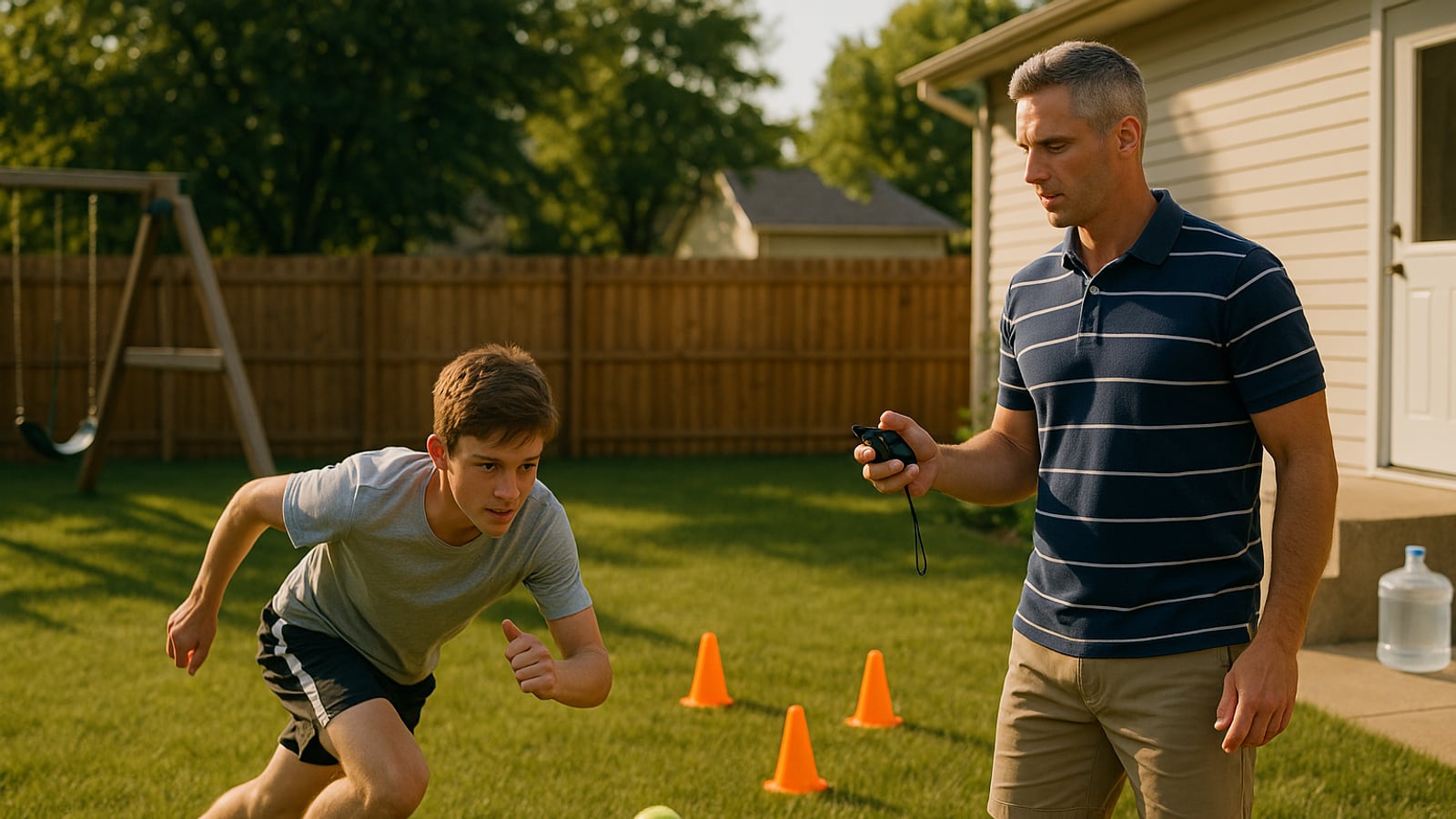
Quick answer: Sprints of 10 to 30 yards, full rest between every rep, and quit the moment the kid starts getting slower. Add one reaction drill per session, because game agility means reacting, not memorizing footwork.
Picture a Tuesday in June. A dad has set up three cones for the 5-10-5 shuttle, the same one they run at the NFL Combine. His twelve-year-old is on rep fourteen. The first rep was sharp. This one is slow and heavy, with a sloppy turn at the far cone. Dad claps and yells "one more, finish strong."
That kid isn't getting faster. He's practicing being slow.
Tired reps teach tired running
Speed is a skill your nervous system learns, and it learns whatever you repeat. Run a sprint at full effort and the body files away how to fire fast. Run it half-gassed and it files away that version instead. Coaches who train sprinters keep speed work short and the rest periods long for exactly this reason. It looks lazy from the patio. It isn't.
A rule of thumb a lot of coaches use is roughly a minute of rest for every 10 yards sprinted. A 20-yard sprint earns two minutes of walking around, getting a drink, talking trash to a sibling. Kids recover faster than adults, so you can shave that a little for a nine-year-old. Don't shave it to nothing.
Stop rule: time the reps. Once the kid runs two reps in a row noticeably slower than their best of the day, the session is over. Not "one more." Over. You'll feel like you're leaving work on the table. You're not. You're protecting the good reps.
Conditioning has its place. Save it for a different day, and don't call it speed work.
What you need
- About 25 yards of reasonably flat grass
- A bag of disc cones (shoes or water bottles work in a pinch)
- A tennis ball
- A phone stopwatch
- A second person, which can be you, a sibling, or the neighbor kid who keeps drifting over to watch
Skip the weighted vest. Skip the parachute. An agility ladder is fine, and I'll get to it, but it isn't the main event.
Warm up for eight minutes, not twenty
Kids don't need a long warm-up, but they do need one. Two trips of 20 yards each:
- Easy jog
- Skips, driving the knee up
- High knees
- Butt kicks
- Side shuffle, both directions
- Backpedal
- Carioca
- Two build-up runs to about 75 percent effort
If it's the ladder they love, this is where it goes. Ladders are good for coordination and for waking the feet up. What they don't do is teach a kid to beat a defender, because a defender doesn't move in a pattern. Use the ladder for five minutes and move on.
The drills
Pick three or four per session. Not all of them.
Falling starts. Stand tall, feet together. Lean forward like a tree falling until you have to step, then explode into a 10- to 15-yard sprint. This teaches the forward body angle that good starts need, and kids get it almost immediately. Four to six reps.
Tennis ball drop. The partner stands about five yards away holding a tennis ball in each hand at shoulder height. They drop one without warning. The athlete sprints and catches it before the second bounce. When that gets easy, back up a yard. This is the best drill on the list, and it's the one kids beg to keep doing. It trains first-step quickness off a real signal, not a "ready, set, go." Six to eight reps.
5-10-5 shuttle. Three cones in a line, five yards apart. Start at the middle cone, sprint five yards right and touch the line, sprint ten yards left and touch, sprint five back through the middle. Alternate the starting direction. The part everyone gets wrong is the turn. Kids try to round it like a racetrack. Teach them to drop their hips, plant the outside foot, and push off hard. Three or four reps each way, timed, with full rest.
Mirror drill. Two cones, five yards apart. Partner faces the athlete and shuffles back and forth between the cones, changing direction whenever they want. The athlete mirrors them and tries to stay square. Ten to fifteen seconds per round, no longer. A defensive back's whole job is some version of this, which is why it pays to watch the safeties first the next time you've got a game on.
Flying 20s. For older kids, roughly 13 and up. Set a 20-yard build-up zone, then a 10- or 20-yard "fly zone" marked with cones. Accelerate through the build-up and hit top speed through the fly zone. Time only the fly zone. This is pure top-end speed, and it takes a lot out of a kid, so three or four reps is plenty.
Hill sprints. If there's a slope in the yard, use it. Short sprints uphill, 10 to 15 yards, walk back down slowly. Hills force good knee drive and are forgiving on the legs because they cut down the pounding. Five or six reps.
What a session actually looks like
Here's a real one for a 12-year-old, about 30 minutes:
- Warm-up, eight minutes
- Falling starts, five reps
- Tennis ball drop, eight reps
- 5-10-5 shuttle, three each way, timed
- Mirror drill, four rounds
Twice a week is enough in the off-season. During the season, once a week or not at all, because practice and games already deliver plenty of running. Put at least a day between sessions. And do speed work before anything else that day, never after a two-hour practice.
The parent's actual job
Your job is to be the stopwatch and the brake. Kids will keep going on the good days and drag on the bad ones, and both are normal. Let them see their times. Nine-year-olds will race a phone screen harder than they'll race anything you say.
Keep it a game. Siblings racing each other in the tennis ball drop will get more honest effort than any speech about hard work. If a kid would rather play tag for 30 minutes, tag is a pretty good agility session, honestly.
Watch for pain that hangs around. Some soreness is normal. A kid limping, favoring a heel or a knee, or complaining about the same spot for more than a few days should see a pediatrician or an athletic trainer before the next session. Growth spurts make kids clumsy and tender in odd places, and a few weeks off costs nothing.
Mixing in other sports helps too. A kid who plays soccer, basketball and a little backyard football is getting a variety of change-of-direction work you can't script with cones. There's good reason to take the one-sport pressure seriously before you turn every weekend into specialization. And if the kid just made a competitive team, the travel soccer piece covers how to keep the calendar from swallowing the family.
One more thing
Concede this much. Some kids are going to be fast no matter what you do, and some are going to run a slow 40 their whole lives. Genetics gets a vote. What backyard work does is make a kid as fast as they can be, and teach them how to practice something hard without a coach watching.
That second part lasts longer than the stopwatch times.
When you're done, have the kid pick up every cone and put the tennis balls back in the bag. Then have them stamp down the divot they tore out of the lawn at the far cone. Your spouse will notice, and it's a good habit for a kid who'll someday borrow somebody else's field.
Cal Brennan
Fitness
Strength coach. Trains fathers, tradesmen and desk workers, which means programmes that survive a bad week.

Watch
Watch how it's done
Picked for this article.
From channels we rate. Plays on YouTube.
ONEighty Athletics
How To PROPERLY Run The Pro Agility Test (5-10-5 Shuttle Instructions)
Waterproof Sports Camp
How to set up the 5-10-5 Shuttle Drill
Read next