
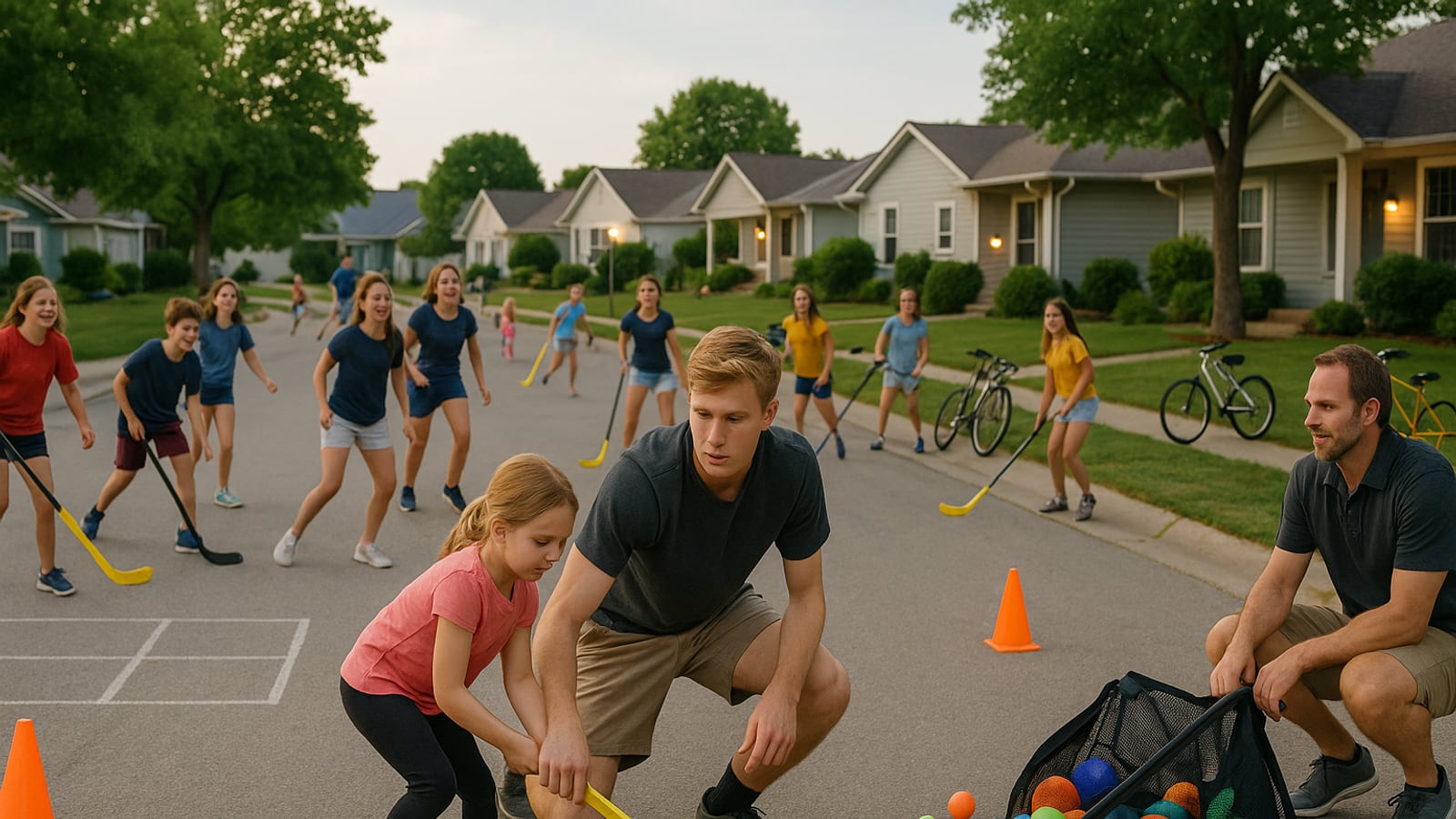
Quick answer: Pick one night and one time, then don't move it. Bring a bag of balls and cones, put the older kids in charge of the younger ones, and keep the adults off the sideline. It'll be small for a month. Then it won't be.
The first Tuesday, you'll have your own two kids and the boy from three doors down who wandered over because he heard a ball bouncing. That's a win. Don't count heads yet. Pickup ball grows by kids telling kids, and that takes a few weeks.
Pick the night, then never move it
This is where most neighborhood sports nights die, before a single ball gets kicked. Somebody starts a group chat, polls twelve families, and gets twelve answers. Two weeks later there's still no game.
Don't poll. Choose a night, say Tuesday at 6:30 p.m., announce it, and show up with the bag. The families who can make it will. The ones who can't will rearrange things once their kid starts begging.
Keep it to ninety minutes and end on time. Parents will say yes to a thing that finishes at 8:00 so bedtime still works. They'll quietly stop coming to a thing that runs "until it gets dark."
Weather rule: rain doesn't cancel it. Lightning does. The National Weather Service line is the one to teach every kid: when thunder roars, go indoors. No arguing, no "one more play."
Where to play
A cul-de-sac works for four square and street hockey, right up until somebody's mother-in-law needs to park. For anything bigger you want a park or a school field.
Call your city parks department or the school district before the first night. Plenty of places have rules about organized groups using fields, and some want a permit. A casual pickup game often doesn't need one, but you'd rather hear that from them than from a groundskeeper at 6:45 with twenty kids watching. If you're hosting in your own backyard, a two-minute call to your insurance agent is worth making. They can tell you what your policy actually covers, and nobody else can.
The bag
You're not building a facility. You're filling one duffel.
What we'd buy:
- Two or three red rubber playground balls. Kickball, four square, dodgeball, all of it.
- A soccer ball. Size 3 is built for kids under 8 and size 5 for teenagers. Size 4 is the compromise that everybody can kick.
- A Wiffle ball and bat. Plastic, light and nobody loses a window.
- A flying disc for when the older kids get restless.
- A dozen cones and two sets of pinnies in different colors.
- A ball pump with a spare needle. You'll need it the first night.
- A small first aid kit and a cooler of water.
What we'd skip:
- Portable goals. Cones are goals.
- Scoreboards, trophies and team names.
- T-shirts. The day you order shirts is the day it starts feeling like a league.
Mixed ages are the whole point
Every adult instinct says split them up. Littles over here, big kids over there. Resist it.
For generations, neighborhood ball meant a six-year-old playing with a thirteen-year-old because those were the kids on the block. The little one learned to play up. The big one learned to lead. You don't get that on a travel team where everybody was born in the same year, which is part of why free, unstructured play matters more than most parents think.
Mixed ages only work with a few house rules, and the kids will respect them faster than you'd expect:
- The little-kid rule. Anybody under 7 bats until they hit it. Nobody counts strikes.
- The pick rule. Two older kids can be captains, but they alternate. Pick a big, pick a little. Every time.
- The big-kid tax. Teenagers kick and throw with their off foot and off hand. If one scores twice in a row, he has to pass before he can shoot again.
- Nobody sits more than one round.
- Do-over. The oldest rule in pickup sports settles about ninety percent of arguments. Teach it on night one.
You'll see a nine-year-old lob a slow, underhand pitch to the four-year-old from across the street, and then the whole field cheers when it dribbles past the pitcher. Nobody told him to do that. The rules made room for it.
Games that survive a five-year-old and a fifteen-year-old
Kickball is the backbone. Everybody can play, the pitcher can roll slower for small kids, and a strong kick from a teenager is still catchable.
Capture the flag is the best game there is for twenty kids of any age. The littles are sneakier than anybody gives them credit for, and a big field wears everybody out in the best way.
Sharks and minnows makes a good five-minute warm-up for the youngest. Wiffle ball wins in a backyard. Ultimate is for the last half hour, when the older kids want something faster.
Let the kids vote on the final game each week. Just the final one. You set the first hour, they earn the last round.
The adults
One person runs it. Call it the commissioner if you want. That person brings the bag, holds the time and makes the calls nobody else wants to make. Other parents can rotate in, but somebody has to own it or it drifts.
For kids under 10, somebody from their family stays. That's not a liability dodge. You simply can't keep an eye on thirty kids, and parents shouldn't expect you to.
The adults who stay get two choices. Play, or sit quietly. No coaching from the lawn chairs. If a dad played high school ball, he plays at thirty percent and plays all-time quarterback for both teams. The same goes for Mom. It turns out to be the most popular job on the field, and the kids will talk about it for years.
Don't keep standings. The moment somebody tracks wins across weeks, you've got a league, and you've got a parent who cares about it more than the kids do. You can save that energy for the day your kid makes a travel team.
What goes wrong
Week three. Soccer practice, a birthday party and a stomach bug all land on the same Tuesday, and four kids show up. Play anyway. Four kids and a ball is still sports night. The families who see you out there on the thin week are the ones who trust it'll be there next week.
The kid who dominates. Every block has one. Don't bench him. Give him a job. Make him the pitcher, the ref or the captain who has to pick the smallest kid first. Most of the time he'll rise to it.
The kid who won't play. Some shy kids need three weeks on the curb before they touch a ball. Hand them the cones to set out. That counts.
Injuries. Scraped knees are part of the deal. A bump to the head is not. Stop play, sit the kid down and get their parent. For anything beyond a Band-Aid, the parent and a doctor decide what happens next. You don't.
The pitch to make it bigger. Somebody will want sponsors, a registration form, a group photo for the local paper. Be friendly and say no. The whole thing works because it's easy. A good commissioner serves everybody on the field, and part of serving them is guarding what makes it good.
The last ten minutes
Save the end of every night for cleanup, and make it the kids' job. Cones in the bag. Balls counted. Water bottles picked up, including the ones that weren't theirs, plus the candy wrapper somebody else left by the bleachers last weekend.
Leave the field cleaner than you found it, every single Tuesday. The groundskeeper notices, and so do the parents. The kids notice most of all, and that's the lesson that sticks.
Six weeks in, you'll show up with the bag and the boy from three doors down will already be there. He'll have his little sister with him, and he'll be the one telling her the pick rule.
Sam Ortiz
Dads & Family
Father of three. Writes about presence, discipline and the long game, without pretending any of it's tidy.

Watch
Worth an hour of your evening
More from Sports.
From channels we rate. Plays on YouTube.
Read next