
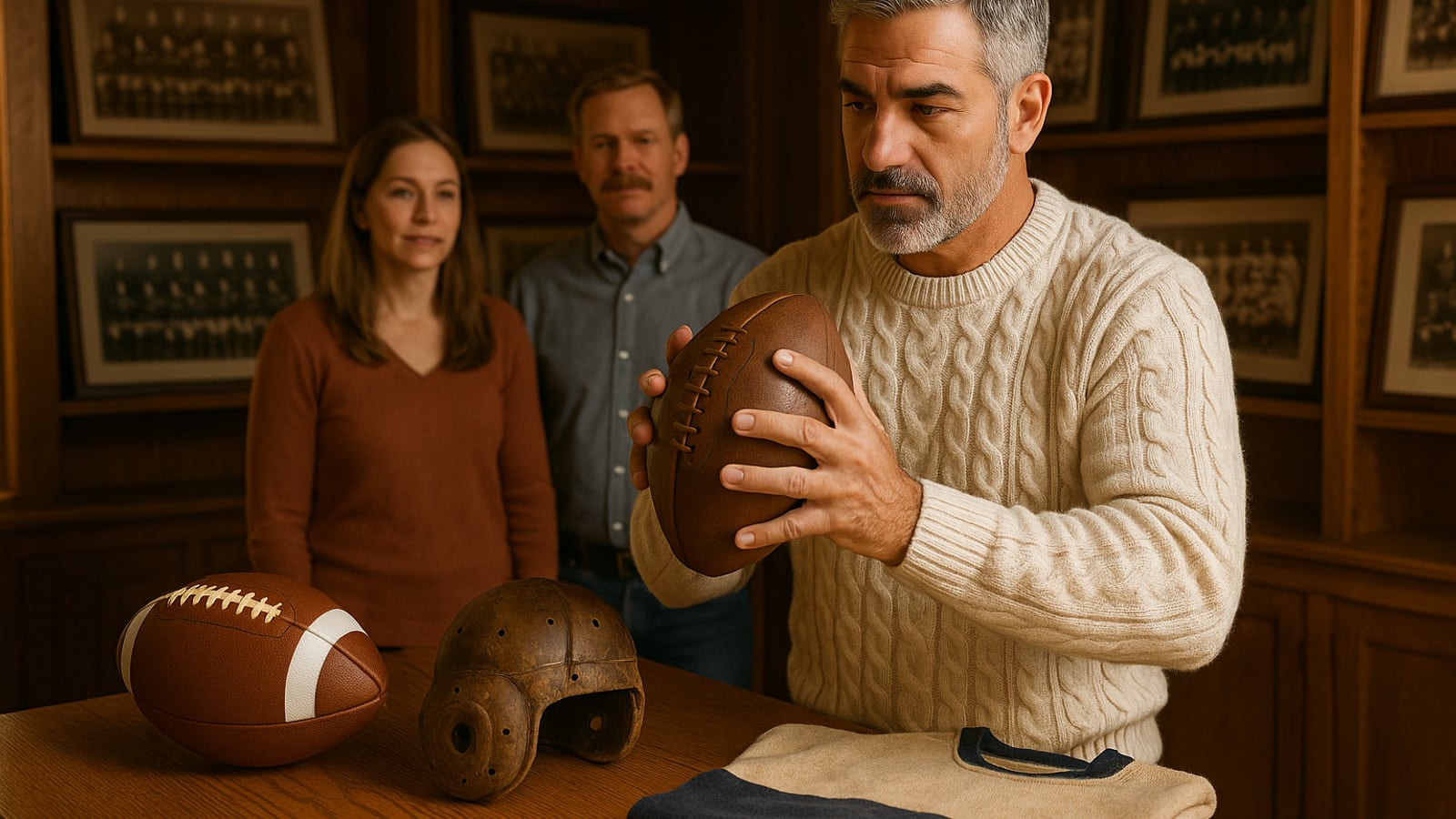
Quick answer: The forward pass became legal in college football in 1906, part of a safety overhaul after a deadly 1905 season. Most coaches ignored it until Notre Dame used it to beat Army in 1913. Rule changes in 1933 and 1978 turned it into the game you watch today.
Waukesha, Wisconsin. September 5, 1906. A Saint Louis University player named Bradbury Robinson drops back and throws the first legal forward pass in American football history.
It falls incomplete. And under the brand-new rules, Saint Louis loses the ball.
That tells you most of what you need to know about how football first felt about passing. The play was legal, and it was also a trap. Later that afternoon Robinson connected with Jack Schneider for a touchdown, and coach Eddie Cochems's team went on to finish the season unbeaten. The rest of the country mostly shrugged and went back to running into each other.
The season that almost ended the sport
You can't understand the pass without understanding 1905. Football then was a shoving match. Teams packed together in mass formations, and the flying wedge was only recently banned. They ground out yardage a few feet at a time. Players died. Newspapers ran tallies of the dead and injured over the course of the season, and the numbers were grim enough that people started asking whether the game should exist at all.
Some schools answered no. Columbia dropped football. Stanford and California switched to rugby. Harvard's president, Charles Eliot, was one of the game's loudest critics and wanted it gone.
Theodore Roosevelt disagreed. He loved the game and believed in its toughness. His son was playing freshman football at Harvard at the time. On October 9, 1905, he called coaches and representatives from Harvard, Yale and Princeton to the White House and pressed them to clean it up.
Then, in late November, a Union College player named Harold Moore died after a game against NYU. NYU's chancellor, Henry MacCracken, called a meeting of schools to decide whether to reform football or kill it. They chose reform. The group became the Intercollegiate Athletic Association of the United States, and in 1910 it renamed itself the NCAA.
So the organization that runs college sports today exists because a handful of men refused to take the easy way out and ban the thing.
Rules written to make you regret throwing
The 1906 package tried to spread the game out. A first down now took 10 yards instead of five, still in three downs. A neutral zone separated the lines. And the forward pass was allowed.
Barely.
The thrower had to be at least five yards behind the line of scrimmage. The ball had to cross the line at least five yards to one side of the center, so no quick throws over the middle. And a pass that hit the ground untouched could hand the ball to the other team.
Think about what that does to a coach's mind. The run was safe and familiar. The pass was a coin flip with your possession on the line. Most of the big Eastern programs treated it like a trick play for desperate teams. In 1910 the rules committee even capped passes at 20 yards beyond the line.
The pass didn't lose because it was bad. It lost because the rules punished anybody who tried it.
Two kids, a beach and West Point
The 1912 rules finally opened the door. The field went to 100 yards with 10-yard end zones, so you could now catch a touchdown pass across the goal line. Teams got four downs. The 20-yard limit disappeared, and a touchdown went up to six points.
That summer and the next, two Notre Dame players named Gus Dorais and Knute Rockne were working summer jobs at Cedar Point, the resort on Lake Erie in Sandusky, Ohio. On their off hours they took a football to the beach. Dorais threw. Rockne ran routes and learned to catch the ball on the run with his hands rather than trapping it against his chest, which was how most players handled a pass back then.
On November 1, 1913, Notre Dame went to West Point to play Army. Army was a power. Notre Dame was a small Midwestern school most Eastern fans didn't take seriously.
Notre Dame won 35-13, and Dorais picked Army apart through the air.
That game didn't invent the pass, and it's fair to point out that Cochems, Pop Warner at Carlisle and others had been throwing for years. But it made the pass famous, because it happened on a big stage against a team everybody respected. Coaches who'd dismissed passing as a gimmick watched a smaller team embarrass a giant with it. That changes minds faster than any rulebook.
The pros turn it into a weapon
For another twenty years the pass was still a supporting actor. The ball itself was part of the problem. Early footballs were rounder and fatter, closer to a rugby ball, and hard to spiral.
In 1933 the NFL broke from the college rules and allowed a forward pass from anywhere behind the line of scrimmage. That killed the old five-yards-back requirement and let a quarterback throw on the move. In 1934 the ball got slimmer, which made it easier to grip and throw.
Then the players showed up. Don Hutson joined the Green Bay Packers in 1935 and spent eleven seasons running routes defenses had never seen. He's the reason the modern wide receiver exists. Sammy Baugh arrived in Washington in 1937 and won a championship as a rookie, throwing in an era when plenty of coaches still thought passing was a little soft.
Neither of them could have done it under the 1906 rules. That's the pattern, and it holds for a hundred years. Talent was always there. The rules decided when it was allowed to matter.
1978, the year that built your Sunday
If you want one date that explains modern football, it's 1978. The NFL made two changes that season.
Defenders could no longer make contact with receivers more than five yards past the line of scrimmage. Before that, cornerbacks could rough up a receiver all the way down the field. And offensive linemen could now extend their arms and use open hands in pass protection, which gave quarterbacks more time.
Then the coaches who'd been waiting for exactly that got loose. Don Coryell's "Air Coryell" Chargers, with Dan Fouts throwing, stretched defenses vertically. Bill Walsh built what became the West Coast offense in San Francisco, using short, timed throws the way older coaches used runs, and won a Super Bowl with Joe Montana after the 1981 season.
Follow the line forward and you get Peyton Manning throwing 55 touchdown passes for Denver in 2013. That's a number a 1906 coach couldn't have imagined, because in his world every one of those throws risked a turnover.
What to look for this weekend
History is more fun when you can see it on the field. Next time you watch a game, try this:
- Watch the first five yards off the line. That contact window is the 1978 rule in action. Once a receiver clears it, the corner has to play the ball without grabbing him.
- Watch the quarterback roll out and throw. Before 1933 in the NFL, he had to be a set distance behind the line to throw at all.
- Watch the end zone catch. Before 1912, that ball was a touchback.
- Watch the safeties. Most of modern defense is an answer to the pass, and the deep players tell you what the defense fears. It's the fastest way to read a play, which is the whole idea behind watching the safeties first.
It shows up on Friday nights, too. Plenty of high school teams now line up in spread formations and throw more than they run, which is why a small-town stadium on a good night can feel like a Sunday broadcast. It's one more reason those Friday night lights are worth keeping on.
The part the history books skip
People tell the forward pass story like it was a bright idea that caught on. It wasn't. It was a reluctant compromise made by men scared of losing the game, and then it sat on the shelf for years because the rules made it too risky to try.
What finally made it work was people. Two college kids played catch on a beach instead of goofing off. A few coaches trusted a play everyone else laughed at. And decades later, rule makers were willing to fix what their predecessors got wrong.
Roosevelt and MacCracken could have banned football in 1905. Eliot wanted them to. They kept the hitting and gave the game somewhere else to go. It went up, about forty yards at a time, and it never came back down.
Marcus Vale
Editor-in-Chief
Twenty years in magazines, most of it deciding what to cut. Writes about work, discipline and the decisions that compound.

Watch
Watch how it's done
Picked for this article.
From channels we rate. Plays on YouTube.
Secret Base
Teddy Roosevelt helped institute the forward pass so football players would stop dying so much
Hardcore College Football History
19 Dead, One Radical Idea: The True Origin of the Forward Pass
Read next