
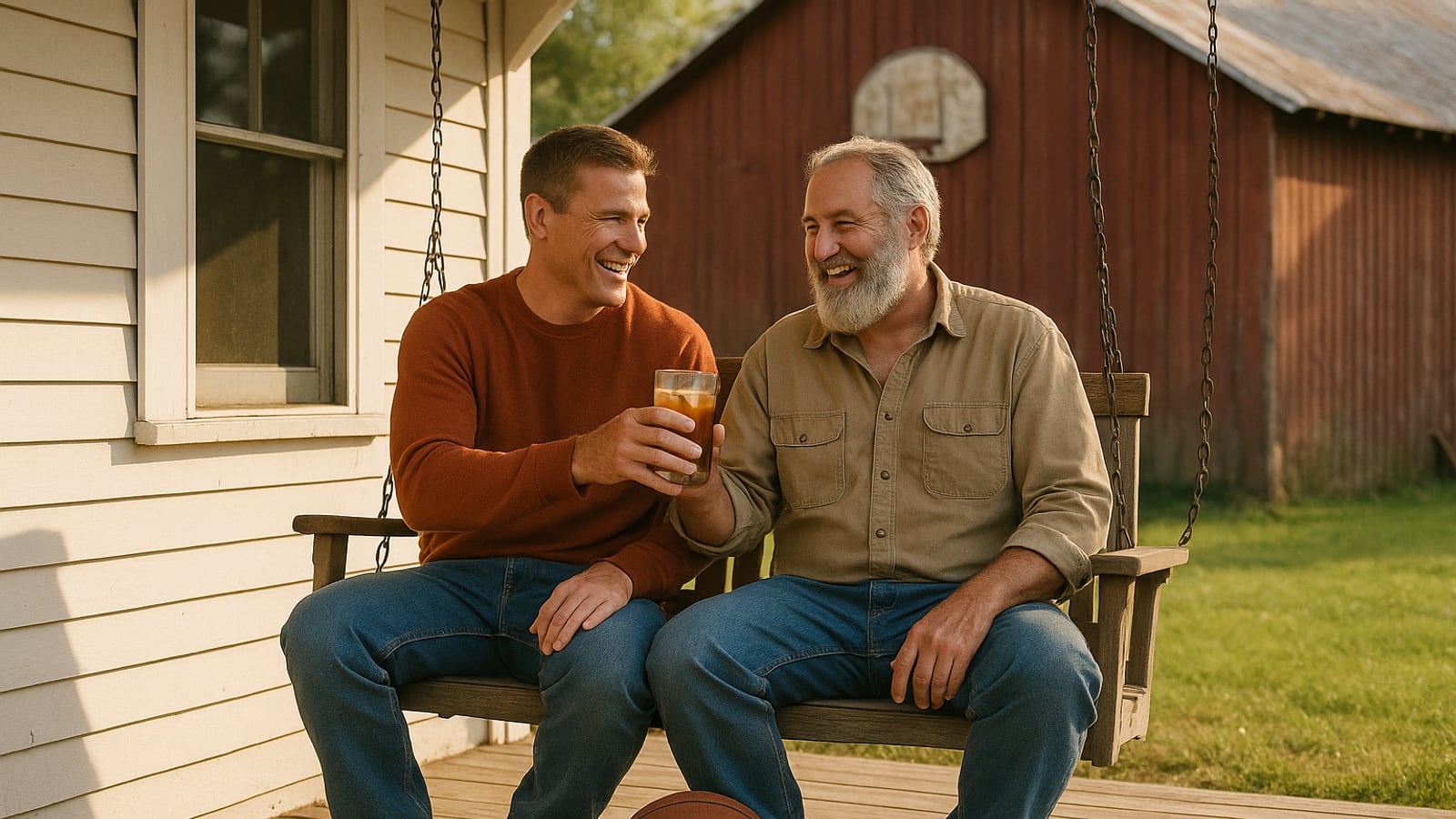
In the summer of 1985, Magic Johnson flew to French Lick, Indiana, to shoot a Converse commercial with the man he'd spent six years trying to beat. Larry Bird's Celtics had just lost the NBA Finals to Magic's Lakers. Neither man liked the other much. Then Bird's mother made them lunch.
Magic has told that story for decades. Somewhere between the shoot and the kitchen table, two guys who'd been cast as opposites (Showtime and the Hick from French Lick) figured out they were the same kind of guy. Both came out of hardworking Midwestern families. Both hated losing more than they loved winning. Nobody else on earth knew exactly what it cost to play at that level against that opponent. Except the opponent.
That's the whole secret, and it runs through every great rivalry that turned into a friendship. The person who pushed you hardest is the only one who fully knows what you did. Your teammates saw it. Your fans cheered it. Your rival felt it.
Magic and Bird: from 1979 to the Dream Team
The rivalry started before either man turned pro. Michigan State beat Indiana State in the 1979 NCAA title game, and a whole country tuned in to watch. Then they met in the NBA Finals in 1984, 1985 and 1987. Bird's Celtics took the first one. Magic's Lakers took the other two.
After French Lick, the rivalry never softened on the court. That's the part people miss. The friendship didn't make them go easy on each other. It made them respect each other enough to go harder.
When Magic announced in November 1991 that he'd tested positive for HIV, Bird was among the players most shaken by the news. A year later they wore the same jersey on the 1992 Dream Team. And when the Celtics retired Bird's number in 1993, Magic was there to speak, telling the crowd there'd never be another Larry Bird. They later wrote a book together, When the Game Was Ours, with Jackie MacMullan.
Fourteen years of trying to take everything the other guy wanted. Then a lifetime of having his back.
Chris and Martina played each other 80 times
Chris Evert and Martina Navratilova met 80 times on a tennis court. Navratilova won 43 of them. Think about that for a second: 80 matches, a huge share of them for major titles, often with the whole sport watching to see which one would crack.
And they were friends through most of it. Before the rivalry fully hardened, they even teamed up to win the Wimbledon doubles title in 1976. Evert was the golden girl from Fort Lauderdale. Navratilova had defected from communist Czechoslovakia in 1975 and was building a new life in America. Different backgrounds, different games, same locker room, same pressure.
The friendship outlasted their careers. When Evert went public with ovarian cancer in early 2022, and Navratilova announced her own cancer diagnoses a year later, they leaned on each other openly. Two women who'd spent years trying to beat each other for the biggest prizes in the game ended up as each other's support system when it mattered most.
That's a better ending than any trophy.
Borg and McEnroe: the tiebreak that made a friendship
The 1980 Wimbledon final had a fourth-set tiebreak that McEnroe won 18-16. Borg won the match anyway, his fifth straight Wimbledon title. The next year McEnroe beat him in the finals at both Wimbledon and the U.S. Open, and Borg, cool as ice his entire career, stepped away from the tour at 26.
McEnroe has said many times that he wishes Borg had stayed. That tells you something. The loudest competitor in tennis history lost the one guy who made him better, and he never stopped missing it.
Starting in 2017, the two captained opposite benches at the Laver Cup for years. Still on different sides. Still clearly enjoying every minute of it.
Nicklaus and Palmer: the kid who beat the King at home
In 1962, a 22-year-old Jack Nicklaus beat Arnold Palmer in an 18-hole playoff at the U.S. Open at Oakmont. That's western Pennsylvania. Palmer country. Arnie's Army heckled Nicklaus without mercy, and the kid won his first professional title anyway.
That could've soured into something ugly. It didn't. Nicklaus and Palmer went on to compete for decades, then stood side by side hitting the ceremonial first tee shots at the Masters. When Palmer died in 2016, Nicklaus spoke about him as a friend first and a rival second.
The hecklers are long forgotten. The friendship isn't.
Not every rivalry heals, and the difference is instructive
Honesty requires this part. Joe Frazier carried the insults Muhammad Ali threw at him for most of his life, and the wound never fully closed. Ali showed up at Frazier's funeral in 2011, but the two never had what Magic and Bird had.
George Foreman is the more hopeful case. After Ali knocked him out in Kinshasa in 1974, Foreman has said he spent years bitter about it. Then he let it go. At the 1997 Academy Awards, when When We Were Kings won for best documentary, Foreman helped a frail Ali up to the stage. The man who lost the most famous fight of his life became the one steadying his old opponent's arm. Foreman died in 2025, and that moment is one of the best things he left behind.
The lesson isn't that rivalries magically become friendships. It's that the loser gets to decide. Foreman decided. It took him a while. He still got there.
What you can take from this, starting this season
You probably don't have an 80-match rivalry with a Hall of Famer. But you've got the guy who beat you out for the promotion. The other dad who coaches the team that always knocks yours out. The kid across town your son has lost to in every wrestling match since sixth grade.
A few things the greats did that you can actually do:
- Compete all the way. None of these friendships came from going soft. Bird never took a play off against Magic. Respect gets earned at full speed.
- Say the specific thing afterward. Not "good game." Say "that pass in the fourth quarter killed us." Specific praise tells the other guy you were really watching.
- Make the first call. Magic flew to Indiana. Somebody has to break the ice, and it's usually the one with more confidence, not less.
- Don't let a loss curdle. Foreman lost years to bitterness. Your version is the coworker you still won't eat lunch with over something from 2019. Cut it loose.
- Show up for their stuff. Their retirement party, their kid's graduation, the funeral nobody wants to go to. That's where these friendships got sealed.
If you're a parent, this is the best thing youth sports can teach, and it barely shows up on a scoreboard. When your kid's getting serious, like the families in Your Kid Just Made a Travel Soccer Team. Now What, they'll run into the same rivals over and over for years. Teach them that the kid who keeps beating them is a gift. He's the reason they'll get better. Some of the best friendships in any town start on opposite sidelines, which is part of what a small town loses when the Friday night lights go out.
One more thing. Sit your kid down and watch the 1980 Wimbledon tiebreak with them. Then tell them those two guys are still friends more than 40 years later.
They'll understand it better than any speech you could give. And someday, they'll get a call from the kid who used to beat them. Make sure they pick up.
Marcus Vale
Editor-in-Chief
Twenty years in magazines, most of it deciding what to cut. Writes about work, discipline and the decisions that compound.

Watch
Worth an hour of your evening
More from Sports.
From channels we rate. Plays on YouTube.
Read next