
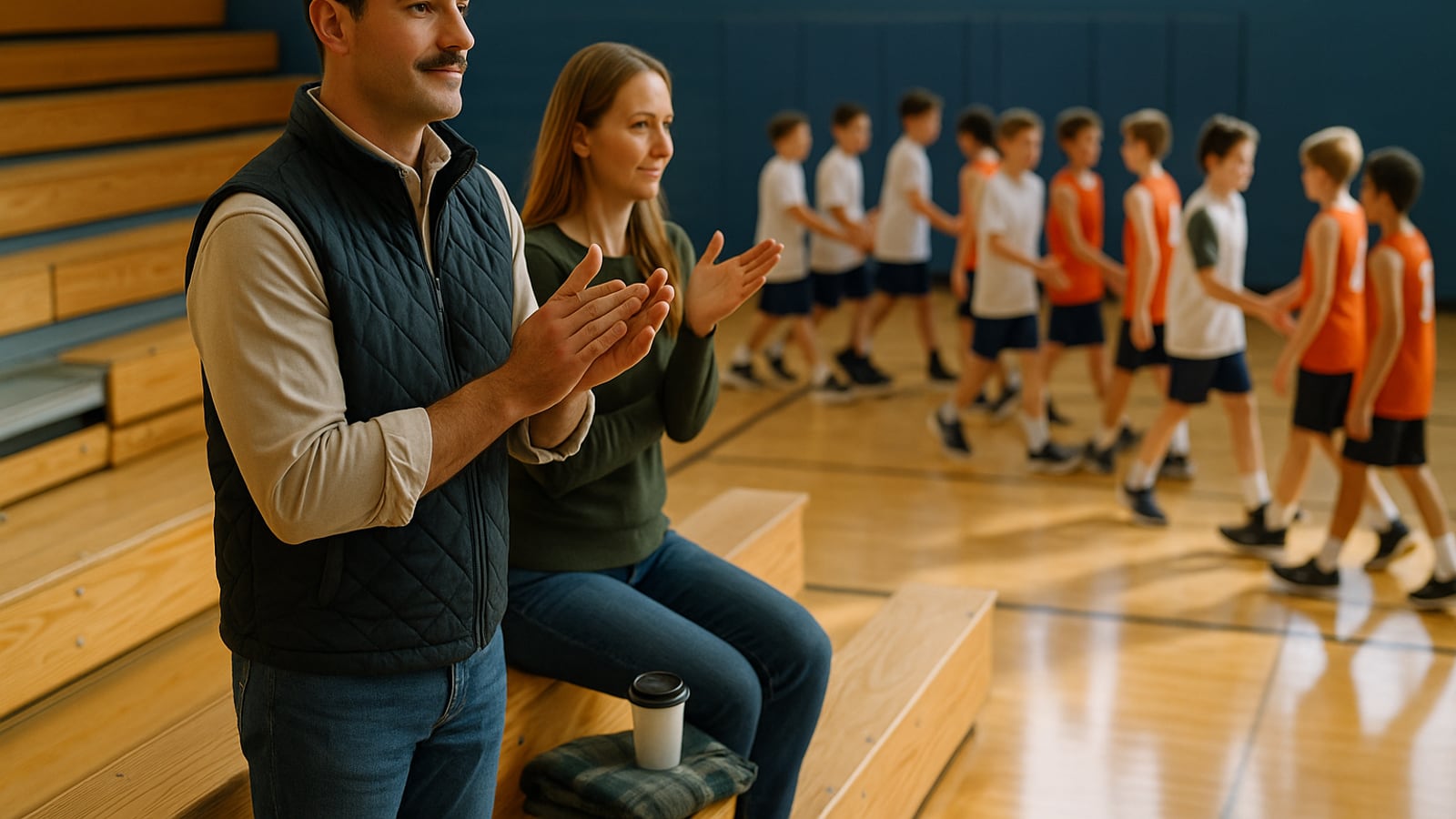
Quick answer: Players shake every hand and play to the whistle. Parents cheer and never coach from the stands or talk to the ref. Coaches teach both, then enforce them, starting with their own behavior.
The ref is fifteen. Her yellow shirt is two sizes too big, she got certified in the spring, and she just called a handball that a grown man in a folding chair thinks was wrong. He tells her. Loudly. Twice.
His son, number 7, is standing ten yards away with his hands on his hips, staring at the grass.
That's youth sportsmanship in one frame. The boy isn't learning anything about handballs. He's learning what his father does when things don't go his way. And he'll do it too, in about six years, to somebody else's kid.
The code below is split three ways, but it runs from the top down. Kids copy adults. Fix the adults and most of the kid problems fix themselves.
First, what sportsmanship isn't
It isn't softness. Keep score. Want to win. Play hard enough that the other team knows they were in a game. A generation of participation trophies didn't make kids kinder. It just made the scoreboard feel like a lie everybody agreed to tell.
Sportsmanship is how you compete, not whether you do. The kid who dives for every loose ball and then helps the other guy up is doing it right. The kid who coasts because "it's just for fun" isn't being a good sport. He's being a bad teammate.
For players
These are short on purpose. A nine-year-old should be able to repeat them back.
- Shake every hand. Look them in the eye. Say "good game" like you mean it, even when you don't feel it yet.
- Play to the whistle, then stop. No extra shove after the play.
- Never show up an official. No thrown arms, no eye rolls, no hands on hips while you glare. Your coach handles calls.
- Celebrate with your team, not at the other one.
- Win like you've been there. Lose like you'll be back.
For the best picture of what this looks like, show your kid the Sara Tucholsky story. In April 2008, the Western Oregon senior hit her first career home run against Central Washington. Rounding first, she missed the bag, turned back, and her knee gave out. Torn ACL. She couldn't walk, and the rules said her own teammates couldn't help her or the hit wouldn't count as a home run.
So two Central Washington players, Mallory Holtman and Liz Wallace, picked her up and carried her around the bases, lowering her foot to touch each one. They were helping the other team score in a game that mattered to their own season.
Nobody told them to. That's the point. They'd already decided what kind of competitors they were long before that afternoon.
For parents
This is the hard section, because it asks the most of the people who think they're doing the least.
Cheer. Only cheer. Cheer effort, cheer good plays, and yes, cheer a great play by the other team. Kids notice when a parent claps for an opponent. It tells them the game is bigger than the result.
Don't coach from the stands. Your kid is hearing the coach say "stay wide" and you yelling "go to the ball." Two voices, and he'll obey neither. If you want to coach, volunteer. Most leagues are desperate for help.
Never talk to an officials. Not once. Not "just asking." State associations and officials' groups have spent years warning that they can't keep referees and umpires, and the reason they cite most is abuse from spectators. When that fifteen-year-old quits, Saturday's game doesn't get a better ref. It gets no ref.
Use the 24-hour rule. Upset about playing time? Wait a full day before you contact the coach. Then do it privately, never in front of the team, and never about somebody else's child. Once your kid is about twelve, let them have that conversation first. It's good practice for a boss someday. If you're new to this level of play, Your Kid Just Made a Travel Soccer Team. Now What covers what to expect from coaches and the calendar.
Leave the field better than you found it. When it's your snack week, bring extra waters for the kid whose parent forgot. Pick up the trash under the bleachers even if none of it's yours. Stay to help carry the goals back to the shed. Find the ref afterward and say thank you, by name if you caught it. Thirty seconds. It might be the only kind word she hears all day.
For coaches
You set the temperature on your sideline, and that includes the parents behind it.
Put the code in writing before the first practice. Hold a ten-minute parent meeting, hand out one page, and say plainly what happens if someone crosses the line. A warning, then a conversation, then the league. Then actually do it. A rule you won't enforce is just a suggestion.
The handshake line isn't optional. Not after a blowout, not after a bad call, not after a loss in the final minute. The kid who skips it sits the first quarter next game. He'll only skip it once.
Don't run up the score. When you're up big, pull your starters, work on your weak foot, practice the play you never run. Your kids still learn. The other kids keep a little dignity. You'll be on the wrong end of a blowout someday, and you'll remember who was gracious.
Handle officials like a professional. In rec leagues, mostly let it go. In competitive leagues, ask one calm question at a stoppage. You can't demand composure from a ten-year-old after you've drawn a card yourself.
Watch the pressure. Kids who burn out at thirteen often got pushed hardest at nine. What the Research Actually Says About One-Sport Kids is worth reading before you start telling a fourth grader to play year-round.
The car ride home
This is where most of the damage happens, and nobody sees it.
The kid just finished. They're tired, maybe embarrassed, maybe thrilled. And a parent starts replaying the game from the driver's seat. The missed tackle. The pass that should've gone left. The ref.
Coaching educators Bruce Brown and Rob Miller spent years asking athletes what they wanted to hear from their parents after a game. The answer that stuck was five words: "I love to watch you play."
Say that. Then stop talking. Let them bring up the game if they want to. If they ask what you thought, answer honestly and briefly. If they don't ask, stop for a milkshake and talk about anything else.
You can go over the film Tuesday. Or never. Honestly, never is usually fine.
When another parent crosses the line
Sooner or later somebody on your side of the field starts screaming at a teenager in stripes. Most parents look at their phones and wait for it to stop.
Don't do that. Don't scream back, either.
Walk over. Stand next to them, not in front of them. Keep your voice low: "Hey, she's fifteen. Let's let her work." Most people deflate the second they realize someone's watching them up close. If they don't, go to the coach or the league rep. Most leagues have a conduct policy, and they want parents to use it.
It'll cost you something. That guy might not wave at you in the parking lot next week. Pay it anyway. Your kid is watching you too, and this is the lesson that'll outlast every trophy in the garage.
Nobody remembers the score of an under-10 game. Your kid will remember exactly what you did in the thirty seconds after a bad call.
Sam Ortiz
Dads & Family
Father of three. Writes about presence, discipline and the long game, without pretending any of it's tidy.

Watch
Worth an hour of your evening
More from Sports.
From channels we rate. Plays on YouTube.
Read next