
Quick answer: Three full-body sessions a week for twelve weeks, supervised, with the first month lighter than feels necessary. No true one-rep maxes for younger lifters, no lifting alone, and eight to ten hours of sleep doing half the work.
It's a Saturday in February. Three sophomores are in somebody's garage with a bench from a big-box store, a bar loaded with every plate in the house, and a phone propped on a paint can. Nobody's spotting. Nobody warmed up. The whole point is a video for the group chat.
That's where high school lifting goes wrong. The school weight room, with a coach watching and a written plan on the whiteboard, isn't the problem. The garage is.
The growth plate scare is outdated
For a generation, parents heard that lifting would stunt a kid's growth. The American Academy of Pediatrics and the National Strength and Conditioning Association both say properly supervised resistance training is safe for children and teens. The AAP's 2020 clinical report on resistance training says the same thing again.
The injuries that do happen tend to follow a pattern you could guess. Bad technique. Too much weight too soon. No adult in the room. Kids goofing around with equipment. Take those away and the barbell is one of the safer things a teenage athlete will touch all year. It's certainly safer than the sport he's training for.
So the goal isn't to keep kids out of the weight room. It's to make the weight room boring for the first month.
Weeks 1 to 4: learn the movements
Three days a week, with a rest day between sessions. Monday, Wednesday, Friday works for most families.
Every session starts with ten minutes of real warm-up: jumping jacks, walking lunges, leg swings, arm circles, a few bodyweight squats. Then:
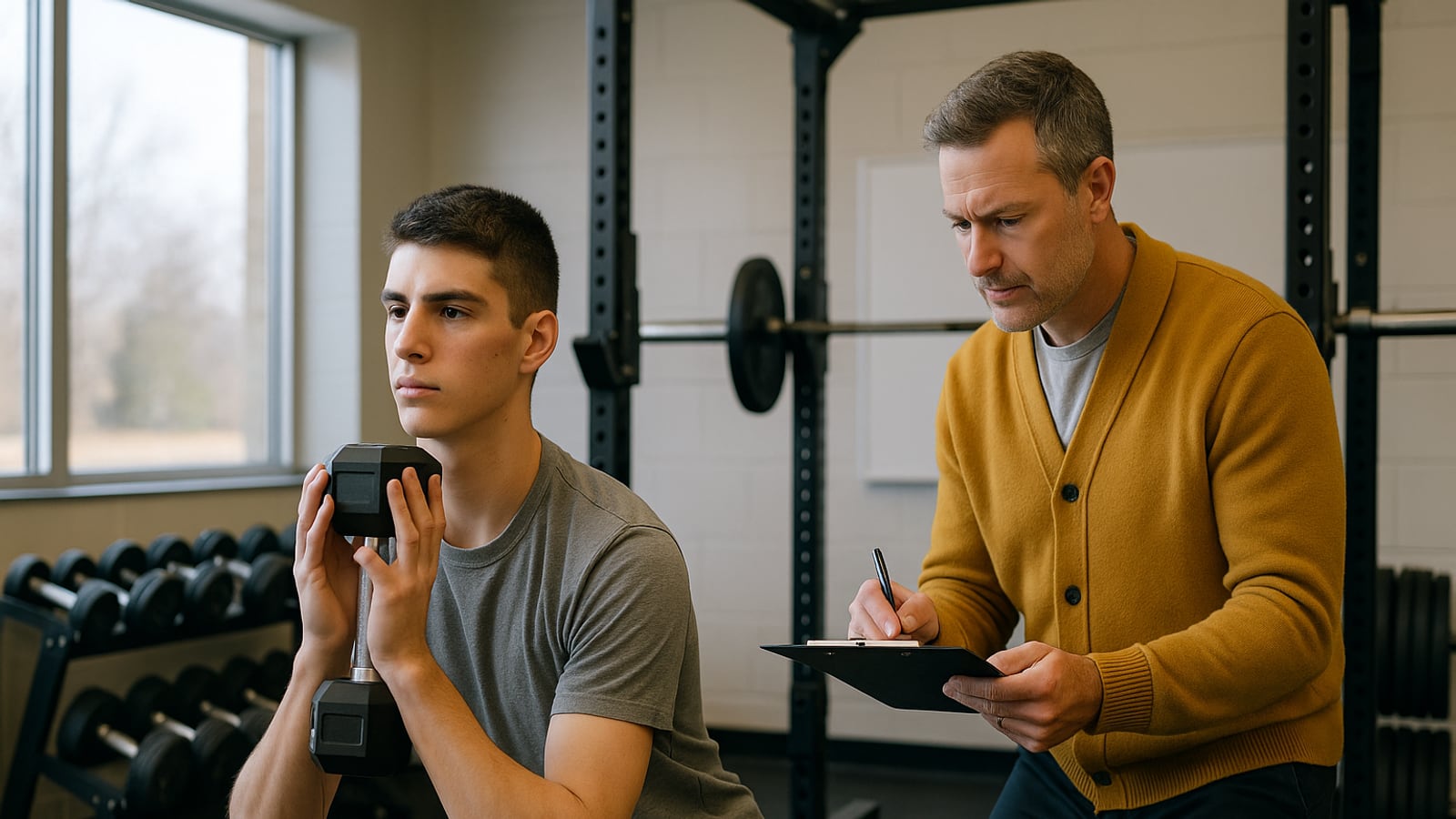
- Goblet squat: 3 sets of 10, holding one dumbbell at the chest
- Dumbbell Romanian deadlift: 3 sets of 10
- Push-ups: 3 sets, stopping two reps before form breaks
- Inverted rows under a racked bar or a table: 3 sets of 8 to 12
- Split squats: 2 sets of 8 per leg
- Farmer carry: 3 trips of about 40 yards with heavy dumbbells
- Front plank: 3 holds of 30 seconds
This phase frustrates strong kids. A linebacker who can already push real weight is going to feel silly doing goblet squats with a 35-pound dumbbell.
Let him feel silly. He's learning to brace, to keep his knees tracking over his toes, to hinge at the hips instead of rounding his back. Those habits are what keep him healthy in week ten when the bar is actually heavy.
The only progression rule that matters: the weight goes up when every rep of every set looks like the first one. Not before.
Weeks 5 to 8: put a bar on his back
Now split the work into two alternating days. Week one is A, B, A. Week two is B, A, B.
Day A
- Back squat or front squat: 4 sets of 6
- Bench press: 4 sets of 6, always with a spotter
- One-arm dumbbell row: 3 sets of 8 per side
- Back extensions: 2 sets of 12
Day B
- Trap bar deadlift: 4 sets of 5
- Landmine press or dumbbell overhead press: 3 sets of 8
- Chin-ups: 3 sets, two reps short of failure
- Step-ups onto a knee-high box: 3 sets of 8 per leg
- Side plank: 2 holds of 30 seconds per side
The trap bar gets a mention because it's the most forgiving way to teach a teenager to pull heavy off the floor. The handles sit at his sides, his back stays more upright, and it's harder to butcher than a straight-bar deadlift. If the school has one, use it.
Add about 5 pounds a week to upper-body lifts and 5 to 10 to lower-body lifts, only when earned. Some weeks nothing goes up. That's a normal week, not a failure.
Weeks 9 to 12: strength and speed
Keep the A/B split and add jumps and throws at the start of each session, right after the warm-up, while he's fresh:
- Box jumps: 3 sets of 3, stepping down, never jumping down
- Broad jumps: 3 sets of 3, sticking every landing
- Medicine ball chest pass against a wall: 3 sets of 5
Main lifts drop to 4 sets of 3 to 5 reps. Heavier, but still with one or two clean reps left in the tank on every set. Accessories stay the same.
The jumps are where athletes turn strength into something that shows up on a field. They're also where landing mechanics get taught, and that matters most for girls. Research on neuromuscular training, meaning programs that teach athletes to jump, land and cut with their knees in line, has shown fewer ACL injuries in female athletes. If your daughter plays soccer or basketball, this phase might be the most valuable part of her whole year. The travel soccer piece covers the rest of what a serious season asks of a family.
About the max-out
Week 12 is when everybody wants to test. For a freshman or a first-year lifter, test a 5-rep max with a coach watching and let the coach estimate the rest. It tells you nearly everything a true single would, and nobody finds out what a missed rep feels like at the bottom of a squat.
A senior with three years of clean training under an experienced strength coach is a different case. Testing a heavy single in a supervised room is reasonable for him. What's never reasonable is the garage version.
What the program can't do for him
Lifting is maybe a third of the off-season. The rest is sleep, food and the other things he plays.
The American Academy of Sleep Medicine recommends 8 to 10 hours a night for teenagers. Most high schoolers don't get close, and no program on earth outworks six hours of sleep. Put the phone in the kitchen at night.
Food means three real meals and snacks between them. Protein at every meal, plenty of carbohydrates on training days, water all day. Teens shouldn't be building their training around supplements. If you're wondering about protein powder or anything stronger, ask his pediatrician or a registered dietitian first.
And if he plays another sport in the spring, the lifting plan bends around it. Two sessions a week during a season is plenty. There's a good case for staying multi-sport anyway; the research on one-sport kids is worth reading before you let him specialize.
Soreness versus pain
Soreness is dull, shows up a day or two after training, sits in the muscle and fades. It's the price of the program.
Pain is different. Sharp pain in a joint, pain that shows up mid-rep, or low back pain that sticks around more than a week or two, especially when he leans backward, needs the school's athletic trainer or a sports medicine doctor. Don't train through it and don't diagnose it at the kitchen table.
Questions to ask the coach
You're allowed to ask. A good coach will be glad you did.
- Is there a written program, or does everyone just show up and bench?
- Does anyone on staff hold a strength certification like the NSCA's CSCS?
- Do freshmen max out, and if so, how?
- Who's spotting, and who's in the room when the coach isn't?
If the answers are fuzzy, back the coach where you can and fill the gap where you have to. Put your kid on the plan above, and stay in the room yourself at the start.
Weight room manners count
Teach this part at home. Put your plates back on the tree. Wipe down the bench. Rerack the dumbbells in order, even if you found them scattered on the floor. Show up five minutes early, and when the session ends, be the kid who stays to help stack the boxes. Spot the guy next to you before he asks.
Coaches notice. So do teammates. The weight room is where a lot of teams decide who they trust.
The kid who wins February has the best video in the group chat. The kid who wins the off-season is still lifting in August, healthy, a little bigger, and ready when the season starts.
Cal Brennan
Fitness
Strength coach. Trains fathers, tradesmen and desk workers, which means programmes that survive a bad week.

Watch
Watch how it's done
Picked for this article.
From channels we rate. Plays on YouTube.
The Movement System
How to Create a Training Program for ANY Sport (Step-by-Step)
YouGoProBaseball
3 Pillars Of A SUCCESSFUL Off-Season Baseball Training Program [STRUCTURE, STRENGTH, SPEED]
Read next