
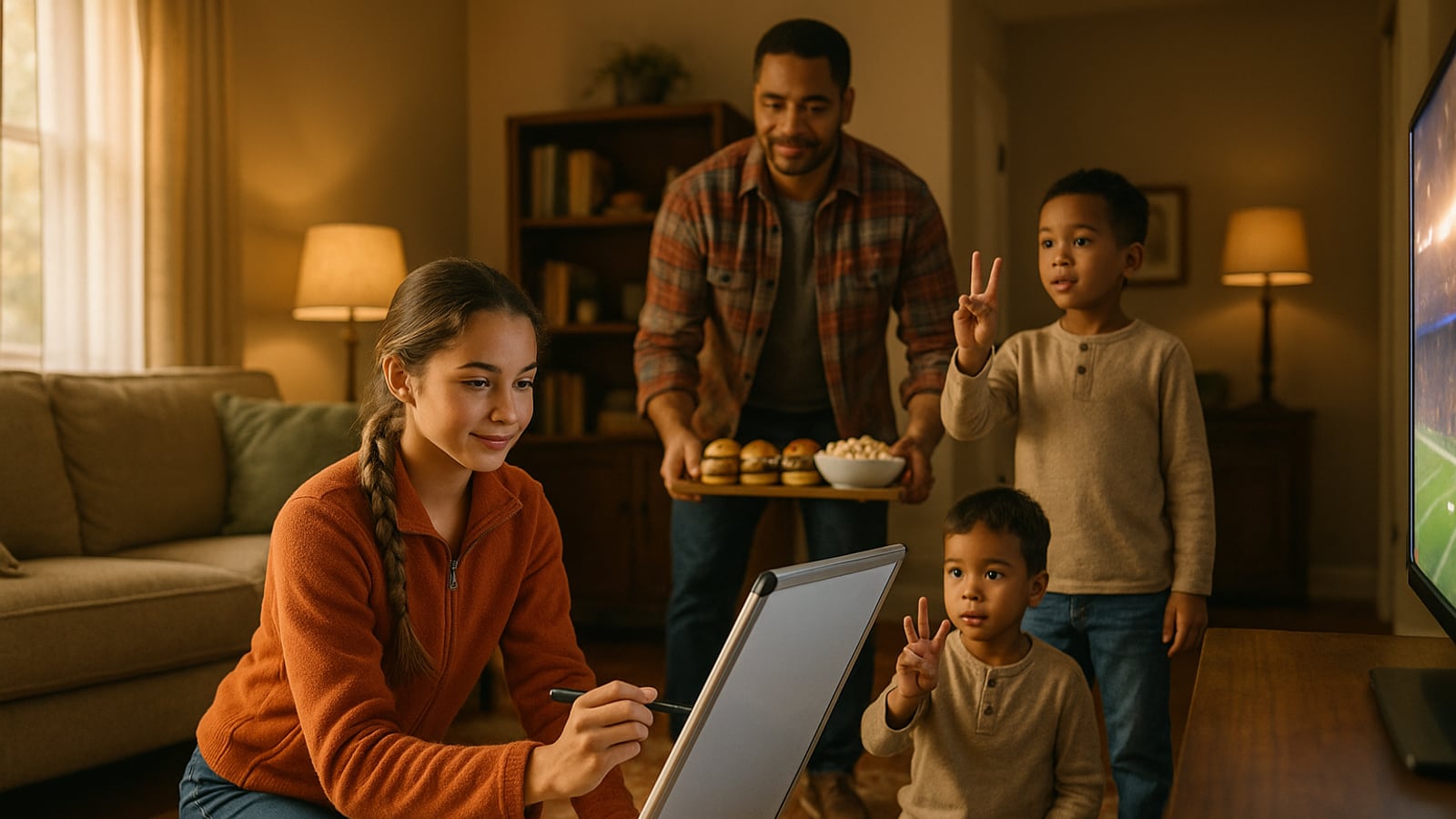
Quick answer: Don't explain the whole game. Hand every kid a job before kickoff, teach one rule per quarter, and time the food to the clock. By the fourth quarter they'll be yelling at the TV like they've done it for years.
Most dads blow this in the first ten minutes. Kickoff hits at 6:30 Eastern, a seven-year-old asks why they're kicking it away, and Dad launches into four downs, ten yards, the neutral zone and the difference between a safety and a touchback. The kid nods. Then the kid goes to find the dog.
It's not the kid's fault. Football's a hard sport to watch cold. It's a series of short, violent sentences with long pauses in between, and nobody explains the grammar. The fix isn't a better lecture. It's giving the kid something to do.
Hand out the jobs before kickoff
Kids who have a role pay attention. Kids who are just "watching with us" drift. So the night before, or at lunch on game day, assign the jobs. Write them on an index card and let each kid tape theirs to their shirt if they want. They will want.
- Scorekeeper. A dry-erase board or a sheet of poster board with both team names. Every time the score changes, they update it and announce it. This teaches scoring faster than anything you can say.
- Down marker. They hold up fingers for first, second, third or fourth down before every snap. After two drives they'll know the count before the graphic shows it.
- Flag spotter. The instant a yellow flag hits the field, they shout "FLAG!" and try to guess the call before the referee announces it.
- Snack runner. Refills, napkins, carrying plates to Grandpa. The kid who doesn't care about football yet often lands here, and that's fine. They're still in the room, and that's the win.
The youngest gets a job too, even if it's just "you're in charge of cheering when anybody scores." Nobody sits out.
One rule a quarter, and no more
Here's the pace that works. Pick a single idea for each quarter and keep coming back to it. Ignore everything else until the next quarter starts.
First quarter: downs. Four tries to go ten yards. Make it, you get four more. Don't make it, you usually punt on fourth down. That's all. Your down marker will reinforce this every play.
Second quarter: scoring. Six for a touchdown. Then a choice: kick for one, or run a play from close in for two. Three for a field goal. Two for a safety, which is when the offense gets tackled in its own end zone. Your scorekeeper will make you prove the math.
Third quarter: penalties. Teach four referee signals and let the kids copy them standing up. Both arms straight up is a touchdown. Rolling your forearms in front of your chest is a false start, somebody on offense moved early. Grabbing your own wrist in front of your chest is holding. Pushing both open hands forward from the shoulders is pass interference. Your flag spotter now has ammunition.
Fourth quarter: why the clock matters. This is where the game gets good, and kids feel it if you tell them what to watch. Timeouts, the two-minute warning, why a team that's winning runs the ball and why a team that's losing throws it to the sideline. If the game's close, you won't need to say much. They'll get it.
Your older kids will want more. Good. Once they know downs cold, have them read Watch the Safeties First and Football Opens Right Up. It's the next step, and it's the one that makes a fan for life.
Use a real play to make it stick
Rules land best attached to a story. Pull up the Philly Special from Super Bowl LII, February 2018. The Eagles were facing fourth-and-goal against the Patriots near the end of the first half. They went for it, and tight end Trey Burton threw a touchdown pass to quarterback Nick Foles. A quarterback catching a touchdown in the Super Bowl.
Show it at lunch. Ask the kids why going for it on fourth down was a big deal. If they can answer, they understand downs. That one clip does more teaching than an hour of explaining.
And when your team is down big at halftime and a kid wants to give up, tell them about the Patriots trailing the Falcons 28-3 in Super Bowl LI and winning in the first overtime in Super Bowl history. There's a whole list of those in Ten NFL Comebacks That Prove Nobody Is Ever Really Finished, and it's a better lesson about not quitting than any speech you'll give.
Time the food to the game
A full spread on the counter at 6:00 means everybody's stuffed by the second quarter and cranky by the third. Serve it in waves, like a restaurant.
Pregame: chips, salsa, a veggie tray nobody will touch but you'll feel better for putting out.
Halftime: the main event. Chili that's been in the slow cooker since noon, or pulled pork on slider buns. Set it up so kids can build their own plate. It keeps them busy during a stretch of the broadcast you may not want them glued to anyway.
Fourth quarter: dessert, held back until the last fifteen minutes of game clock. Brownies cut into football shapes, or a pan of cookie bars. Knowing it's coming keeps the little ones in their seats when the game gets tight.
Make one thing together. Let the kids stir the chili or press the brownie batter into the pan. The thing they helped make becomes the thing they request every year, and that's how a tradition gets started without anybody deciding to start one.
Decide the hard calls before kickoff
A few things are easier to settle at noon than at 9:15 p.m.
Bedtime. The Super Bowl is on a Sunday and it often runs past 10:00 Eastern. Monday is a school day. Decide in advance whether the young ones go to bed at halftime, at the end of the third quarter, or stay up for the finish. Say it once and hold the line. The kid who begs for "just one more drive" is making a fair argument, and you're allowed to say no anyway. Families on the West Coast get a 3:30 kickoff and don't have this problem. Enjoy it.
Commercials and halftime. The remote stays with a parent. Plenty of the ads are fun. Some aren't what you want your eight-year-old watching. Halftime can be a great time to send everybody outside to throw a football in the driveway, even in the dark, even in February. Ten minutes of two-hand touch and they come back inside ready for the second half.
Phones. Into a basket on the counter at kickoff, yours included. You'll be tempted to check scores from other games or scroll the reactions. Don't. The kids are watching what you watch.
If you're the guest
Plenty of families watch at somebody else's house. Bring a dish, not just a bag of ice. Bring it already cooked. And when the confetti falls, don't be the family that grabs coats and heads for the door. Have your kids carry plates to the kitchen, bag the trash and wipe the counter. Leave the host's house cleaner than you found it. The kids learn more from that last fifteen minutes than from the whole game.
Not every kid will love it, and that's okay
Some kids are never going to care about football. Maybe your daughter's a basketball fanatic who lives for the first Thursday of March Madness. Maybe your son would rather draw the logos than watch the plays. Let them. The point of the night isn't to manufacture a fan. It's to have everybody on the same couch for three hours with nowhere else to be.
Do it right, and years from now one of your kids will host their own game night. They'll hand their kid a dry-erase board and say, "You're the scorekeeper." And they'll have no idea they learned that from you.
Sam Ortiz
Dads & Family
Father of three. Writes about presence, discipline and the long game, without pretending any of it's tidy.

Watch
Worth an hour of your evening
More from Sports.
From channels we rate. Plays on YouTube.
Read next