
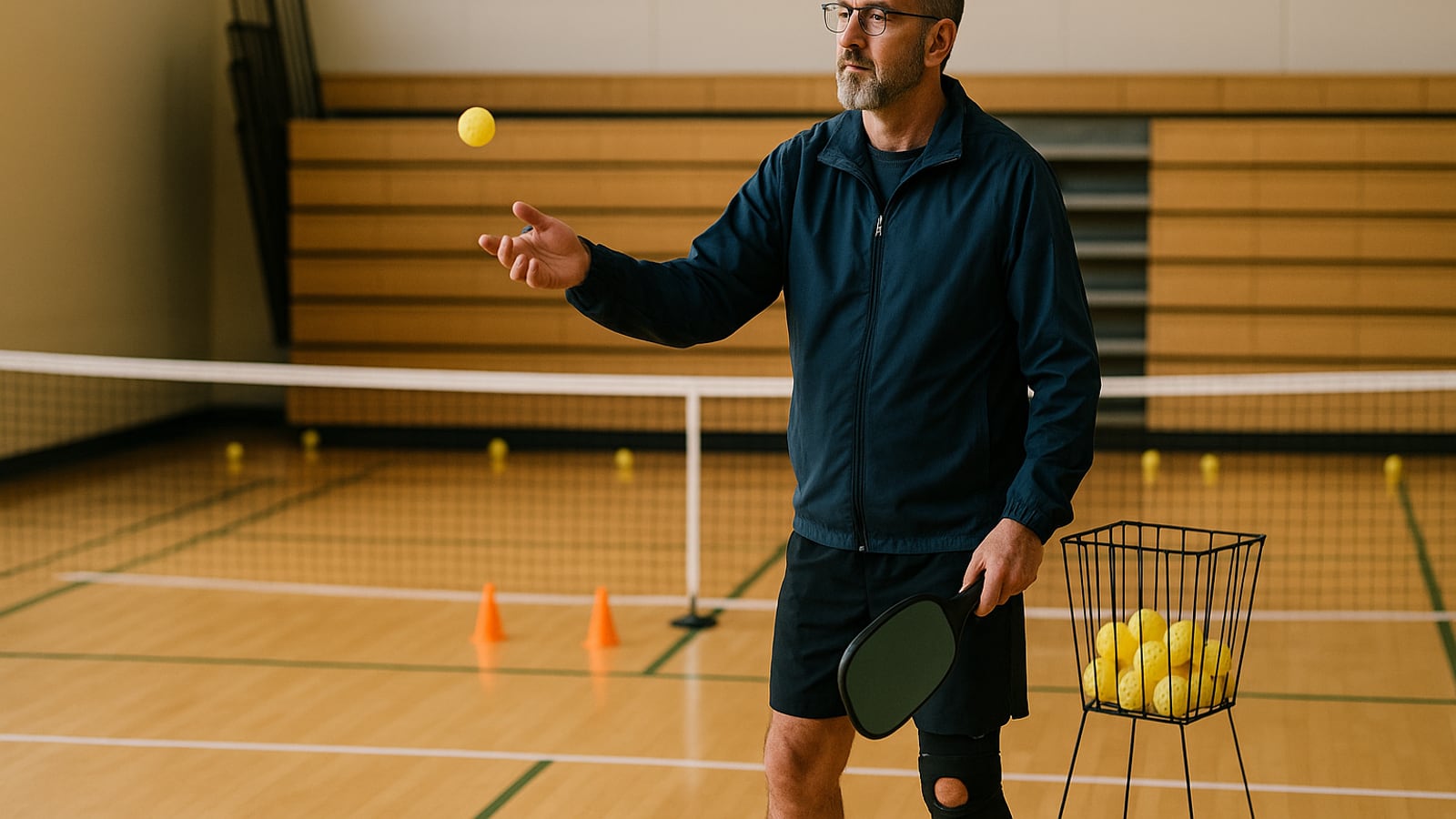
Quick answer: Stop trying to win points with power. Hit deep returns, walk up to the kitchen line, learn a third-shot drop that lands soft, and dink until the other side pops one up. That's most of the gap between 3.0 and 3.5.
Every open play has him. Ex-tennis guy, strong forearm, hits every ball like it owes him money. He cleans up for his first two months because beginners can't handle pace. Then he plays the same people a year later and starts losing to a retired couple who never hit anything harder than a firm handshake.
He didn't get worse. They got better at the part of the game he skipped.
Why the hard hitter stalls
Pickleball's court is small. It's 20 by 44 feet, and the net sits at 34 inches in the middle. The non-volley zone, the "kitchen," runs seven feet back from the net on each side. At the beginner level, a hard drive gets through because nobody's standing where they should be. Once your opponents learn to stand at that kitchen line with their paddles up, a hard ball becomes a gift. They just block it back at your feet, and you're hitting up while they're hitting down.
The whole game above 3.0 turns on one question. Who gets to the net first and stays there? Soft shots are how you get there. Power is how you finish once you've earned it.
A word on what the numbers mean
You'll hear two kinds of ratings. USA Pickleball publishes skill-level descriptions that people use to rate themselves. DUPR, the Dynamic Universal Pickleball Rating, runs on a 2.0 to 8.0 scale and calculates your number from actual match results.
The annoying part: self-ratings at open play run generous. Plenty of self-declared 3.5s are 3.0s with confidence. If you want an honest number, play recorded DUPR matches. If you don't care about the number, the skills below are what a real 3.5 looks like anyway.
The return: deep, then walk in
Because of the two-bounce rule, the serve has to bounce and the return has to bounce. That gives the returning team a head start to the net. Most beginners waste it.
- Hit the return deep, not hard. A high, slow ball that lands near the baseline pins the serving team back. A hard, short one bounces up into their strike zone.
- Walk in behind it. Right after you hit, move to the kitchen line. Not halfway. All the way, toes just behind the line.
- Get set before they hit. Split-step when they make contact so you're balanced, not lunging.
If you do nothing else this month, do this. It's the cheapest rating point in the sport.
The third shot is the whole test
When you're the serving team, you start at the baseline and the returners are already at the net. The third shot of the rally decides whether you ever catch up. This is why the third-shot drop exists, and it's the skill that separates 3.0 from 3.5 more than anything else.
The goal is a soft ball that lands in their kitchen, low enough that they can't attack it. Think of it like a shallow rainbow with the peak on your side of the net, so the ball is already coming down when it crosses.
- Lift from your shoulder, not your wrist. Wrist flicks are why drops sail.
- Keep the paddle face slightly open and finish low-to-high, like tossing a bean bag underhand.
- After you hit it, move forward. Two or three steps, then split-step and see what comes back.
Concede this: drives have their place on the third shot. A hard, low drive followed by a drop on the fifth shot is a real pattern that good players use. But you need the drop first. A player with only a drive is predictable. A player with both is a problem.
Also expect to lose more points for about a month. Drops go into the net. They float too high and get smashed. Keep hitting them. Most people quit right before the shot starts working.
Dinking is patience with a paddle
Once all four players are at the kitchen line, the rally becomes a dink battle: soft shots that land in the kitchen and bounce low.
Hit most of them cross-court. The net is two inches lower in the middle than at the sidelines, and the diagonal gives you more court to work with. Both of those buy you margin.
The rule at this level is simple. Your job isn't to win the dink rally. It's to not lose it. Keep the ball low and in, move your opponent side to side, and wait for somebody to hit one high. At 3.5, somebody always does.
If you like reading the field in other sports, this is the same skill. The way watching the safeties opens up a football game, watching your opponent's paddle face tells you where the ball's going before it leaves.
The transition zone and the reset
The space between the baseline and the kitchen is where points go to die. You'll get caught there constantly while you're learning to move forward.
When a hard ball comes at you mid-court, don't swing back. Reset. Soften your grip, absorb the pace with a short block, and drop it into the kitchen. Then keep moving in. A reset feels like surrender the first dozen times. It's actually how you survive long enough to get to the line.
Stop attacking balls below the net
This one habit ends more 3.0 rallies than anything. A ball comes to you below net height, you swing hard at it, and it either hits the net or rises into your opponent's backhand for an easy put-away.
The rule: if contact is below the top of the net, you're hitting up, so hit soft. If it's above, you can attack. Say it out loud on the court if you have to.
A four-week plan that changes your game
You don't need more matches. You need 20 minutes of drilling before them.
- Week one: Deep returns and walking in. Have a partner feed serves; you return and move to the line every single time.
- Week two: Third-shot drops from the baseline to a partner at the kitchen. Count how many of ten land in the kitchen without being attackable.
- Week three: Cross-court dinks. Goal is long rallies, not winners.
- Week four: Resets. Your partner drives at you from the kitchen while you stand mid-court and block everything soft.
Then play, and try the new shot even when the old one would win the point. Rec play is where you practice. Save the winning for tournaments.
This is also a great one to bring a teenager into. It sharpens hands and footwork for other sports, and a second sport tends to help kids more than it hurts.
How to get better games at open play
Better players pick who they play with. Give them reasons to pick you.
Call your own faults, including foot faults in the kitchen, before anybody asks. If you're unsure whether a ball was out, it was in. Bring a sleeve of good outdoor balls and hand them out. Rotate off the court on time without being chased. And when the session ends, stay and help roll up the portable nets and haul them to the car. The people who run open play remember who stacks the gear.
But don't be a pushover about your game. If a stronger partner tells you to hang back at the baseline so he can cover everything, politely say no and walk to the line. You'll never learn the kitchen from behind it.
The first time a 4.0 asks you to be his partner for the next game, you'll know the soft stuff finally stuck.
Dean Shaw
Gear & Garage
Reads the warranty, the parts list and the long-term owner reviews before anything else. Trucks, tools, watches, and the cheap version that costs more.

Watch
Watch how it's done
Picked for this article.
From channels we rate. Plays on YouTube.
ThatPickleballGuy - Kyle Koszuta
A Third Shot Drop Strategy Masterclass
Selkirk TV
The Perfect Third Shot Drop: A Step-by-Step Drill to Practice Your Pickleball 3rd Shot
Read next