
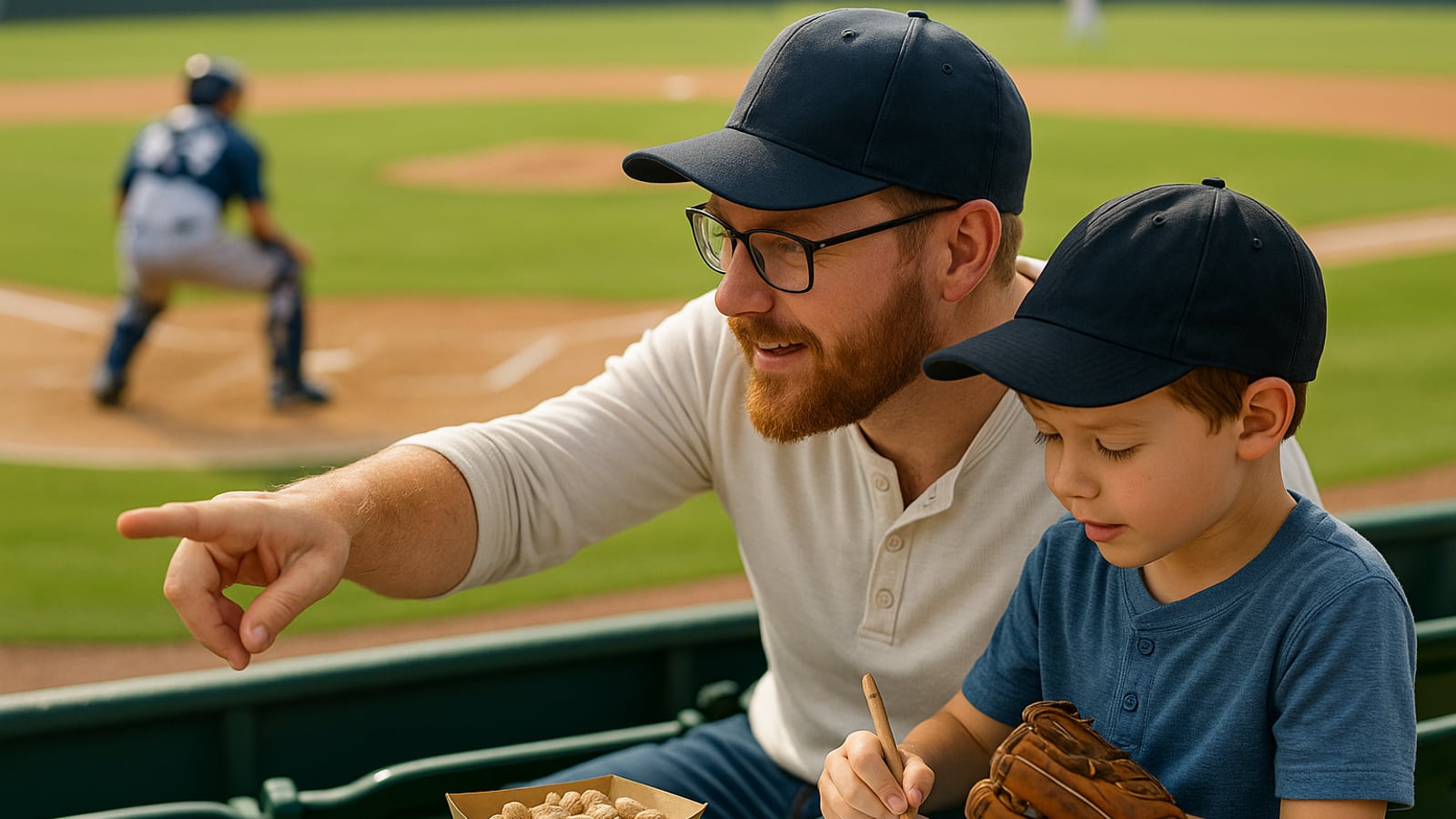
Quick answer: Pick a small ballpark, not the biggest stadium in town. Hand them a pencil and a scorecard, bring a glove, and leave while they're still having fun, even if it's the sixth inning of a tie game.
Jack Norworth wrote "Take Me Out to the Ball Game" in 1908, and the story goes that he hadn't been to a game yet. Your kid is in the same spot. They've heard the song, seen the highlights and watched you yell at the TV. They have no idea what three hours on a plastic seat actually feels like.
Your job isn't to show them a whole game. Your job is to make sure they want to come back.
Start small on purpose
Most dads want the big one first. The NFL stadium, the big-league park with the retired numbers on the wall. I get it. But a 70,000-seat stadium puts a six-year-old in the upper deck, where the players look like ants and the walk from the parking lot takes longer than some innings.
Go to a minor league park, a college game or a Friday night high school game first. At a place like Durham Bulls Athletic Park, you can sit close enough to hear the catcher talk to the umpire. Kids remember sounds. The pop of the mitt, the crack of the bat, a coach barking at a runner. You won't hear any of that from row 40 of the upper deck.
High school football works for the same reason. You're ten feet from the fence, the band is loud, and somebody's grandmother is handing out popcorn. There's a reason a town feels it when those lights go out.
Save the cathedral for the third or fourth trip. By then they'll know what they're looking at, and that's when the big place actually lands.
What to bring
Pack light. Every stadium has its own bag rules, and a lot of NFL stadiums only let clear bags through the gate. Check the team's website the night before. You don't want your first memory of the day to be walking a diaper bag back to the truck.
- A glove. For baseball, this isn't optional. A kid with a glove watches every pitch like a ball might come right at them. It almost never does. Doesn't matter.
- A pencil and a scorecard. Most parks sell or hand out scorecards. Bring your own pencil, because the tiny golf pencils break.
- Ear protection for little ones. Hockey arenas and domed stadiums get loud enough to rattle a grown man. A pair of kids' earmuffs takes up no room and can save the whole afternoon.
- A layer. Night games get cold fast after the sun drops, even in summer.
- A ball and a marker, if you're getting there early for autographs.
- Your phone number in marker on their arm. More on that below.
- A card, not a roll of fives. A lot of big-league parks have gone cashless. Check first.
For a day game, sunscreen goes on before you leave the house and again around the fifth inning. That's the part that matters most: any broad-spectrum SPF 30 or higher, reapplied every two hours, beats the sunburn that ruins the ride home. Add a hat, and shade if your section has any. For kids, I'd go mineral: zinc oxide or titanium dioxide. Those filters sit on the skin, they're broad-spectrum, and they're the only two the FDA proposed in 2019 as generally recognized as safe and effective, while it asked makers for more data on the others. They're also gentler on sensitive skin. Thinkbaby, Blue Lizard Sensitive Mineral SPF 30 and Badger Clear Zinc SPF 30 are all easy to find. Fair warning: some mineral formulas leave a white cast, and your kid will look like a lifeguard for a few minutes. They'll survive.
Decide the souvenir before you walk in
This is the part where you serve the kid and still hold the line.
Tell them in the car: "You get one thing. A hat, a foam finger or a bobblehead. You pick." Then stick to it when you're standing in front of the team store and they spot a second hat.
It sounds small. It isn't. Kids who know the rule ahead of time don't melt down at the register, and the one thing they pick means more because they had to choose it. Food works the same way. One treat, their pick, and you're not negotiating in the concourse during a 3-2 count. If you want the full game plan for keeping the tab reasonable, we laid out how to do a family ball game without blowing $400.
Teach them to keep score
This is the best trick I know for a first baseball game, and almost nobody does it anymore.
Every defensive position has a number:
- 1 pitcher, 2 catcher, 3 first base
- 4 second base, 5 third base, 6 shortstop
- 7 left field, 8 center field, 9 right field
A grounder to the shortstop who throws to first is a "6-3." A strikeout is a K. A called strikeout, where the batter just stands there, is a backward K. Kids love the backward K. They'll wait all game for one.
Once they know the numbers, the game stops being a bunch of guys standing around. They're watching where the ball goes because they have to write it down. When the shortstop flips to second and the relay beats the runner at first, you get to say "that's a 6-4-3 double play," and they'll write it and repeat it to their mother for a week.
Don't make them finish the card. If they quit keeping score in the fourth inning to eat nachos, fine. The card goes in a drawer, and in twenty years it's the best thing they own from that day.
What to watch in other sports
Not every first game is baseball. Give them one thing to track, not ten.
Football: Skip the quarterback and watch the two deep safeties before the snap. If one creeps toward the line, something's coming. It's the single fastest way to understand what the defense is doing, and we broke down why watching the safeties opens the whole game up.
Hockey: Watch the goalie when the puck is at the other end. Then watch the benches. Line changes happen on the fly every minute or so, and kids get a kick out of spotting the swap before it's done.
Basketball: Pick one player and follow him when he doesn't have the ball. Who's he screening? Where's he running? It teaches them the game is played by all ten guys, not the one dribbling.
Have a lost-kid plan
Write your cell number on their forearm in marker before you go through the gate. Then show them what an usher or a stadium security jacket looks like and say: "If you can't find me, go to one of them and show them your arm."
Point out your section number together and make them say it back to you. Take a quick photo of them when you get to your seats so you have a current picture of what they're wearing.
You'll probably never need any of it. But the one time you do, you'll be glad the plan took two minutes and not two hours.
Walk out while it's still good
This is the one most parents get wrong, and I got it wrong the first time too.
You paid for nine innings. You want nine innings. But the kid's tank empties long before the game does. Somewhere around the sixth, the questions stop, the wiggling starts, and they're asking about the car. If you push through, the last thing they remember is being bored and tired on a cold seat.
Leave on a high. Leave right after the seventh-inning stretch, while they're still humming the song. Yes, you might miss a walk-off. You'll catch the score on the radio. You're buying the next ten games, not this one.
Before you go, have them grab every wrapper and cup under your seats and carry it out. The guy with the broom will thank you, and your kid learns that you leave a place better than you found it.
And in the car, don't ask if they had fun. Ask who their favorite player was.
If they have an answer, you're coming back.
Sam Ortiz
Dads & Family
Father of three. Writes about presence, discipline and the long game, without pretending any of it's tidy.

Watch
Watch how it's done
Picked for this article.
From channels we rate. Plays on YouTube.
TODAY
Inside the art of baseball scorekeeping with just pen and paper
Schaumburg Boomers
HOW TO KEEP SCORE OF A BASEBALL GAME
Read next