Patios pay. Decks can cost you. Price them differently.
Concrete is where the money is in power washing. A wood deck is where one bad pass wipes out a month of profit. Here's how to tell the jobs apart.
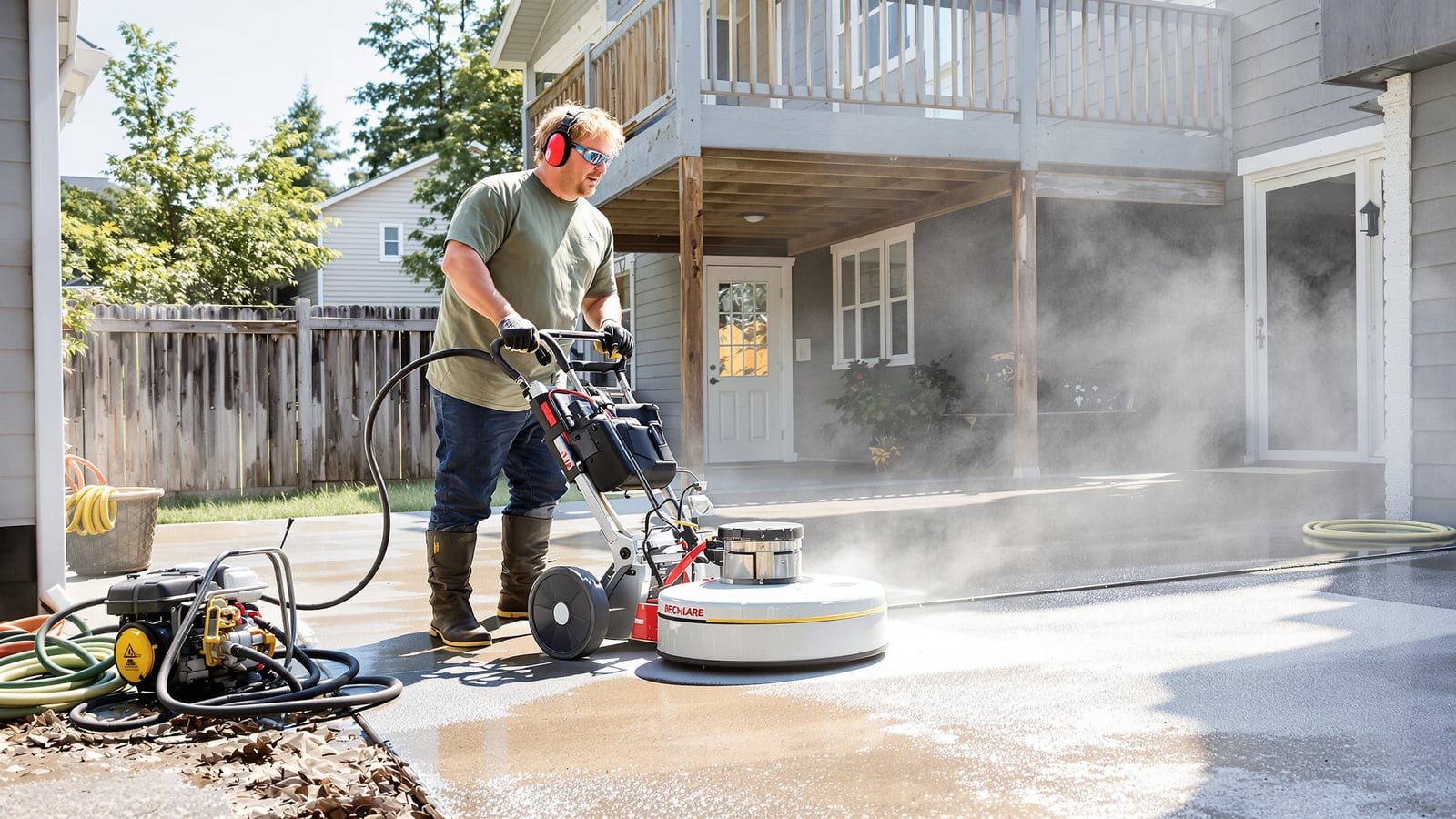
Quick answer: Wash concrete and pavers at full pressure with a surface cleaner. Wash wood at low pressure with the right cleaner and let the chemistry do the work. Quote decks higher than patios, put the terms in writing, and don't buy a machine unless you'll run it more than a handful of times a season.
The mistake that costs you the week
A homeowner calls about a 300-square-foot cedar deck gone gray and green. You've got a gas washer that cleaned a driveway beautifully last Saturday. You pull the trigger, run a pass down the first board, and leave a pale, fuzzy stripe where the soft grain just blew out.
That stripe doesn't wash off. It sands off, if you're lucky. If you're not, it's a replaced board and a customer telling the neighbors.
This is why one job on your menu deserves a different price than the others. Concrete forgives you. Wood remembers.
Know what each surface can take
These are common rules of thumb, not a guarantee for your deck. Test every job in a spot nobody will see.
- Concrete and pavers: Full pressure is fine. A rotary surface cleaner, the round spinning bar in a hood, gives you even results with no zebra stripes and finishes faster than a wand.
- Softwood decking like cedar, pine and redwood: Stay low, in the neighborhood of 500 to 1,200 PSI, with a wide fan tip. Most of the damage you'll ever see on a deck comes from a narrow tip held too close.
- Hardwood decking: It tolerates more, but it's still wood. Keep your distance and your angle consistent.
- Composite: Check what the manufacturer says. Some voids their warranty with high pressure.
Whatever the surface, keep the tip a foot or more off the boards, move with the grain, and keep the wand moving. Never stop mid-board. Never use a zero-degree tip on anything you want to keep.
And respect the stream itself. A high-pressure jet can inject water and debris under skin. Wear closed-toe boots and eye protection, and never point it at your own feet or hands.
Let chemistry do the heavy lifting
On wood, the pressure should barely be doing anything. The work is done by a cleaner you apply and let sit.
Two common choices are a sodium hypochlorite mix with a surfactant, which is the stronger option for mildew and algae, and an oxygen-based cleaner, which is gentler on plants and some finishes. Either way, wet down the surrounding plants first, keep them wet, and rinse them again after. Cover anything delicate. Read the label and follow it.
Apply, wait the time on the label without letting it dry on the boards, then rinse with that light, wide fan. If the deck is still dark, apply again. Don't solve it with more PSI.
Then leave it alone. Wood generally wants a day or two to dry before anyone seals or stains it. If you're offering sealing, price it as its own job.
The honest startup numbers
These are rough planning figures, so check your local prices before you spend anything.
- A consumer or light-commercial gas pressure washer: figure several hundred dollars, more for a better one.
- A 15- or 16-inch surface cleaner: a couple hundred.
- Extra hose, a set of tips, a foam or chemical sprayer, tarps, a few gallons of cleaner, good boots and eye protection: another few hundred.
Call it roughly $800 to $1,500 to start working properly. You can go cheaper with an electric washer, and it's actually a decent tool for a small wood deck because it can't hurt anything. But it'll be painfully slow on a driveway.
Then there's the part nobody lists. Fuel. Chemical that gets used faster than you expected. A trailer or a truck bed that smells like bleach for a month. Water: some customers will let you use their spigot, some won't.
What it actually pays
Here's a made-up but realistic month, to show how the math works. Don't treat it as a promise.
Say you do four jobs on weekends, averaging $250 each. That's $1,000 in revenue. Take out cleaner, fuel and wear on equipment, and you might keep $800 or so before taxes and insurance. At four to five hours a job, including setup, wash, rinse, cleanup and the drive, that's roughly $35 to $45 an hour before those last two items. It's decent money. It isn't a career.
Decks drag that number down more than patios do, because they take longer and carry more risk. A patio you can wash in an hour or two. A deck is prep, protecting plants, cleaner dwell time, careful rinsing, and then someone standing on it afterward asking whether it looks right.
So price decks higher. Quote by square foot or by job, not by hour, because you'll be slow on purpose. Charge more for the risk too, since you're the one who pays if a board gets chewed up. Your local market sets the real prices. If you don't know them, call two established outfits for quotes and see what they say.
For more on the full picture, read Weekend Pressure Washing and What It Actually Pays.
Taxes and insurance
This is general education, not advice for your situation. A CPA or tax preparer can tell you exactly what applies.
In the U.S., side income is generally taxable, and self-employed people typically owe both income tax and self-employment tax, which together can take a bigger bite than people expect. Don't spend the whole check. Open a separate savings account and move a chunk of every payment into it the day it arrives. The piece on what to set aside for taxes on side income from dollar one walks through a habit that works.
Insurance matters more here than in most weekend jobs. Your homeowner's or auto policy generally doesn't cover business activity, and a pressure washer can break windows, blow out door seals, strip paint and ruin a deck. Call an independent insurance agent and ask about general liability coverage for a small power-washing business. Ask what's excluded and what the deductible is. Don't skip the call.
Protect yourself in writing
Before any deck job:
- Walk it with the customer. Photograph every cracked, split, soft or loose board.
- Test a hidden spot first and show them the result.
- Put the price, scope and condition of the deck on a short written estimate they sign.
- Say plainly that you won't wash a deck with rot or loose fasteners until it's repaired. If the wood is soft enough that a screwdriver sinks in, walk away politely. That job loses money before you start.
A signed page won't protect you from everything, but it ends most arguments before they begin.
When it's not worth it
Skip this if you'd do fewer than a few jobs a season. Rent a machine for a weekend instead of buying one.
Skip it if you can't charge enough to clear a fair hourly wage after supplies, fuel and insurance. Skip it if your market is full of guys undercutting each other at prices that only work with no insurance and no tax planning. Don't join that race.
And skip any deck that's already failing. Telling a customer no costs you a Saturday. Saying yes costs you a lot more.
Leave it better than you found it
Do what the good ones do. Rinse the siding and the walkway. Sweep up leaves and grit. Put the furniture back where it was, and put the plants back in good shape. Take your hose with you, and don't leave a chemical smell in their yard.
Then ask for the review and the neighbor's name. A clean finish is the cheapest advertising you'll ever get, and it's why the next job comes without a bidding war.
If you want to know when to turn a few Saturdays into something bigger, read When a Side Hustle Should Become a Business and When It Shouldn't.
Ray Okonkwo
Money & Business
Former commercial banker turned small-business owner. Covers salary, credit, margins and the arithmetic nobody does before signing.

Watch
Worth an hour of your evening
More from Side Hustles.
From channels we rate. Plays on YouTube.
Read next