CPR and choking rescue, in the order it actually happens
Compressions, breaths, the AED, and what changes for a kid or a baby — the whole sequence, plus the part everybody gets wrong at the table.
A man goes down at the church potluck. Nobody moves for six or seven seconds, which feels like nothing when you read it and like an hour when you're standing in it. Somebody says "is he okay?" Somebody else says "call 911." Then everyone looks at each other.
Be the person who kneels down.
Cardiac arrest doesn't come with a countdown clock you can see, but the brain starts losing ground within a few minutes of the heart quitting. Chest compressions keep a trickle of oxygenated blood moving until a defibrillator or a paramedic can do something better. Imperfect compressions beat perfect hesitation, every time.
The first ten seconds
Look at the scene before you look at the person. Live wires, traffic, water, gas smell, anything that turns one patient into two. If it isn't safe, don't go in.
Then tap the shoulders hard and shout. "Hey! Are you okay?" Not a polite nudge. A real one.
No response? Yell for help and point at a specific human being. "You, in the blue jacket — call 911 and put it on speaker. You, find the AED." Vague instructions to a crowd get you a crowd of spectators. Named assignments get you an ambulance.
Now look at the chest for no more than ten seconds. Normal breathing looks like normal breathing. What fools people is agonal gasping — irregular, snoring, fish-out-of-water gulps that can go on for a minute or two after the heart stops. That's not breathing. That's a sign to start compressions immediately.
If you're alone with an adult and no phone in reach, call first, then start. If you're alone with a child or infant who collapsed, give two minutes of CPR before you leave to call, because children usually arrest from a breathing problem and those two minutes matter.
Adult compressions
Get them flat on their back, on the floor or the ground. A mattress absorbs everything you're trying to deliver.
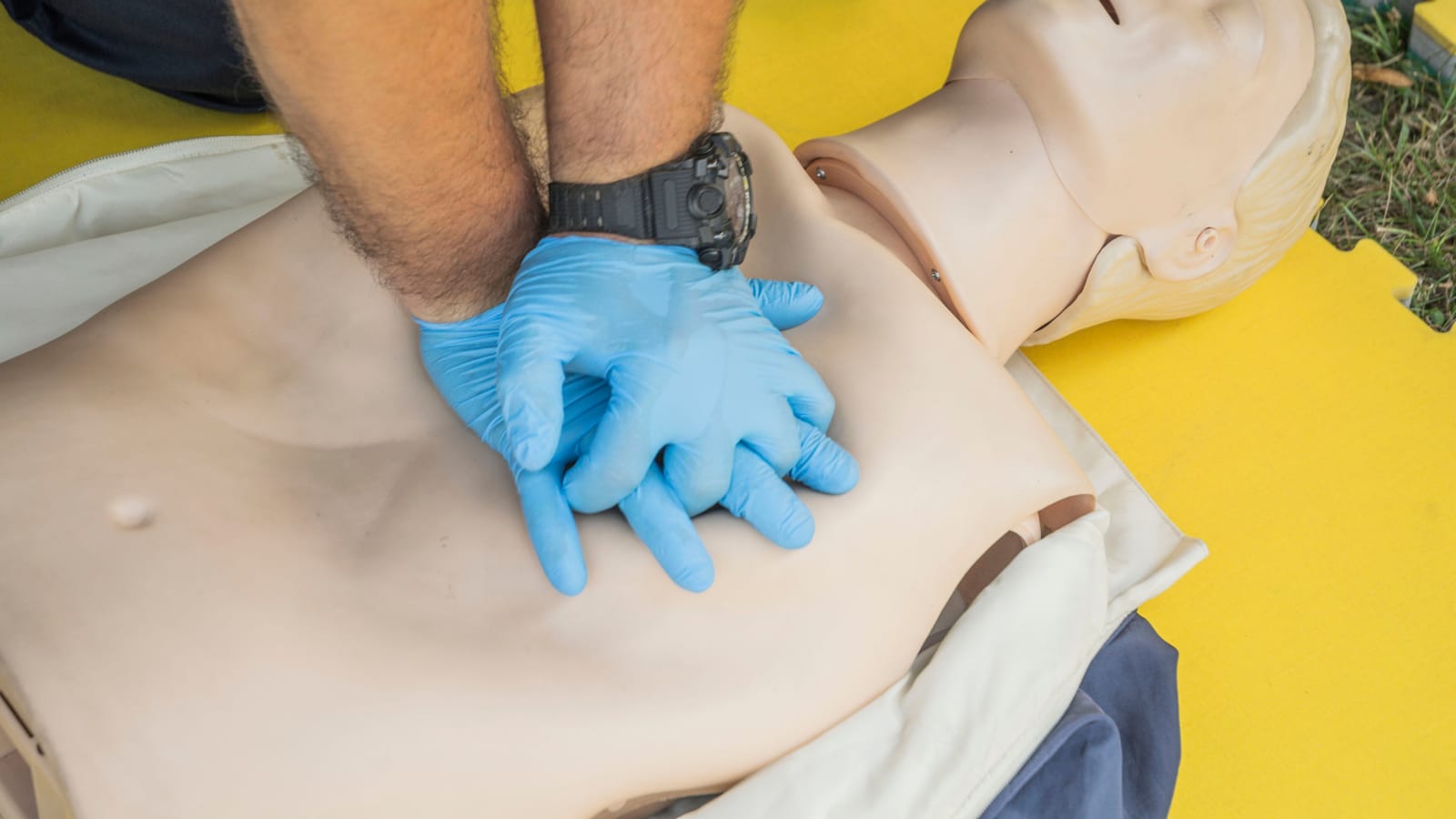
Heel of one hand on the center of the chest, lower half of the breastbone, right between the nipples. Second hand on top, fingers interlaced, fingers lifted off the ribs. Lock your elbows. Stack your shoulders directly over your hands so the push comes from your hips and your body weight, not your arms. Your arms will quit in ninety seconds. Your core won't.
Push at least 2 inches deep, and no more than about 2.4 inches. That's deeper than feels reasonable. At a rate of 100 to 120 per minute, which is the tempo of "Stayin' Alive" and also, grimly enough, "Another One Bites the Dust."
Let the chest come all the way back up between pushes. Full recoil is how the heart refills. Leaning on the chest between compressions is the single most common mistake in a real rescue.
You may feel cartilage pop or a rib crack. Keep going. A cracked rib heals. Everything else about that outcome doesn't.
Swap with another person every two minutes if you've got somebody. Quality falls off a cliff after that and you won't notice it happening.
Breaths, and whether you give them
If you're untrained, or you're alone with a stranger and no barrier mask, hands-only CPR is the right answer for an adult. Don't stop pushing. That's the official position and it saves lives.
If you're trained and willing: 30 compressions, then 2 breaths. Tilt the head back with one hand on the forehead, lift the chin with two fingers, pinch the nose, seal your mouth over theirs and blow for about one second. Watch for the chest to rise. If it doesn't, reposition the head and try once more. Then get straight back on the chest. The breaths should cost you less than ten seconds total.
For kids and infants, breaths matter more, because their arrests are usually oxygen problems. Give the breaths if you can.
The AED
When it arrives, turn it on and do what the voice says. That's genuinely most of it.
Bare the chest. Dry it with a shirt if it's wet, shave nothing unless the kit has a razor and the pads won't stick. One pad upper right chest below the collarbone, one on the left side below the armpit — the pictures are printed on the pads. Keep doing compressions while the pads go on.
When it says "analyzing," stop and don't touch the patient. When it says "shock," make sure nobody is in contact, then press the button. Then go immediately back to compressions without checking a pulse. Move a nitroglycerin patch off the chest first. Don't put a pad directly over an implanted pacemaker bump.
For a child under eight, use pediatric pads or the pediatric key if the unit has one. If it doesn't, adult pads are fine. Placing one on the front of the chest and one on the back works for a small child.
Children and infants
For a child from age one to puberty: same sequence, less force. One hand or two, depending on the child's size and yours. Compress about 2 inches, or roughly a third of the chest depth. Single rescuer stays at 30:2. If two of you're working, go 15:2.
For an infant under one: two fingers on the breastbone just below the nipple line, compressing about 1.5 inches — again, about a third of the chest. If there are two rescuers, the stronger method is both thumbs side by side on the breastbone with your hands wrapping the chest and your fingers supporting the back. Single rescuer 30:2, two rescuers 15:2.
Breaths for an infant are small and gentle. Cover the mouth and nose with your mouth, tilt the head to a neutral "sniffing" position, not way back, and give just enough air to make the chest rise. Your cheeks, not your lungs.
Choking, adult or child
First question: "Are you choking?" If they can cough, speak or wheeze, air is moving. Stand there, stay calm, and let them cough. Don't slap their back while they're still working on it and don't stick your fingers in their mouth.
Silence is the emergency. Silence, or that two-handed grab at the throat, or lips going dusky.
Get behind them. Five sharp back blows between the shoulder blades with the heel of your hand, angled downward and forward. Then five abdominal thrusts: fist thumb-side in, just above the navel and well below the ribs, other hand over the fist, pull in and sharply up. Alternate until it clears or they go unconscious. The Red Cross teaches the back blows first; the American Heart Association goes straight to thrusts. Both work. Do something.
Pregnant woman, or a man you can't get your arms around? Move your hands up to the center of the chest and thrust straight back instead.
If they collapse, lower them to the floor, call 911, and start CPR. Before each set of breaths, open the mouth and look. If you can see the object, hook it out with a finger. Never sweep blindly — you'll push it deeper.
Infants get no abdominal thrusts, ever. Lay the baby face down along your forearm, head lower than the body, jaw supported in your hand, and give five back blows with the heel of your other hand. Flip to face up, still head-down, and give five chest thrusts with two fingers on the breastbone. Repeat.
If you're alone and choking
Get to a chair back, a counter edge or a railing. Position it above your navel, and drop your weight onto it hard. Repeat. It's ugly and it works. You can also do the thrusts on yourself with your own fist, but the furniture generates more force.
Anyone who's had abdominal thrusts should get checked by a doctor afterward. So should anyone you resuscitate, obviously — but people forget the choking part, and internal injury from a good hard thrust is real.
Most states have Good Samaritan laws that protect a bystander acting in good faith. The details vary, so if that worries you, look up your own state's statute on a quiet evening rather than in the middle of somebody's worst day.
Now go sign up for a hands-on class with the Red Cross or the American Heart Association. Reading this makes you useful. Two hours on a manikin, with an instructor telling you you're not pushing hard enough, makes you dangerous in the right direction.
Cal Brennan
Fitness
Strength coach. Trains fathers, tradesmen and desk workers, which means programs that survive a bad week.

Watch
Worth an hour of your evening
More from Skills.
From channels we rate. Plays on YouTube.
Read next