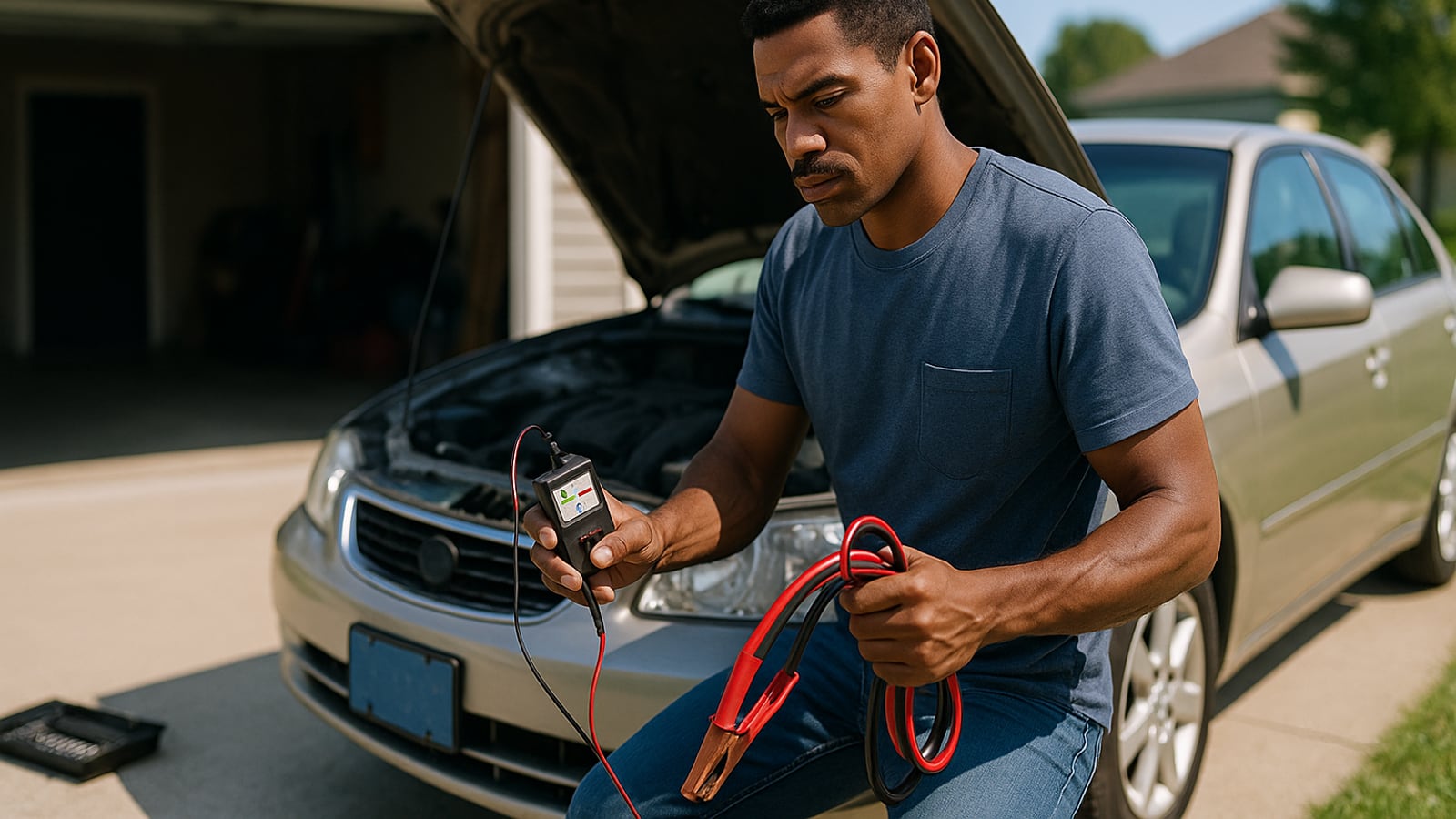
Turn the key and listen. Don't pop the hood, don't call anyone, don't start Googling your model year. The noise the car makes in the first two seconds narrows the problem down more than anything else you'll do, and most people skip it because they're already annoyed.
So sit there. Turn the key to crank and pay attention to whether you get silence, a fast machine-gun clicking, one solid clunk, or the engine turning over healthily and simply refusing to catch. Those four sounds point in four different directions. Everything below follows from which one you heard.
Before you open anything
Park brake on. Transmission in Park, or neutral with the brake on if it's a manual. If the car died in a driving lane, that matters more than the diagnosis does. Get it visible or get yourself out of the traffic.
If you're driving a hybrid or an EV, look for orange cables under the hood. Never touch them, never cut them, never lean on them. The 12-volt battery in a hybrid is fair game and is very often the actual culprit, but the orange stuff is a different order of voltage and it will kill you.
No smoking near a battery. A flooded lead-acid battery vents hydrogen when it's charging, and a spark at the wrong terminal is how people lose an eye. If a battery case looks swollen or is leaking, or if it's hissing, walk away and call someone.
And don't crank for more than about ten seconds at a stretch. You'll cook the starter motor and drain what charge you have left. Ten seconds on, thirty seconds off.
Silence, or a dashboard that dims
Nothing at all when you turn the key, or dash lights that fade to nothing, means power isn't reaching the starter. Nine times out of ten that's the battery or its connections.
Open the hood and look at the terminals. You're looking for white or blue-green crust around the posts, and for a clamp you can twist by hand. A loose clamp will run your headlights happily and still refuse to deliver the 150-plus amps a starter wants.
Grab the negative clamp and try to rotate it. If it moves, that's your fault right there. A 10mm wrench fixes most of them. I once spent twenty minutes in a grocery store lot in January convinced a truck needed a starter, and the whole problem was a negative clamp that came snug off a wrench but not tight. Cleaned the post with a wire brush, torqued it down, fired first turn.
Disconnect the negative first when you're removing a clamp, reconnect it last. That's the rule and it exists so your wrench doesn't weld itself to the frame.
The one number that settles it
Put a multimeter across the posts, red to positive, black to negative, set to DC volts.
- 12.6 or higher, engine off: battery is fully charged. Your problem is probably elsewhere.
- 12.4: roughly three quarters charged. Should still start a healthy car.
- 12.2 or below: significantly discharged. It might crank, it might not.
- Under about 10.5 with the engine off: likely a dead cell. This battery is finished, and a jump will only get you one more trip.
Now the more useful test. Leave the meter connected and have someone crank the engine while you watch the display. A good battery holds above roughly 9.6 volts while cranking. If it collapses to six or seven, it's shot, even if it read 12.5 sitting still. Surface charge lies. Load doesn't.
Watching the voltage drop off a cliff while the starter groans is the moment you stop guessing and start buying a battery.
Jump starting without wrecking something
Order matters. Red to the dead positive, red to the good positive, black to the good negative, and then black to a bare bolt or bracket on the dead car's engine block, not to its negative post. That last connection is where a spark happens, and you want it as far from the battery vent as you can get it.
Let the donor car run for two or three minutes before you try cranking. Then crank in short bursts.
If it fires and runs, don't switch it off for twenty minutes, and drive it rather than idling it. Idling barely charges anything.
If it fires on a jump and then dies the second you disconnect, the alternator isn't producing. With the engine running, a healthy charging system reads somewhere in the 13.7 to 14.7 volt range at the battery. If it reads 12.4 with the engine running, you're running on stored charge and you've got maybe twenty minutes of headlights before it stops again. Drive it straight to a shop, not home.
Clicking, clunking, and the starter
Rapid clicking, like a playing card in bicycle spokes, is almost always low voltage. The solenoid keeps pulling in and dropping out. Go back to the battery test.
One loud single clunk with no spin is different. That's the solenoid engaging and the motor not turning. Could be a seized starter, could be worn brushes inside it, occasionally it's an engine that won't rotate, which is a much worse day.
There's an old trick where you tap the starter body with a hammer handle while someone cranks. It sometimes works, because it jars worn brushes back into contact. It's also a diagnosis, not a repair. If tapping it works, the starter is on borrowed time and you should replace it this month. Don't go under a car supported only by a jack to reach it. Stands or nothing.
Cranks strong but won't catch
Now you've got fuel, spark, compression, or security. Good news: the expensive electrical stuff is fine.
Turn the key to the "on" position without cranking and listen for a two-second whirr from the rear of the car. That's the fuel pump priming. No whirr on a car that normally makes one means pump or pump relay. Relays are cheap and usually live in a box under the hood with a diagram on the lid. Swap the fuel pump relay with an identical one doing something less urgent, like the horn, and try again.
Check the gauge, then check it with suspicion. Sending units fail, and a reading of a quarter tank isn't proof of a quarter tank.
Look at the dash for a key or padlock symbol. If it's flashing, the immobiliser isn't recognising the key. Try the spare. A dying fob battery will stop some cars dead even though the key still turns.
Manual transmission? Push the clutch all the way to the floor. Automatic? Shift into Neutral and try there. Worn safety switches are common and completely invisible until they strand you.
And in very cold weather on a diesel, wait for the glow plug light to go out before cranking. Cranking through it does nothing but flatten the battery.
Know when you're done
If the engine cranks and you've confirmed fuel pressure and spark and it still won't run, you've reached the end of what's worth doing in a parking lot. Same if you smell raw gas, see smoke, or hear anything metallic and rhythmic from inside the engine. Stop. Call the tow.
The point of all this isn't to fix everything yourself. It's to arrive at the shop able to say "it cranks at 9.1 volts and the fuel pump doesn't prime" instead of "it makes a noise". One of those gets you a diagnosis. The other gets you an estimate.
Keep a multimeter and a 10mm wrench in the trunk. You'll use them more than the jack.
Wes Dunbar
Country & Skills
Grew up on an acreage and never quite left. Covers trucks, trades, land, and how to do the thing yourself.

Watch
Worth an hour of your evening
More from Skills.
From channels we rate. Plays on YouTube.
Read next