
Your survival kit doesn't fit on a wrist
Bracelet kits, credit-card tools and hollow-handle knives sell the feeling of being prepared. Here's what to skip and what to carry instead.
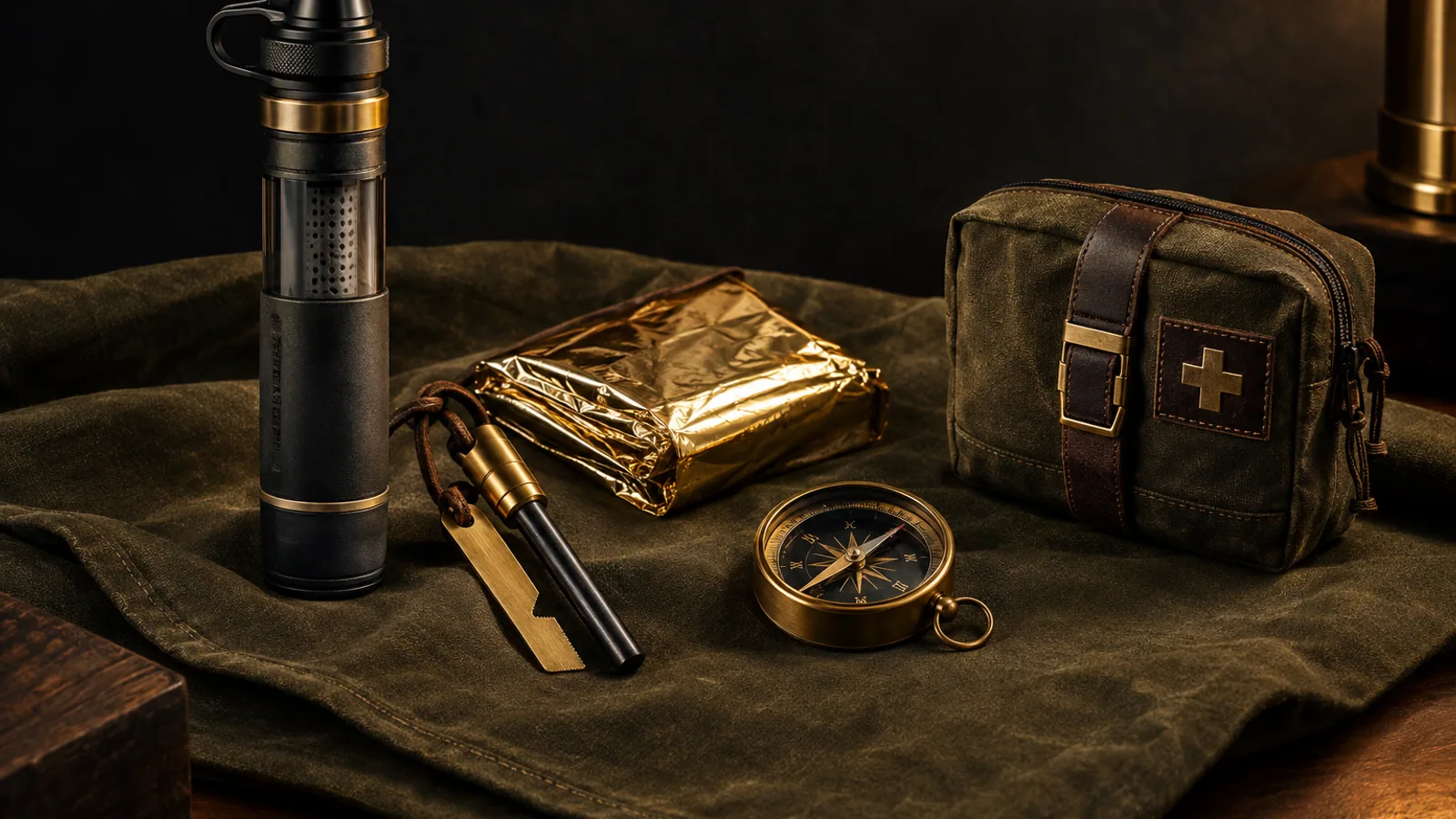
These get sold at the checkout lane, on the rack by the gas station register, in the gift-set aisle every December, and in social ads with a man in a fedora lighting a fire with a bracelet. They're priced to be impulse buys, which is the first clue. Nobody impulse-buys a good compass. Here are seven things to skip, and the plain alternative for each.
The paracord bracelet "survival kit"
It promises a wearable emergency kit: cord, a compass, a whistle, and a tiny fire rod, all on your wrist. In practice the cord is a few feet at most. The compass is a bead that swings and sticks. The whistle is often too small to carry far. And the one time you need to build a shelter, you'll unravel a bracelet to find out it wouldn't tie off a tarp.
Do this instead: Carry the pieces separately, and spread them out. A real whistle on your pack strap. A lighter in one pocket and a backup fire starter in another. A baseplate compass you've actually practiced with. A hank of cord in the pack, from a store that tells you what it is. If you're heading into new country, take a hands-on navigation class from a qualified instructor. A compass you can't read is jewelry.
Worth it when: you like wearing one and know it's a keepsake. Braiding your own from decent cord as a backup length isn't a bad Saturday project.
The credit-card tool
It promises a toolbox in your wallet. Say it costs $20, which is an example, not a quote. What you get is thin stamped steel with a stub blade you can't grip, a notch that sort-of opens a can, and a wallet that now has a bulge. It flexes. It slips. The person most likely to get hurt is the one pressing hard on a blade with no handle.
Do this instead: Carry a small folding knife or a compact multitool. Pick one with a locking blade and a handle your whole hand can hold. Check the maker's repair and warranty policy before you buy, and read the actual document. Blade length laws vary by state, province and city, and some places (schools, courthouses, airports) are off limits regardless. Nothing here is legal advice. Check local law.
Worth it when: it's a stocking stuffer for somebody who will never carry a knife and just wants a box opener.
The 100-piece survival kit
The number is the pitch. Count how they do it: every bandage is a piece, every safety pin is a piece, and the fishing hooks and the twelve matches are pieces. You end up with a bag of lightweight junk and no idea what's in it until the day you need it.
Do this instead: Build your own and know every item. Start with a lighter and a backup fire starter, a whistle, a headlamp with spare batteries, a space blanket, a way to treat water, basic first aid, a map and compass, and a knife. Then read what to do in the first hour you're lost in the woods, because the kit only matters if you stop and think first.
Worth it when: you treat it as a shopping list. Buy the bag, keep what's good, replace the rest.
The hollow-handle "survival knife"
It promises a whole kit in the grip: matches, hooks, a compass in the pommel. A knife is a tool you lean on. When the handle is a hollow tube bolted to the blade, the steel that should run through it isn't there, and the first hard push is where it gives. A cracked grip is also how people end up with a cut hand a long way from help.
Do this instead: Buy one sound fixed blade with a full tang (steel running the length of the handle) and stash your kit items in a pouch. Budget fixed blades such as the Swedish Mora line have been a bushcrafter standby for years. Check the current price. Then learn to use it properly in a bushcraft class, with a qualified instructor who'll show you where the blade goes when it slips.
Worth it when: honestly, I can't name a case. Skip it.
The mystery water-filter straw
It promises safe water from any puddle. The problem is the word "any". A filter stops some things and not others, and the cheap no-name ones often won't say which. Viruses are the usual gap. If the box doesn't list what the filter removes and how it was rated, you're drinking on faith.
Do this instead: Boil it. The CDC's general guidance is one minute at a rolling boil, three minutes above roughly 6,500 feet. For a filter, buy from a maker that publishes the pore size and exactly what it removes, and carry purification tablets as a backup. Read the data sheet before the trip, not at the creek. For anything specific to your health, ask a doctor.
Worth it when: the maker publishes what it removes, you've read it, and you're carrying it as the third layer behind boiling and tablets.
The tactical pen and the self-defense keychain
It promises protection in a pocket. What it really delivers is confidence, and unearned confidence is the dangerous part. Every one of these requires you to be close enough to touch someone, and none comes with training. Some are illegal to carry in some places. A frightened person with a gadget they've never practiced with is not better protected, just less careful.
Self-defense starts earlier. Notice the situation, leave it, put distance and a locked door between you and trouble. Force is the last resort. The right to keep and bear arms is a real right, and the people who take it most seriously treat it as a responsibility: the four rules every time, locked storage away from children, and professional instruction. If you're thinking about carrying anything, start with your first firearms class and read what real defensive gun uses teach about training.
Do this instead: Take a class from a qualified instructor. If you carry pepper spray, check that it's legal where you live and practice with an inert trainer. Carry, force and weapons laws vary by state, province and city. Nothing here is legal advice. Ask a qualified attorney or instructor in your area.
Worth it when: a simple personal alarm sits on your bag as a supplement, never as the plan.
The 18-in-1 hatchet-shovel-saw-everything tool
It promises every outdoor job in one handle. Each job gets done badly. The hatchet is thin, the saw teeth are small, and the pivot wobbles. Add a hinge that can pinch fingers and a locking collar that loosens in the cold, and you've bought a tool that's weaker than any of its parts.
Do this instead: Buy one good tool per job. A folding saw cuts firewood far more safely than a stubby hatchet, and it packs flat. A real knife handles the rest.
Worth it when: it's a folding shovel in your truck for digging out of snow or mud. That one earns its spot.
How to say no at the counter
You don't need a speech. Be friendly and brief.
- "Thanks, I'm good. I build my own kit."
- "I'll pass. I'd rather put that toward a class."
- "Not today, but I'll check the manufacturer's page first."
Then walk out and spend the money on training. A $20 gadget won't get you home, but a skill you've practiced will.
Dean Shaw
Gear & Garage
Reads the warranty, the parts list and the long-term owner reviews before anything else. Trucks, tools, watches, and the cheap version that costs more.

Watch
Worth an hour of your evening
More from Survival & Self-Defense.
From channels we rate. Plays on YouTube.
Read next