Buy the brad nailer first. The framing gun can wait.
A nail gun saves hours on the right job and wrecks the wrong one. Here's how to tell which is which, what to pay, and when to rent.
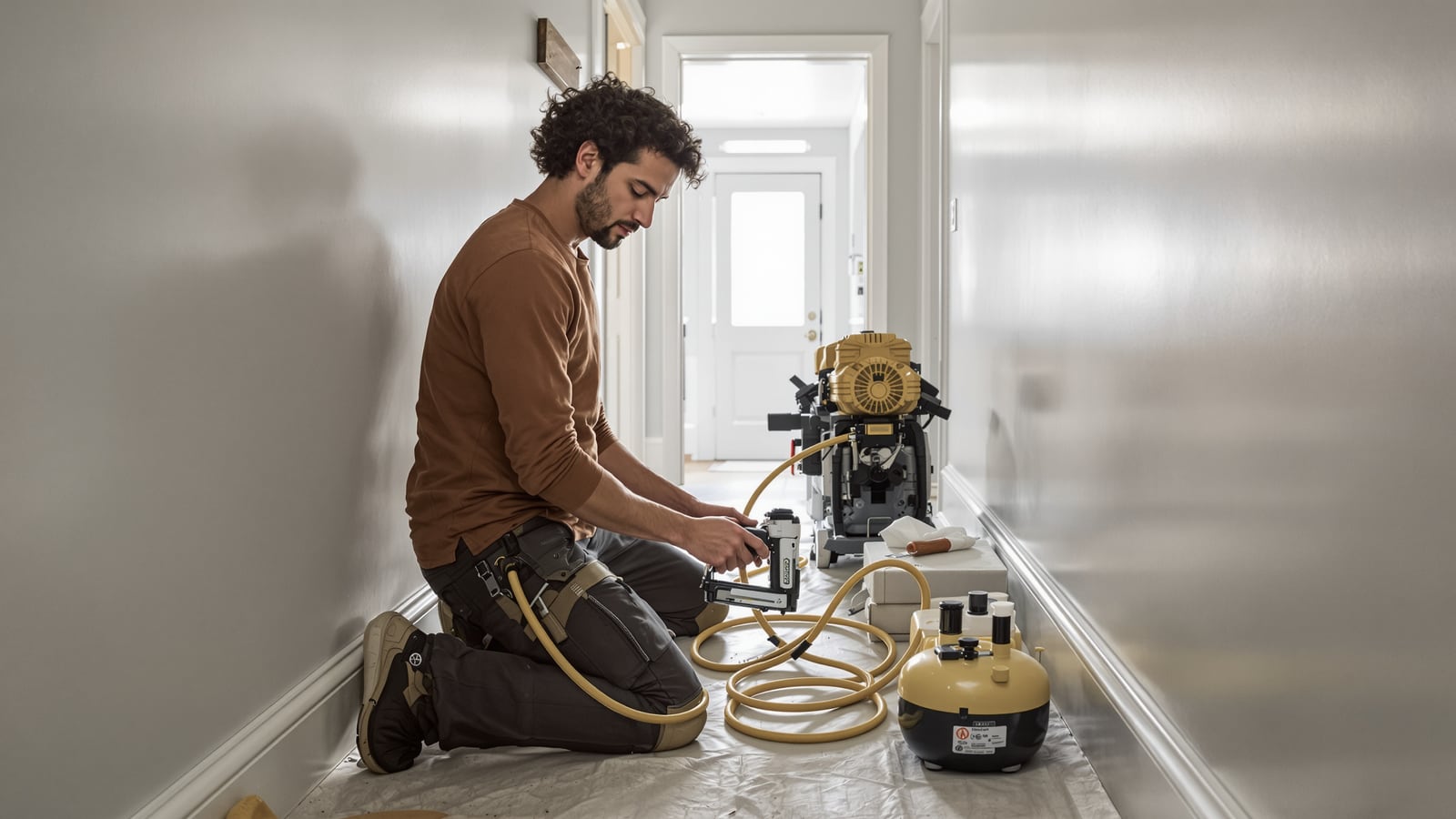
Quick answer: If you're hanging trim, building a shelf or assembling anything with thin stock, buy a brad or finish nailer before anything else. If you're framing a deck or a wall once, rent the framing gun. Keep a good hammer either way. You'll reach for it more than you think.
The gun you actually need isn't the one in the ad
Ads sell you the framing nailer. It's loud, it looks like work, and it throws 3-inch nails into 2x4s like they owe it money.
Most homeowners need it twice a decade.
What you'll use every year is smaller. A brad nailer (18 gauge) handles trim, small cabinet work, picture-frame stock and jigs. A finish nailer (15 or 16 gauge) holds baseboard, casing and crown molding where a brad would let go. Both leave a hole you can fill with a dab of putty and forget.
Try that with a hammer. Trim is where hammers go to leave dents. One missed swing and you've put a crescent moon in a $4 piece of poplar, which sounds cheap until you've done it nineteen times in a hallway.
When the hammer still wins
Hammers aren't obsolete. They're just not for everything.
- Setting a few nails. Pulling out a compressor, hose and gun to drive six nails is slower than driving six nails.
- Toenailing and tight spots. A gun needs room and a flat approach. A hammer fits between joists and behind a stud.
- Adjusting. Tapping a board a sixteenth over before you fasten it is a hammer job. So is pulling a bent nail.
- No power. A gun is dead weight without air or a charged battery. A hammer works in a field, on a roof or at a campsite.
- Old or brittle wood. A gun can split old trim or a dry board's edge. A hand-driven nail gives you feel.
If you're buying one hammer, make it a 16-ounce curved-claw for general work. A 20 to 22 ounce framing hammer with a milled face is better for rough carpentry, but the waffle face will mark finished wood, so keep it away from trim.
Estwing makes the classic one-piece steel hammer, usually in the $25 to $45 range. A wood-handled hammer from Vaughan or similar costs about the same and swings lighter. Titanium hammers like Stiletto run well over $100. They're lovely and mostly for people swinging all day, so skip them unless you are.
The math that decides it
Count the nails.
A single trim room might take a couple hundred. A deck can take well over a thousand. A shed frame, a fence, subfloor, sheathing: thousands. At some point your arm and your patience quit before the job does, and the gun stops being a luxury.
A rough rule: if you're driving more than a few hundred nails in a weekend, use a gun. If it's under fifty, swing the hammer.
Speed isn't the only gain. A hammer driving a nail into the last inch often shakes the board. A nailer sets it in a fraction of a second with the board held tight, so joints close cleaner. Anyone who's tried to hold a 12-foot piece of trim in place with one hand and a hammer in the other knows why.
What to pay
Prices move, so check current ones. Rough ranges to expect:
- Brad nailer, pneumatic: about $50 to $130. Bostitch, Metabo HPT and Freeman all sit in this range. Cheaper ones get you a gun that works. What you give up is depth adjustment that stays put and a jam-clearing latch that doesn't need a screwdriver.
- Finish nailer, pneumatic: about $100 to $200. Metabo HPT and Bostitch are the common ones.
- Framing nailer, pneumatic: about $150 to $300. Metabo HPT, Bostitch and Senco are the names you'll see on job sites.
- Pancake compressor, 6 gallon: about $100 to $250. Fine for trim guns. It'll gasp a bit running a framing gun all day, but it can do it.
- Hose: a 25-foot hose is plenty for a garage shop. A cheap one is fine, but get a 3/8-inch hose if you can. It delivers air better than a skinny 1/4-inch one.
- Cordless: Milwaukee, DeWalt and Metabo HPT sell battery nailers. Paslode uses a fuel cell and battery. Expect roughly $250 to $500 and up for a cordless framing nailer, usually more with batteries. If you already own batteries from one of those brands, read How to Pick a Cordless Tool Platform You Won't Regret before you buy into a new one.
The cheap gun gets the basics right. It drives nails, and for one deck or one house of trim it'll do. What it gets wrong is consistency. Depth drifts, the nose jams, and the plastic bits wear. That's a nuisance on a Saturday and a disaster when you've got eleven feet of crown molding half installed.
Pneumatic is cheaper per tool and lighter in your hand. You pay with the compressor, the hose and the noise. Cordless costs more up front and gives you freedom, which matters most when you're working on a roof or in a crawl space. Neither is wrong. Pick based on how much ground you'll cover.
When to rent instead
Framing nailers are the classic rent. You'll use one for a deck, a wall or a shed, then it sits for years while the O-rings dry out.
Renting is smart when:
- You need the gun for a single weekend.
- The gun costs more than a few days of rental.
- You want to try a style before you commit to a brand.
Call first and ask whether nails and the compressor come with it. Ask what they charge for a late return. Then follow the old rule: return it cleaner than you got it, with the dust blown out, a drop of oil in the inlet if it's an oiled model, and any leftover nails handed back. Do that and the guy at the counter will remember you next time. I wrote more on the rent-versus-buy call in The Tools You Should Rent and the Ones You Should Just Buy.
Safety, because a nail gun doesn't forgive
A nail gun is a firearm for fasteners. Treat it like one.
- Wear eye protection every time. Nails ricochet, and so does debris. Add earplugs for a framing gun, which is louder than people expect.
- Never point it at anyone. Not as a joke, not "it's disconnected."
- Keep your free hand out of the line of fire. Many injuries happen when someone holds a board near the spot where the nail lands.
- Disconnect the air or pull the battery before clearing a jam. No exceptions.
- Use sequential trigger mode when you can. Contact (bump) firing is fast, but it can fire if the gun bounces. Sequential fires only when you touch the nose first and then pull the trigger.
- Watch for knots and edges. A nail can deflect off a knot and exit the side of a board. Stay a nail length from the edge when you can.
- Lock the gun away from kids. Disconnected is safer. Locked up is safer still.
What I'd buy and what I'd skip
Buy:
- One 16-ounce hammer you like.
- A brad nailer and a 6-gallon pancake compressor, if you do any trim or small carpentry.
- A finish nailer when a project calls for one.
- Safety glasses you'll actually wear, kept where you can grab them.
Skip:
- A framing nailer you'll use once. Rent it.
- The bargain-bin compressor with no regulator. You need to set pressure.
- Any gun you've never held. Feel the weight and the trigger before you commit.
Where it lives: hang the hose on a hook, put the guns in their cases, and keep nails sorted by size in labeled containers. A tool that has a home gets used and put back, which is the whole idea behind Where Every Tool Goes and Why You'll Actually Put It Back.
The hammer built the country and it isn't going anywhere. The nail gun just means you can finish the job before dark.
Dean Shaw
Gear & Garage
Reads the warranty, the parts list and the long-term owner reviews before anything else. Trucks, tools, watches, and the cheap version that costs more.

Watch
Worth an hour of your evening
More from Tools & Organizing.
From channels we rate. Plays on YouTube.
Read next