The $80 pass pays for itself on one good road trip
Most families overpay at the gate or buy the wrong pass. Here's the math on which parks justify the fee and how to see more of them for less.
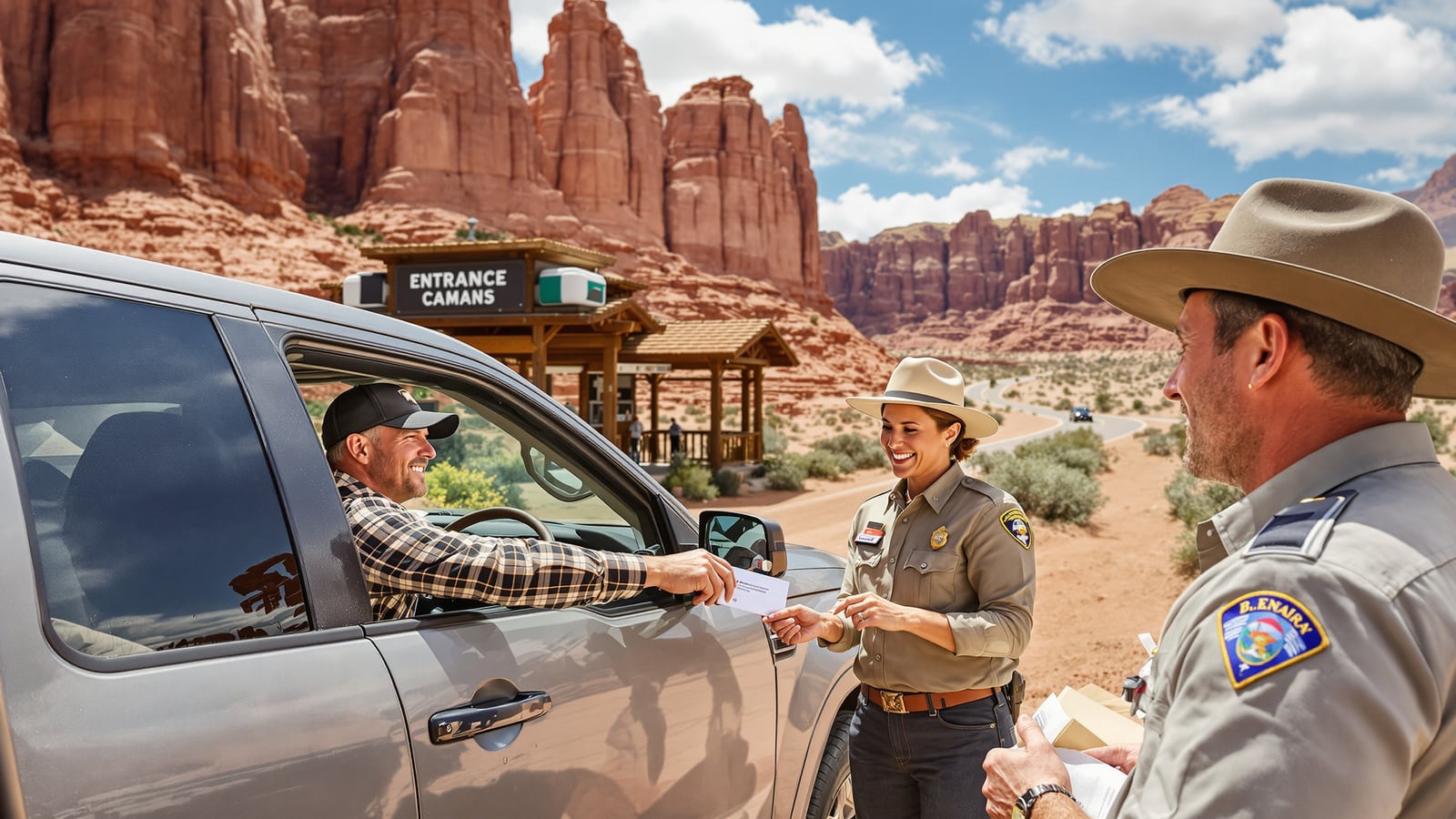
Quick answer: If you'll visit three or more fee-charging parks in the next twelve months, buy the $80 America the Beautiful annual pass. If you're visiting one or two, pay at the gate. Check current prices at nps.gov before you go, because they've changed before and they'll change again.
Do the math before you reach the gate
Most big-name parks charge per vehicle, not per person. The usual rate is somewhere between $30 and $35, and it's good for seven days. Yellowstone, Grand Canyon, Zion, Yosemite and Acadia sit at the top of that range. Arches and Rocky Mountain run a little under it.
So the annual pass breaks even at the third park. Two parks at $35 is $70. Ten dollars cheaper than the pass, and you'll never use the pass again. Three parks is over $100, and the pass has already won.
Here's the part people miss. The pass isn't priced per trip. It's good for twelve months from the month you buy it. A summer loop through Utah and a fall weekend in the Smokies can both ride on the same $80.
A family of six in one minivan pays the same as a man alone in a pickup. That's the best deal in American recreation, and a reason to fill the vehicle.
The loops that make the pass obvious
Geography does the work for you. Some regions bunch parks so tightly that you'll cross three gates in a week without trying.
- Southern Utah. Zion, Bryce, Capitol Reef, Arches and Canyonlands are all in one long day's drive of each other. Capitol Reef is cheaper than the rest, but even so, any three of these pays off the pass.
- Wyoming and Montana. Grand Teton and Yellowstone are neighbors. Each charges its own fee, and the seven-day receipt from one doesn't cover the other. Add Glacier later in the week, or next summer, and you're well ahead.
- Arizona and Utah. Grand Canyon, Petrified Forest and Zion fit one trip if you don't mind the miles. Which brings up the other cost of a park loop. Don't plan one that wrecks the people riding in the back seat. Planning a road trip that's still fun on day four covers pacing, and three hundred miles a day, and other rules for driving with kids will keep you from overscheduling the whole thing.
Where the pass saves you nothing
Know what the pass doesn't touch. It covers the entrance fee and standard day-use fees. It does not cover:
- Campgrounds and lodging
- Guided tours, boat rides and shuttles run by concessioners
- The small booking fee on timed-entry reservations
- Parking tags in parks that use them instead of gate fees
That last one trips people up. Great Smoky Mountains has no entrance fee at all. It charges a parking tag instead, a few dollars a day, with weekly and annual options. The pass doesn't replace it. Read the park's own page first.
And some parks make you reserve an entry window in busy season. The pass gets you through the gate. It doesn't get you a time slot. If you land at Arches without a reservation during a timed-entry period, you'll spend the morning in a parking lot with $80 in your pocket and nowhere to use it.
The mistake that costs groups real money
The pass covers the vehicle the pass holder arrives in. If four friends take two trucks to Zion, one truck is covered and the other pays at the gate. Ride in one vehicle through the entrance, or buy a second pass and split it. Splitting is how a two-truck trip comes out ahead. How four friends share a car for a week without falling out deals with the rest of that arrangement.
Where a park charges per person (walk-ins, bikes, motorcycles), the pass covers the holder plus three adults. Kids under sixteen usually get in free.
Sign the pass when you get it. Carry a photo ID, because the ranger can ask for it. A second driver can be listed on the pass, which matters if your wife's driving half the miles.
Discounts worth checking before you pay full price
Several groups get a lower price or a free pass. Check whether anyone in your house qualifies:
- Fourth graders. The Every Kid Outdoors program gives a fourth grader and the family a free pass for the school year. Print the voucher from the official site, bring it with you, and trade it in at a park.
- Military. Active-duty members and their dependents, plus veterans and Gold Star families, qualify for a free annual pass. Bring proof of service.
- Seniors. Americans 62 and older can buy a pass at a steep discount. They have an annual and a lifetime option.
- Access pass. Free for U.S. citizens and residents with a permanent disability.
- Volunteers. Put in 250 hours of qualifying service and you earn a free annual pass.
Buy only from the park service, its online store or Recreation.gov. Resellers charge more, and fakes show up in online marketplaces. If the price isn't what nps.gov lists, back away.
If you have a foreign visitor in your group, the rules and prices for non-residents have changed recently. Look at the official fee page before you quote a number to a cousin from overseas.
The trick nobody advertises
Most of the park system doesn't charge anything. National monuments, historic sites, battlefields, seashores and memorials mostly let you in free. Gettysburg, Mount Rushmore's neighbors, the Blue Ridge Parkway, and dozens of smaller places are open to anybody with a car and an afternoon.
If you're after the same views and fewer people, build a trip around those. A week of free sites with one paid park in the middle costs you almost nothing at the gate and teaches the kids more American history than a visitor center ever will.
National forests are another option. They have their own fee system, and some trailhead parking costs a few dollars. But the pass covers many of those standard day-use fees too. Look for the sign.
Skip the fee-free days
The park service waives fees a handful of days a year. It's tempting. Don't do it with kids.
Those days are the busiest of the year. The parking lot at Zion fills before eight a.m. on an ordinary Saturday. Imagine it when it's free. You'll save $35 and spend three hours in traffic. Check nps.gov for the current list, then go on a Tuesday in shoulder season and pay the $35 gladly.
What we'd do
Buy the pass in the month you start planning, not the month you leave. That way the twelve months run from when you're actually using it. Map your fee parks, count them, and check the arithmetic. If you're short of three, pay at the gate and save the $80 for something else.
If you're over three, buy it, sign it, keep it in the glove box, and take the family back next year. And when you get there, do what a decent guest does. Pick up the wrapper that isn't yours and leave the campsite cleaner than you found it. These places belong to all of us, and they stay worth the fee because somebody before you did the same.
Dean Shaw
Gear & Garage
Reads the warranty, the parts list and the long-term owner reviews before anything else. Trucks, tools, watches, and the cheap version that costs more.

Watch
Worth an hour of your evening
More from Travel.
From channels we rate. Plays on YouTube.
Read next