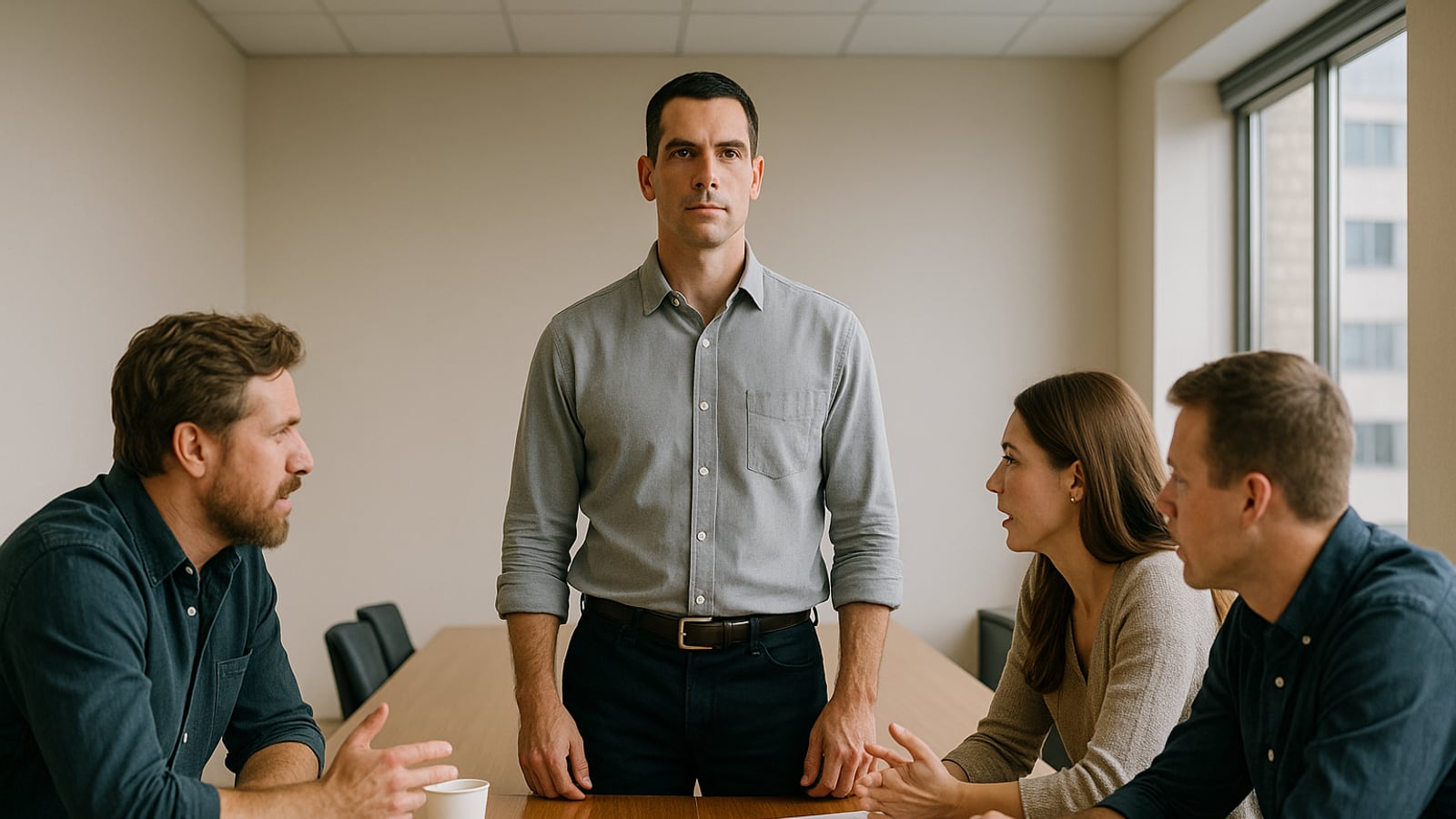
Start with this: stop moving so much.
Watch the man everyone turns toward when he walks into a meeting or a garage or a church hall. He isn't taller. He usually isn't louder. What he's, almost always, is still. His hands aren't doing anything. He isn't shifting his weight, adjusting his collar, patting his pockets, scanning the room for someone more important. He arrives, he stops, he looks at who's there.
Stillness reads as certainty. Fidgeting reads as searching for approval. Nobody consciously decides this, but everybody reads it, and they've read it about you before you've said a word.
Movement is a volume knob
Every unnecessary motion you make lowers your signal. The bouncing knee under the table. The pen click. The half-laugh you tack onto the end of your own sentences to check whether it landed. The nod-nod-nod while someone else is talking, which you think signals attention and which actually signals anxiety.
Try this the next time you're in a conversation that matters. Put both feet flat. Let your hands rest, one on the table or one in a pocket, and leave them there. When you want to gesture, gesture once, deliberately, then stop. It will feel strange for about four minutes. Then it'll feel normal, and you'll notice people looking at you longer.
The point isn't to become a statue. Stiffness is its own tell. The point is that motion should mean something when you use it.
Slow the first three words
Most men speed up when they get nervous, and the acceleration happens at the start of a sentence. The first three or four words come out compressed, apologetic, half-swallowed. "SoIwasjustthinkingmaybe we could..."
Everything after that's discounted. The listener has already filed you.
Fix the opening. Take a breath, then say the first few words at about two-thirds of your usual pace. "I've got a different read on this." Then continue at normal speed. That one adjustment does more for how you're received than any amount of vocabulary.
Related: let your voice fall at the end of a sentence. A lot of men finish statements on a rising note, which turns everything into a question awaiting permission. "We should move the deadline?" Drop the pitch. Land it. You're allowed to say a thing.
The pause is the whole game
When someone asks you a question, especially a hard one, wait. One second. Two if it deserves it.
Almost nobody does this, which is exactly why it works. The pause says you're considering the question rather than reaching for a ready-made answer. It also buys you the answer you actually meant, instead of the one that fell out.
The same principle applies to silence in a room. Most people can't stand it and will fill it with whatever's nearest. If you can sit in three seconds of quiet without flinching, you'll find that others start looking at you to see what you make of it. Silence is unclaimed territory. Whoever's comfortable in it owns it.
Learn to say "I don't know" without rushing to soften it. "I don't know. I'll find out by Thursday." That's a complete answer and a strong one. The hedging, the throat-clearing, the four sentences of context before you admit the gap — that's what costs you.
Look at people
Eye contact is where a lot of men get bad advice. The advice is usually some variation of "hold it longer," which produces an unblinking stare that makes everyone uncomfortable.
What you want is simpler. When someone is speaking to you, look at them. When you're speaking, look at them for most of it, and look away when you're genuinely thinking. Break contact sideways or down, not up. Looking up reads as exasperation.
And greet people properly. Stop what you're doing, turn your body to face them, use their name. Turning your torso toward someone is a small thing that lands hard, because the alternative — the over-the-shoulder hello while you finish a text — tells them exactly where they rank.
Presence you haven't earned wears off in ten minutes
Everything above is mechanics, and mechanics only get you the first hearing. What gets you the second is that the first one was worth it.
The men who are listened to before they speak have usually built a record of being right, or being honest when they weren't, or turning up when they said they would. The room isn't reacting to their posture. It's remembering the last six months.
So the unglamorous half of this:
- Do what you said, on the day you said it. Reliability compounds faster than talent.
- Don't speak on things you haven't done the work on. One confident wrong answer costs you more than ten silences.
- Know one thing cold. Every man who commands attention has a domain where nobody argues with him. Build one. It can be small.
- Correct yourself out loud when you're wrong. "I got that wrong last week, here's the actual number." This is counterintuitive and it raises your standing every single time.
- Cut the self-narration. "I'm probably talking too much." "Sorry, this might be a dumb question." You're reviewing your own performance in public. Stop.
What gets mistaken for presence
Volume. Interrupting. Being the funniest man in the room. Talking over disagreement until it stops. Standing too close. The performance of not caring.
These produce compliance, sometimes, and they produce it briefly. They don't produce attention, and they never produce trust. You can tell the difference by watching what happens when the man leaves. Real presence leaves the room a little emptier. The counterfeit leaves it relieved.
There's a version of this that shows up in marriages too, and it's worth naming. A man who dominates a conversation at home isn't present. He's loud. Presence in a marriage looks like putting the phone face-down, asking a second question instead of offering a solution, and being the one whose temper the household doesn't have to forecast. Your wife knows which one you're. So do your kids, and they figured it out earlier than you'd like.
How to practice without looking like you're practicing
Pick one thing a week.
Week one: hands still. Week two: pause before answering. Week three: no self-deprecating tag on the end of your sentences. Week four: turn your whole body toward whoever's talking to you.
Do it in low-stakes places first. The hardware store, the sidelines, the coffee line. You want it automatic before you need it in front of people whose opinion you care about, because under pressure you'll default to whatever you've grooved.
And watch yourself for the drift. Presence erodes when you're tired, when you're behind on something, when you've been on a screen for four straight hours. The fidgeting comes back first. Use it as a gauge. If your hands won't sit still, something in your week needs attention.
The part nobody tells you
The reason stillness works isn't that it's an impressive trick. It's that a man who isn't managing his own anxiety has spare capacity to notice everyone else in the room. He catches who hasn't spoken. He sees which person is upset and covering it. He knows what the actual question was, under the one that was asked.
That's what people are responding to. Not the posture. The attention behind it.
Which means the shortcut isn't a shortcut at all. Get your own house quiet enough that you can hear other people, and the room will start turning toward you on its own.
Marcus Vale
Editor-in-Chief
Twenty years in magazines, most of it deciding what to cut. Writes about work, discipline and the decisions that compound.

Watch
Worth an hour of your evening
More from Be a Man.
From channels we rate. Plays on YouTube.
Read next