Is It Wrong to Doubt God
A reader asks whether his doubts disqualify him. Scripture has more room for that question than most churches let on.
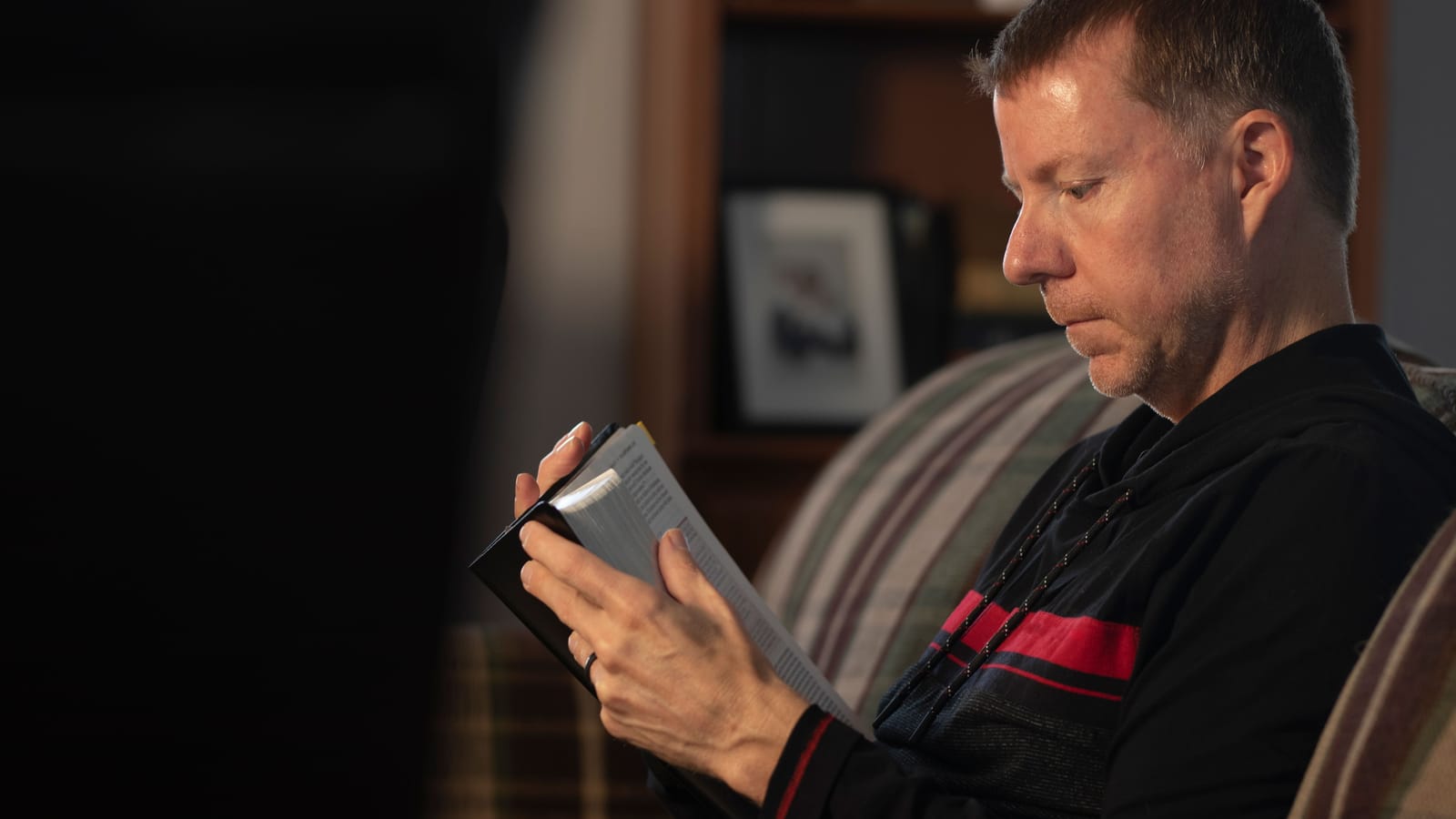
The question came in almost apologetically: "I've been a Christian for nineteen years. Lately I catch myself wondering if any of it is true. I still go to church. I still pray. But there's a voice in the back of my head asking what if it's all nothing. Am I in sin? Have I lost my salvation?"
Short answer: no, and almost certainly no.
Longer answer takes a few minutes, because the Bible treats doubt with a great deal more care than the average small group does.
The Bible is full of people asking
Start with the man in Mark 9. His son has suffered since childhood and the disciples couldn't help. He tells Jesus, "if you can do anything, have compassion on us and help us." Jesus presses the "if." And then comes one of the most honest lines in Scripture:
"Immediately the father of the child cried out and said, 'I believe; help my unbelief!'" (Mark 9:24, ESV)
Jesus heals the boy. He doesn't send the father away for a probationary period. He doesn't demand the man get his percentages up. Faith mixed with unbelief was enough, because the object of the faith was Christ and not the quality of the faith itself.
Then there's John the Baptist. This is the man who leapt in the womb, who called Jesus the Lamb of God, who baptized Him and watched the heavens open. Sitting in Herod's prison, he sends messengers:
"Are you the one who is to come, or shall we look for another?" (Matthew 11:3, ESV)
That's a doubt. A serious one, from the greatest prophet born of a woman, and Jesus says so a few verses later. His response isn't rebuke. He sends back evidence: the blind see, the lame walk, the poor have good news preached to them. He gave a doubting man reasons.
And after the resurrection, on the mountain in Galilee, Matthew records something the church has never quite known what to do with: "And when they saw him they worshiped him, but some doubted" (Matthew 28:17, ESV). They're looking at the risen Christ. Some of them still doubted. He gave them the Great Commission anyway.
What James actually says
The verse people club themselves with is James 1:6.
"But let him ask in faith, with no doubting, for the one who doubts is like a wave of the sea that is driven and tossed by the wind." (James 1:6, ESV)
Read the sentence before it. James is talking about asking God for wisdom. The "doubting" he's describing is the man who isn't sure he even wants what he's requesting, who prays with one hand while hedging with the other, who's fundamentally unwilling to be settled. The Greek word carries the sense of dividing or disputing with yourself. James calls him "double-minded."
That isn't the man who lies awake at 2 a.m. wondering if the tomb was really empty and hating that he's wondering. That man isn't double-minded. He's single-minded and in pain.
There's a difference between doubt that seeks and doubt that refuses. One is a question. The other is a posture. Scripture is patient with the first and firm with the second, and if you're anxious enough about your doubt to write a pastor about it, you're in the first category. Nobody in the second category ever lost sleep over it.
Jude's one-line instruction to the rest of us
Here's the part churches skip. Jude, writing about how to handle people in a congregation under pressure, gives this order:
"And have mercy on those who doubt" (Jude 22, ESV)
Mercy. Not suspicion, not a meeting, not a whisper in the hallway. If you're the doubter, that verse is written about you and it's binding on the people around you. If you're sitting next to a doubter, it's written to you.
I think about a man I know who spent most of a Sunday morning in the gravel lot behind the building, engine off, windows down, listening to the singing carry out the side door. He couldn't make himself go in. Not because he'd stopped believing. Because he was afraid somebody would ask how he was doing and he'd have to lie. He did that for six weeks. When he finally said it out loud to another man in the church, the other man said, "Oh. Yeah. Me too, in 2011." That was the whole intervention. It worked.
Isolation is what turns a question into a crisis.
The Psalms gave you permission already
If you think God requires a cheerful face, read Psalm 13 out loud.
"How long, O LORD? Will you forget me forever? How long will you hide your face from me?" (Psalm 13:1, ESV)
That's in the songbook. God put the complaint in the hymnal. Habakkuk opens by asking the Lord how long he has to cry for help before anybody listens. Asaph, in Psalm 73, admits his feet had almost slipped because he looked at the prosperity of the wicked and couldn't square it. Christ Himself, on the cross, prays Psalm 22: "My God, my God, why have you forsaken me?"
A faith that can't hold a hard question isn't strong. It's brittle. And brittle things break at the worst possible moment, usually in a hospital hallway.
What to actually do this week
Doubt is rarely one thing, so treat it like a mechanic and not a philosopher. Figure out what kind you've got.
Name the specific question. Write it on paper. Not "I doubt everything." Something like "I don't understand how a good God allows a four-year-old to get leukemia" or "I can't tell if the resurrection accounts contradict each other." Vague dread can't be answered. A specific question can.
Check your body before your theology. A lot of what men diagnose as a spiritual crisis is six months of four-hour nights, a job that's eating them, and no one to talk to. Elijah under the broom tree got a nap and a meal before he got a word from God. That order is in the text on purpose.
Ask whether it's the head or the conscience. Intellectual doubt wants an argument. Moral doubt, the kind that grows out of sin you haven't dealt with, wants the faith to be false so the guilt goes away. Those need different medicine. Be honest with yourself about which one you're holding.
Keep showing up. Faith comes by hearing (Romans 10:17), and you don't generate it by staring at yourself. Sit in the pew. Sing the words even if they feel like somebody else's. Take the Lord's Supper. The habit isn't hypocrisy. It's a trellis for something that's still growing.
Tell one person. Your pastor, an elder, the older man who's been in that church forty years. Choose someone whose faith survived something.
Where good-faith Christians differ
Not everyone frames this the same way, and you should know that.
Some traditions, particularly in the Reformed stream, will say doubt is a real failing of faith, a fruit of remaining sin, something to repent of even while trusting that God bears with weak believers. Others, including many Lutherans and Anglicans, emphasize that the feeling of doubt isn't itself culpable and point you back outside yourself to the objective promise made at your baptism. Catholic teaching draws a sharp line between involuntary doubt and deliberately cultivated unbelief. Wesleyans will often talk about assurance as something the Spirit grants rather than something you manufacture.
They disagree about the diagnosis. They agree completely on the treatment: don't isolate, don't quit the means of grace, and don't make your feelings the foundation.
The sentence to hold on to
Paul, writing to a young pastor who was probably scared out of his mind, said this:
"if we are faithless, he remains faithful—for he cannot deny himself." (2 Timothy 2:13, ESV)
Your salvation was never anchored in the strength of your grip. It's anchored in His. Some mornings you'll feel it and some mornings you'll feel nothing at all, and the tomb is empty either way.
Nineteen years in and still asking questions isn't a man losing his faith. That's a man who never outsourced it.
Josh Halloran
Christian Bro
Leads a mid-week mens group and has done for eleven years. Writes about faith as a practice rather than a position.

Watch
Worth an hour of your evening
More from Bible.
From channels we rate. Plays on YouTube.
Read next